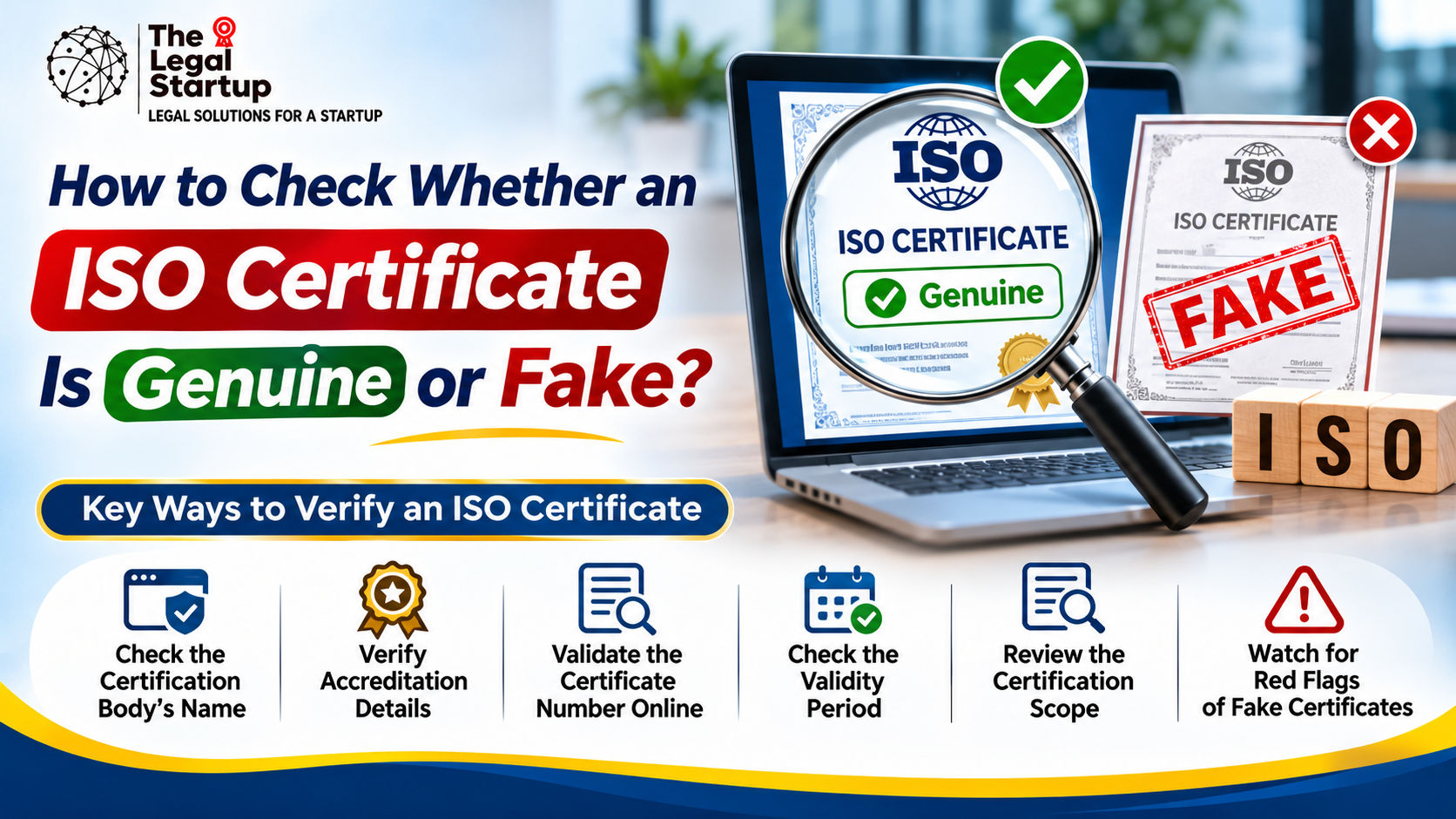
How to Check Whether an ISO Certificate Is Genuine or Fake
23 Nov 2026
Introduction
ISO certification plays an important role in building business credibility, improving customer confidence and meeting quality requirements. Many Indian businesses, including manufacturers, exporters, service providers and MSMEs, obtain ISO certification to strengthen their market reputation and qualify for business opportunities.
However, not every ISO certificate available in the market is genuine or issued through a reliable certification process. Some organisations receive certificates from questionable agencies that may not have the required accreditation or authority to issue accredited certifications.
This creates an important question for business owners: How to check whether an ISO certificate is genuine or fake?
Verifying an ISO certificate before accepting it is essential. Whether you are purchasing from a supplier, participating in a government tender or checking your own company's certification, you should confirm the certification body, accreditation details, certificate number, validity and scope.
In this guide, we explain practical ways to verify an ISO certificate in India and identify common warning signs of fake ISO certification.
Why Is It Important to Verify an ISO Certificate?
An ISO certificate is evidence that an organisation's management system has been assessed against the requirements of a particular ISO standard. Its credibility depends on the certification process and the competence of the organisation that issued it.
For example, a manufacturing company in Delhi may receive an ISO 9001 certificate from an organisation claiming international recognition. Before submitting that certificate to a large buyer, the company should verify the certification body's credentials and confirm whether the certificate is valid.
Checking certification authenticity helps businesses:
-
Avoid misleading certification claims.
-
Protect their reputation and customer relationships.
-
Reduce the risk of tender or supplier rejection.
-
Confirm whether a certificate is active or expired.
-
Identify unauthorised or misleading certification agencies.
-
Maintain confidence during audits and business transactions.
How to Check Whether an ISO Certificate Is Genuine or Fake?
You can verify an ISO certificate by following these important steps.
1. Check the Certification Body's Name
Start by identifying the organisation that issued the ISO certificate. Every certificate should clearly mention the certification body's name and relevant contact information.
Visit its official website and check whether it provides certificate verification facilities.
Look for:
-
Registered organisation name.
-
Official website and business address.
-
Certificate verification facility.
-
Details of applicable accreditation.
-
Contact information for verification enquiries.
If the issuing organisation cannot provide clear information about its identity or certification activities, investigate further before accepting the certificate.
2. Verify Accreditation Details
Accreditation is an important factor when checking an accredited ISO certification.
An accreditation body independently assesses whether a certification body is competent to perform certification activities within a defined scope.
In India, businesses can check relevant accreditation information through the National Accreditation Board for Certification Bodies (NABCB), where applicable.
You should also verify whether the accreditation body is recognised under the International Accreditation Forum (IAF) Multilateral Recognition Arrangement (MLA), and whether the certification body's accreditation covers the relevant ISO standard.
Remember that accreditation is not compulsory for every legitimate certification arrangement. However, if a buyer, tender or regulatory requirement specifically asks for accredited certification, the relevant accreditation must be verified.
3. Verify the Certificate Number Online
A genuine certificate normally contains a unique identification or registration number.
Visit the issuing certification body's official website and look for its certificate verification page.
Enter the certificate number and compare the displayed information with the document.
Check whether the following details match:
-
Company or organisation name.
-
Certificate identification number.
-
Applicable ISO standard.
-
Certification date.
-
Expiry date.
-
Certification scope.
-
Registered business location.
For eligible accredited management system certificates, you can also use the official IAF CertSearch database.
Website: https://www.iafcertsearch.org/
4. Check the Certificate's Validity Period
ISO management system certificates commonly have a three-year certification cycle, subject to ongoing surveillance and renewal requirements.
However, the printed expiry date alone does not prove that a certificate is currently valid.
Check whether the certificate is:
-
Active – Currently valid.
-
Suspended – Temporarily inactive.
-
Withdrawn – Certification has been cancelled.
-
Expired – Its validity period has ended.
Contact the certification body if the online status is unclear or does not match the certificate.
5. Examine the ISO Standard and Certification Scope
A genuine certificate should identify the relevant ISO standard and explain the activities covered by certification.
For example, ISO 9001 certification relates to a Quality Management System (QMS), while ISO 14001 relates to an Environmental Management System (EMS).
Suppose a company manufactures electrical equipment but its certificate covers only office administration services. The certificate may be genuine, but its scope may not cover the manufacturing activities being claimed.
Always check whether the certification scope matches the actual business operations.
6. Look for Warning Signs of Fake ISO Certificates
Some warning signs should encourage you to investigate further.
-
The certificate does not mention the issuing organisation.
-
The certificate number cannot be verified.
-
The accreditation details are misleading or unsupported.
-
The certificate has expired or been withdrawn.
-
The company name or address does not match.
-
The certification scope is unclear.
-
The agency promises certification without any meaningful assessment where an audit is required.
-
The agency claims that ISO itself directly issues certificates.
One important point: ISO develops international standards but does not certify companies. Certification is conducted by independent certification bodies.
Key Benefits of Genuine ISO Certification
Obtaining genuine ISO certification can provide several advantages to an organisation.
1. Improved Business Credibility: A properly issued certificate helps demonstrate that the company has implemented a management system assessed against the applicable standard.
2. Better Customer Confidence: Customers and business partners can feel more confident when certification claims are supported by verifiable information.
3. Business and Tender Opportunities: Certain buyers, contracts and tenders require certification against specific standards. Genuine certification can help businesses meet these requirements.
4. Improved Internal Processes: Implementing an ISO management system can improve documentation, responsibilities, process control and performance monitoring.
5. Better Supplier Relationships: Verifiable certification can support supplier evaluation and strengthen business relationships.
6. International Business Confidence: Recognised accredited certification can improve acceptance across international supply chains, subject to the buyer's requirements and applicable recognition arrangements.
Step-by-Step ISO Certification Process
If your business does not have ISO certification or needs to obtain a new certificate, follow a structured certification process.
Step 1: Understand Your Business Requirements
Identify your industry, business activities and certification objectives. Select an appropriate standard such as ISO 9001, ISO 14001 or ISO 27001.
Step 2: Select a Suitable Certification Body
Evaluate the certification body's experience, accreditation status, applicable scope and credibility. Confirm that it meets your buyer or tender requirements.
Step 3: Prepare the Required Documents
Collect business registration documents, address proof, business activity details and relevant management system documentation.
Step 4: Implement the ISO Management System
Develop the required policies, procedures, records and operational controls according to the selected standard.
Step 5: Conduct an Internal Audit
Review the implemented system, identify gaps and take corrective action before the certification audit.
Step 6: Complete the Certification Audit
The certification body conducts the required audit to assess whether the organisation meets the applicable standard.
Step 7: Receive and Verify Your Certificate
After successful completion of the certification process and certification decision, the certification body issues the certificate. Verify its details and maintain the system through applicable surveillance audits.
Documents Required for ISO Certification
The documents required depend on the selected ISO standard, business size and nature of operations.
Commonly requested documents include:
-
Certificate of Incorporation, GST registration or other business registration proof.
-
PAN card of the business, where applicable.
-
Business address proof.
-
Owner or authorised representative details.
-
Company letterhead or visiting card.
-
Description of business activities.
-
Employee details and organisational structure, where applicable.
-
Relevant policies and procedures.
-
Process records and operational documents, depending on the standard.
Additional technical documentation may be required for standards involving information security, environmental management, food safety or medical devices.
Why Choose The Legal Startup for ISO Certification Assistance?
Choosing the right ISO certification consultant can make the certification journey easier and more organised.
The Legal Startup helps startups, MSMEs and established businesses understand their certification requirements and navigate the ISO certification process.
Here is why businesses can consider our assistance:
-
Expert Guidance: Get assistance in identifying the appropriate ISO standard for your business.
-
Documentation Support: Receive guidance on preparing the documents required for certification.
-
Transparent Assistance: Understand the certification requirements, process and associated costs.
-
Business-Focused Solutions: Get recommendations based on your industry and operational requirements.
-
End-to-End Coordination: Receive support throughout documentation, implementation and audit coordination.
-
Multiple Certification Options: Explore ISO 9001, ISO 14001, ISO 27001, ISO 22000 and other relevant certifications.
Our objective is to help businesses understand certification requirements and connect with an appropriate certification process. The final certification decision and certificate issuance remain the responsibility of the independent certification body.
Frequently Asked Questions (FAQs)
1. How can I check whether an ISO certificate is genuine or fake?
Check the certificate number, issuing certification body, accreditation details, validity period and certification scope. You can also verify eligible accredited certificates through the IAF CertSearch database or directly with the issuing certification body.
2. Can I verify an ISO certificate online in India?
Yes. You can visit the issuing certification body's official website or use IAF CertSearch for eligible accredited management system certificates. You can also check the relevant accreditation body's official directory.
3. Does ISO itself issue certificates to companies?
No. The International Organization for Standardization (ISO) develops international standards but does not directly certify businesses. Independent certification bodies conduct certification assessments and issue certificates.
4. What happens if my ISO certificate is fake or invalid?
An invalid or misleading certificate may result in rejection during supplier evaluation, tender assessment or customer verification. It can also damage business credibility. Contact the issuing organisation and relevant accreditation body to investigate any suspected irregularity.
5. How long is an ISO certificate valid in India?
ISO management system certificates commonly follow a three-year certification cycle. Continued validity depends on applicable surveillance audits, certification requirements and the certification body's decisions. Always confirm the current status rather than relying only on the expiry date.
Conclusion: Verify Before You Trust an ISO Certificate
Knowing how to check whether an ISO certificate is genuine or fake can protect your business from misleading certification claims and unnecessary financial losses.
Always verify the issuing certification body, accreditation details, certificate number, validity period and certification scope before accepting or using an ISO certificate. Remember that a professional-looking document or an ISO logo alone does not establish authenticity.
If your business is planning to obtain ISO certification, The Legal Startup can help you understand the requirements, prepare documentation and navigate the certification process.
Get professional ISO certification assistance from The Legal Startup.
Website: https://thelegalstartup.com/
Email: info@thelegalstartup.com
Contact our team to discuss your business requirements and find the appropriate ISO certification solution.