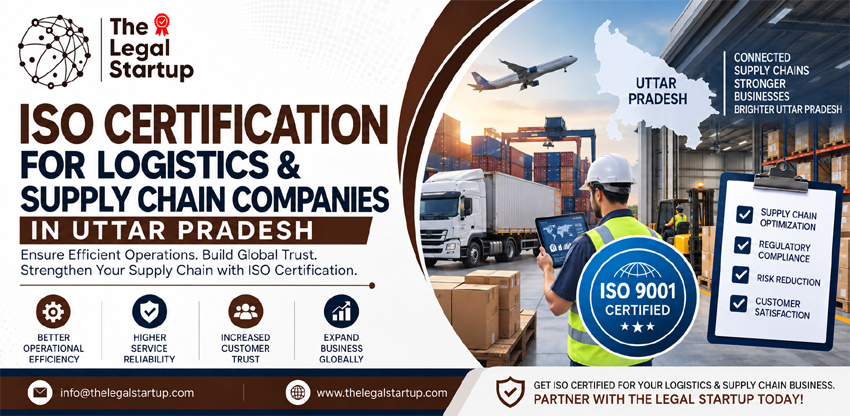
ISO Certification for Logistics & Supply Chain Companies in Uttar Pradesh
ISO Certification for Logistics & Supply Chain Companies in Uttar Pradesh helps organizations establish consistent processes for transportation, warehousing, inventory management, order fulfillment, information security, and customer service. As logistics operations become increasingly technology-driven and interconnected, companies need structured management systems to maintain quality, improve operational efficiency, and manage business risks.
Uttar Pradesh has a growing logistics ecosystem covering freight transportation, warehousing, distribution, e-commerce fulfillment, cold-chain operations, third-party logistics (3PL), courier services, and supply chain management. ISO standards can help these businesses document their processes, monitor performance, reduce operational errors, and demonstrate their commitment to internationally recognized management practices.
Whether a logistics company operates locally in Uttar Pradesh or manages national and international supply chains, implementing an appropriate ISO management system can strengthen operational controls and improve customer confidence.
What Is ISO Certification for Logistics & Supply Chain Companies?
ISO certification demonstrates that a company's management system has been assessed against the requirements of a particular ISO standard by a competent certification body. For logistics and supply chain organizations, the appropriate standard depends on the company's services, operational risks, technology infrastructure, and customer requirements.
A logistics company may implement ISO standards to improve areas such as:
- Transportation and delivery processes
- Warehouse and inventory management
- Supplier and vendor management
- Customer service and complaint handling
- Information and data security
- Operational risk management
- Employee safety and workplace controls
- IT service management
- Documentation and process monitoring
- Continuous improvement
Why ISO Certification Is Important for Logistics Companies in Uttar Pradesh
Logistics companies handle multiple activities simultaneously, including shipment booking, transportation, warehousing, inventory tracking, documentation, customer communication, and delivery coordination. A small process failure can result in delays, damaged goods, incorrect deliveries, customer complaints, or financial losses.
An ISO-based management system provides a structured approach to identifying risks, defining responsibilities, documenting procedures, monitoring performance, and improving processes.
ISO certification can also help logistics and supply chain companies demonstrate their commitment to quality, security, employee safety, and reliable business operations when dealing with customers, vendors, large enterprises, and international partners.
ISO 9001 Certification for Logistics & Supply Chain Companies
ISO 9001 is one of the most widely used management system standards for organizations that want to establish a structured Quality Management System (QMS). It is highly relevant to logistics companies because service quality depends on consistent processes across transportation, warehousing, documentation, customer support, and delivery operations.
For a logistics company, ISO 9001 can help establish documented procedures for shipment handling, order processing, supplier evaluation, customer communication, service monitoring, corrective actions, and continuous improvement.
Companies looking to establish a quality-focused management system can explore:
→ ISO 9001 Certification in Uttar Pradesh
ISO 27001 Certification for Logistics & Supply Chain Companies
Modern logistics operations depend heavily on digital systems. Transportation management systems, warehouse management software, GPS tracking, customer portals, ERP platforms, shipment databases, and electronic documentation all involve sensitive business information.
ISO 27001 provides a framework for establishing an Information Security Management System (ISMS). It can help logistics organizations identify information security risks and implement appropriate controls for protecting confidential, sensitive, and business-critical information.
ISO 27001 can be particularly relevant to logistics companies handling:
- Customer and supplier information
- Shipment and order data
- Financial information
- Employee records
- Digital transportation records
- Warehouse management data
- Cloud-based business applications
- Customer portals and tracking systems
For information security management requirements, businesses can explore:
→ ISO 27001 Certification in Uttar Pradesh
ISO 13485 Certification and Logistics Businesses
ISO 13485 is specifically associated with quality management systems for organizations involved in medical devices and related activities. Therefore, it is not a general certification requirement for every logistics or supply chain company.
However, ISO 13485 may become relevant where a logistics organization provides specialized services connected with medical devices or supports organizations operating within the medical-device supply chain. In such cases, the organization's responsibilities and applicable regulatory requirements should be evaluated before selecting the standard.
For organizations involved in applicable medical-device-related activities, more information is available here:
→ ISO 13485 Certification in Uttar Pradesh
OHSAS 18001 for Logistics & Supply Chain Companies
Logistics operations involve workplace and transportation-related risks. Employees may work around loading equipment, forklifts, warehouses, trucks, heavy materials, loading docks, and other operational environments.
OHSAS 18001 was previously used as an occupational health and safety management standard. It has been superseded by ISO 45001, which is the current internationally recognized standard for occupational health and safety management systems.
For businesses researching the historical OHSAS standard or related certification information, the following page can be referenced:
→ OHSAS 18001 Certification in Uttar Pradesh
ISO 20000 Certification for Logistics Companies
Technology has become an essential part of modern logistics. Companies use software and IT infrastructure for shipment tracking, inventory management, fleet management, customer communication, billing, warehouse operations, and supply chain coordination.
ISO 20000, particularly ISO/IEC 20000-1, focuses on IT Service Management (ITSM). It can be relevant to logistics organizations where IT services are a critical part of business operations or where the company provides technology-driven logistics services.
An effective IT service management system can help organizations establish structured processes for service delivery, incident management, service continuity, monitoring, and continual improvement.
Businesses interested in IT service management certification can explore:
→ ISO 20000 Certification in Uttar Pradesh
Benefits of ISO Certification for Logistics & Supply Chain Companies
Implementing an appropriate ISO management system can provide several operational and business benefits to logistics companies in Uttar Pradesh.
- Improved process consistency: Standardized procedures help employees perform important activities consistently.
- Better customer satisfaction: Defined service processes can help improve reliability and responsiveness.
- Reduced operational errors: Documented processes and monitoring can help identify recurring problems.
- Better risk management: Organizations can systematically identify and address operational and information security risks.
- Improved supplier management: Structured vendor evaluation can support more reliable supply chain operations.
- Enhanced information security: ISO 27001 can provide a structured approach to managing information security risks.
- Improved employee safety: Occupational health and safety practices can help organizations manage workplace risks.
- Better documentation: Defined procedures and records make business processes easier to monitor and control.
- Support for business growth: A structured management system can help companies manage expanding operations.
- Increased customer confidence: Certification can demonstrate a company's commitment to recognized management practices.
ISO Certification Process for Logistics Companies in Uttar Pradesh
The certification process generally involves several stages. The exact process depends on the selected ISO standard, organization size, operational complexity, and certification body's requirements.
1. Identify the Applicable ISO Standard
The company should first determine which ISO standard is appropriate for its activities. A logistics organization may require ISO 9001, ISO 27001, ISO 45001, ISO 20000-1, or a combination of standards depending on its business operations.
2. Define the Certification Scope
The organization should define which locations, departments, services, and business activities will be covered under the management system.
3. Conduct a Gap Assessment
A gap assessment helps identify differences between existing business processes and the requirements of the selected ISO standard.
4. Develop the Management System
The company establishes appropriate policies, procedures, responsibilities, controls, records, and monitoring mechanisms based on the applicable standard.
5. Implement the System
The documented processes need to be implemented throughout the relevant departments. Employees should understand their responsibilities and follow established procedures.
6. Employee Awareness and Training
Staff members involved in transportation, warehousing, customer service, IT, administration, procurement, and other relevant functions may require appropriate awareness or role-specific training.
7. Internal Audit
An internal audit is conducted to evaluate whether the management system has been implemented effectively and whether processes meet applicable requirements.
8. Corrective Actions
If nonconformities or process gaps are identified, the organization takes corrective action and maintains appropriate records.
9. Certification Audit
An independent certification body evaluates the organization's management system through the applicable certification audit process.
10. Certification and Continual Improvement
After successfully meeting the certification requirements, the organization receives certification. Maintaining the system requires ongoing monitoring, internal audits, corrective actions, and continual improvement.
Which Logistics Businesses Can Consider ISO Certification?
ISO management systems can be considered by different types of logistics and supply chain organizations, including:
- Third-party logistics (3PL) companies
- Freight forwarding companies
- Transportation companies
- Warehousing service providers
- Courier and delivery companies
- E-commerce fulfillment companies
- Cold-chain logistics providers
- Distribution companies
- Supply chain management companies
- Fleet management service providers
- Inventory management companies
- Packaging and distribution service providers
ISO Certification for Logistics Companies in Major Cities of Uttar Pradesh
Logistics and supply chain organizations operating across different parts of Uttar Pradesh can consider ISO certification according to their business activities and customer requirements.
Businesses in areas such as Noida, Greater Noida, Ghaziabad, Lucknow, Kanpur, Agra, Meerut, Varanasi, Bareilly, Moradabad, Prayagraj, Gorakhpur, and Aligarh may benefit from implementing structured management systems when their operations require formal quality, information security, occupational safety, or IT service controls.
ISO Certification for Small and Growing Logistics Companies
ISO certification is not limited to large logistics organizations. Small and medium-sized logistics businesses can also implement management systems to organize their processes as they grow.
For smaller companies, a structured approach can help define responsibilities, standardize documentation, establish measurable processes, improve customer communication, and identify operational risks.
The scope and complexity of the management system should be appropriate to the organization's size, activities, risks, and business requirements rather than creating unnecessary documentation.
ISO Certification for Logistics Companies Serving International Customers
Companies involved in international logistics and supply chain services may need to demonstrate structured business processes to customers, suppliers, and business partners. Depending on the nature of their services, ISO certification can support supplier confidence and demonstrate that the organization follows a defined management system.
For logistics companies handling sensitive customer information or operating technology-based supply chain platforms, information security controls can also become an important consideration.
How to Choose the Right ISO Certification for a Logistics Company
The right ISO standard depends on the organization's actual activities and objectives. A company should consider the following factors before selecting a certification:
- Nature and scope of logistics services
- Customer and contractual requirements
- Operational risks
- Information security requirements
- Workplace health and safety risks
- Dependence on IT services
- Regulatory and industry requirements
- Business growth plans
- Supplier and partner expectations
For example, a general logistics company may focus on ISO 9001, while a technology-intensive logistics organization may also consider ISO 27001 or ISO 20000-1. Organizations with significant workplace risks may consider ISO 45001.
Conclusion
ISO Certification for Logistics & Supply Chain Companies in Uttar Pradesh can provide a structured framework for improving quality, operational consistency, information security, workplace safety, and IT service management. The appropriate certification should be selected according to the organization's actual services, risks, customer requirements, and business objectives.
By implementing documented processes, monitoring performance, conducting internal audits, addressing nonconformities, and continually improving operations, logistics companies can develop a more controlled and reliable management system.
Frequently Asked Questions About ISO Certification for Logistics Companies
Is ISO certification mandatory for logistics companies in Uttar Pradesh?
ISO certification is not universally mandatory for every logistics company. However, certain customers, tenders, contracts, industries, or business partners may require specific management system certifications. The applicable requirements should be checked based on the organization's activities and contracts.
Which ISO certification is suitable for a logistics company?
ISO 9001 is commonly relevant to organizations seeking a quality management system. Depending on the company's operations, ISO 27001, ISO 45001, ISO 20000-1, or other applicable standards may also be considered.
Can a logistics company obtain multiple ISO certifications?
Yes. An organization can implement multiple management systems when different standards address its business requirements. For example, a logistics company may integrate quality management, information security, and occupational health and safety systems.
Is ISO 27001 useful for logistics companies?
It can be particularly relevant for logistics companies that manage customer information, shipment data, cloud systems, tracking platforms, ERP systems, warehouse management systems, or other sensitive digital information.
Is OHSAS 18001 still the current occupational safety standard?
No. OHSAS 18001 has been superseded by ISO 45001. Organizations seeking a current occupational health and safety management system should evaluate ISO 45001 and its applicability to their operations.
Can small logistics companies apply for ISO certification?
Yes. Small and medium-sized logistics companies can implement ISO management systems. The scope and documentation should be appropriate to the organization's size, activities, risks, and operational complexity.
Latest Posts
- → ISO 9001 Certification in Uttar Pradesh
- → ISO 27001 Certification in Uttar Pradesh
- → ISO 13485 Certification in Uttar Pradesh
- → OHSAS 18001 Certification in Uttar Pradesh
- → ISO 20000 Certification in Uttar Pradesh
- → ISO 22000 Certification in Uttar Pradesh
- → SA 8000 Certification in Uttar Pradesh
- → ISO 50001 Certification in Uttar Pradesh
- → CE Marking Certification in Uttar Pradesh
- → HACCP Certification in Uttar Pradesh
- → GMP Certification in Uttar Pradesh
- → ISO Certification in Noida
- → ISO Certification in Lucknow
- → ISO Certification in Ghaziabad
- → ISO Certification in Kanpur
- → ISO Certification in Agra
- → ISO Certification in Uttar Pradesh