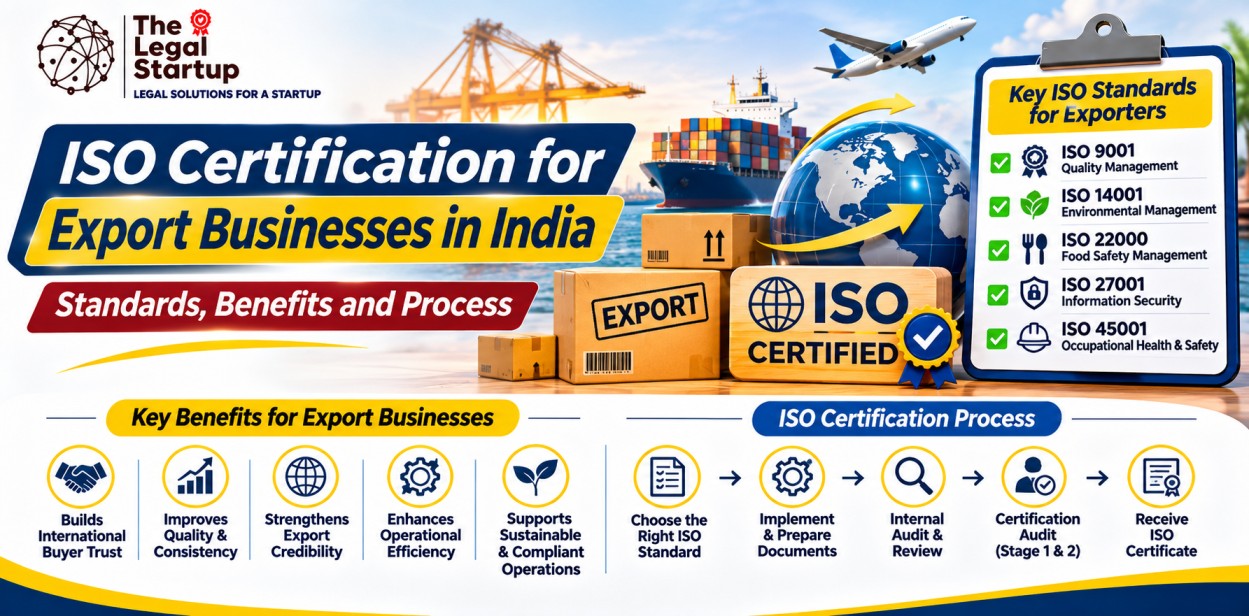
ISO Certification for Export Businesses in India Standards Benefits and Process
09 Nov 2026
Introduction: Why Do Export Businesses in India Need ISO Certification?
Expanding into international markets is a major opportunity for Indian businesses. Whether you manufacture industrial equipment, food products, textiles, pharmaceutical products, packaging materials or electronic components, exporting allows you to reach customers beyond India.
However, international buyers do not evaluate suppliers only on product prices. They also consider product quality, consistency, safety, environmental practices and the ability to meet contractual requirements.
This is where ISO Certification for Export Businesses in India can make a difference.
ISO certification helps organizations establish structured management systems that support consistent operations and improve customer confidence. It can also help Indian exporters meet specific supplier approval requirements imposed by overseas buyers.
For example, an Indian textile manufacturer exporting garments to Europe may be asked to demonstrate a quality management system. Similarly, a food processing company supplying products to overseas distributors may benefit from ISO 22000 food safety management certification.
However, ISO certification does not automatically authorize a company to export. Businesses must separately meet applicable DGFT, customs, product-specific and destination-country requirements.
Let's understand which ISO standards are suitable for exporters, their benefits and the certification process.
Which ISO Certifications Are Suitable for Export Businesses?
Different export businesses require different management systems. Selecting the right ISO standard depends on your products, operations and international customer expectations.
1. ISO 9001 – Quality Management System
ISO 9001 is one of the most widely used management system standards for exporters.
It helps businesses establish consistent quality processes, monitor customer requirements, control production activities and improve operational performance.
Suitable for:
-
Engineering and manufacturing exporters.
-
Textile and garment manufacturers.
-
Packaging companies.
-
Automobile component suppliers.
-
Industrial equipment manufacturers.
For example, an Indian auto component manufacturer supplying parts to an overseas automobile company can use ISO 9001 to strengthen production controls and quality management.
2. ISO 14001 – Environmental Management System
International buyers increasingly consider environmental performance when selecting suppliers.
ISO 14001 helps organizations identify environmental impacts, manage resource consumption, control waste and improve environmental performance.
It is particularly relevant for:
-
Chemical manufacturers.
-
Textile processing companies.
-
Packaging manufacturers.
-
Engineering industries.
-
Industrial exporters.
3. ISO 22000 – Food Safety Management System
Food exporters must pay close attention to food safety requirements in international markets.
ISO 22000 provides a framework for managing food safety hazards throughout the food supply chain.
Suitable businesses include:
-
Food processing companies.
-
Packaged food manufacturers.
-
Agricultural product processors.
-
Beverage manufacturers.
-
Food ingredient suppliers.
Remember that ISO 22000 does not replace FSSAI licensing, destination-country food regulations or other required product approvals.
4. ISO 27001 – Information Security Management System
Export companies often exchange confidential customer information, commercial agreements, product designs and financial records.
ISO 27001 helps organizations establish controls to manage information security risks.
It is particularly useful for:
-
IT exporters.
-
Software development companies.
-
Export documentation service providers.
-
Technology-based businesses.
-
Companies handling international customer data.
5. ISO 45001 – Occupational Health and Safety Management System
ISO 45001 helps businesses manage workplace health and safety risks.
It is particularly relevant for manufacturing units, engineering companies, factories and industrial suppliers working with international buyers that assess supplier safety practices.
Key Benefits of ISO Certification for Export Businesses in India
Obtaining the appropriate ISO certification can support export growth in several ways.
1. Builds International Buyer Confidence
Overseas customers often evaluate a supplier's quality and management practices before placing large orders. An appropriate ISO certificate can provide additional confidence in the organization's management system.
2. Improves Product and Service Consistency
ISO management systems encourage businesses to establish documented procedures, monitor performance and control operational processes.
This helps exporters maintain consistent quality across multiple shipments.
3. Supports International Supplier Approval
Some international buyers and corporate procurement teams specifically request ISO certification as part of their supplier qualification process.
Having the required certification can help businesses meet these contractual expectations.
4. Strengthens Business Credibility
An independently assessed management system can improve the professional image of an Indian exporter when approaching international distributors and business partners.
5. Improves Operational Efficiency
Better documentation, process monitoring and corrective action can reduce avoidable errors, production delays and customer complaints.
6. Supports Risk Management
Relevant standards help organizations identify and manage risks related to quality, environmental performance, information security and workplace safety.
7. Helps Prepare for New Export Markets
ISO certification can support a company's readiness for international business opportunities. However, exporters must still satisfy the specific product, labelling, testing and regulatory requirements of each destination market.
Is ISO Certification Mandatory for Export Businesses in India?
ISO certification is not universally mandatory for every exporter in India.
Whether certification is required depends on the industry, product, export destination, applicable regulations and buyer requirements.
For example:
-
An overseas customer may require ISO 9001 from an Indian manufacturing supplier.
-
A food importer may request evidence of a suitable food safety management system.
-
An IT client may require ISO 27001 certification before sharing sensitive business information.
-
A government procurement contract may specify a particular ISO certification as an eligibility condition.
Exporters should also understand that IEC registration, customs documentation, product-specific approvals and certificates of origin are separate requirements.
The Directorate General of Foreign Trade (DGFT) provides the applicable export policy and documentation framework.
Step-by-Step ISO Certification Process for Exporters
The ISO certification process involves preparation, implementation and an independent external assessment.
Step 1: Identify the Right ISO Standard
Select the standard according to your export products, manufacturing activities and customer requirements.
For example, a food exporter may consider ISO 22000, while an engineering exporter may choose ISO 9001.
Step 2: Conduct a Gap Assessment
Review your existing business processes and identify the improvements required to meet the selected standard.
Step 3: Prepare ISO Documentation
Prepare relevant policies, procedures, quality objectives, operational records and risk assessments according to the standard.
Step 4: Implement the Management System
Introduce the required procedures into daily business operations. Train employees and assign responsibilities.
Step 5: Conduct an Internal Audit
Review whether the management system is properly implemented. Identify gaps and complete corrective actions.
Step 6: Complete the External Certification Audit
An independent certification body generally conducts Stage 1 and Stage 2 audit activities to evaluate the organization's management system.
Step 7: Certification Decision and Issuance
After reviewing audit findings and corrective actions, the certification body decides whether to grant certification.
Once certified, the organization must maintain the management system and complete applicable surveillance audits.
Documents Required for ISO Certification for Exporters
The exact documents depend on the selected ISO standard and the nature of the export business.
Commonly required documents include:
-
Business registration certificate.
-
Company PAN details.
-
GST registration, where applicable.
-
Business address proof.
-
Importer Exporter Code (IEC), where applicable.
-
Company profile and export activity details.
-
Employee details and organization chart.
-
Manufacturing or service process details.
-
Proposed ISO certification scope.
-
Quality, environmental or other relevant management policies.
-
Operational procedures and records.
-
Employee training records.
-
Risk assessment documents.
-
Internal audit reports.
-
Management review records.
-
Corrective action records.
Additional Export Documentation
Apart from ISO certification documents, exporters of goods may need additional trade documents depending on their products and destination markets.
These may include:
-
Commercial invoice.
-
Packing list.
-
Shipping bill or bill of export.
-
Bill of lading or airway bill.
-
Certificate of origin, where required.
-
Inspection or testing certificates, where applicable.
-
Product-specific licences, NOCs or regulatory approvals.
The exact requirements should be checked with DGFT, customs authorities and the relevant product regulator.
Why Choose The Legal Startup for ISO Certification Assistance?
Preparing for international business requirements can be challenging, especially when your organization is applying for ISO certification for the first time.
The Legal Startup helps Indian exporters, manufacturers, startups and MSMEs understand the relevant ISO standards and prepare for the certification process.
Our assistance includes:
-
ISO Standard Selection: Guidance on selecting an appropriate ISO standard according to your export business activities.
-
Documentation Assistance: Support in preparing relevant policies, procedures and management system records.
-
Gap Assessment: Identifying areas that require improvement before certification.
-
Implementation Guidance: Understanding how to establish and maintain the required management system.
-
Audit Preparation: Guidance on preparing for external certification audits.
-
Cost Guidance: Understanding applicable consultancy, audit and certification expenses.
Our objective is to help exporters approach certification with proper preparation and a clear understanding of the requirements.
Certification is granted by the independent certification body after successful assessment. Businesses should verify the certification body's accreditation, competence and certification scope before proceeding.
Frequently Asked Questions (FAQs)
1. Is ISO certification mandatory for export businesses in India?
No. ISO certification is not mandatory for every export business in India. However, certain overseas buyers, government tenders, contracts or industry-specific requirements may make a particular ISO certification necessary.
2. Which ISO certification is best for exporters in India?
ISO 9001 is suitable for many manufacturing and service exporters because it focuses on quality management. Food exporters may consider ISO 22000, while businesses handling sensitive information may benefit from ISO 27001. The appropriate standard depends on the business activity.
3. How does ISO 9001 help Indian exporters?
ISO 9001 helps exporters establish consistent quality processes, improve production controls, monitor customer satisfaction and manage operational risks. It can also support supplier approval when international buyers request quality management certification.
4. Does ISO certification guarantee export orders from international buyers?
No. ISO certification does not guarantee export orders. However, it can improve business credibility and help exporters meet specific buyer qualification requirements. Product quality, pricing, delivery performance and destination-country compliance also influence purchasing decisions.
5. What documents are required for ISO certification for export businesses?
Common documents include business registration proof, PAN, address proof, company profile, IEC where applicable, employee details, certification scope, management policies, operational records, risk assessments and internal audit reports. Additional documents depend on the selected ISO standard.
Conclusion: Strengthen Your Export Business with the Right ISO Certification
International markets offer significant growth opportunities for Indian exporters, but long-term success requires more than competitive pricing.
Businesses must demonstrate consistent quality, reliable processes and the ability to meet customer expectations.
ISO Certification for Export Businesses in India can help establish a structured management system, improve international buyer confidence and strengthen supplier credibility.
Whether you are a manufacturer, food processor, engineering company, textile exporter or IT service provider, selecting the right ISO standard is an important step towards preparing your business for international opportunities.
Get Professional ISO Certification Assistance from The Legal Startup
Connect with our team to understand the appropriate ISO standard, documentation requirements, certification process and applicable costs for your export business.
Email: info@thelegalstartup.com
Website: https://www.thelegalstartup.com/
Share your business activity, export products and target market with our team to discuss your ISO certification requirements.