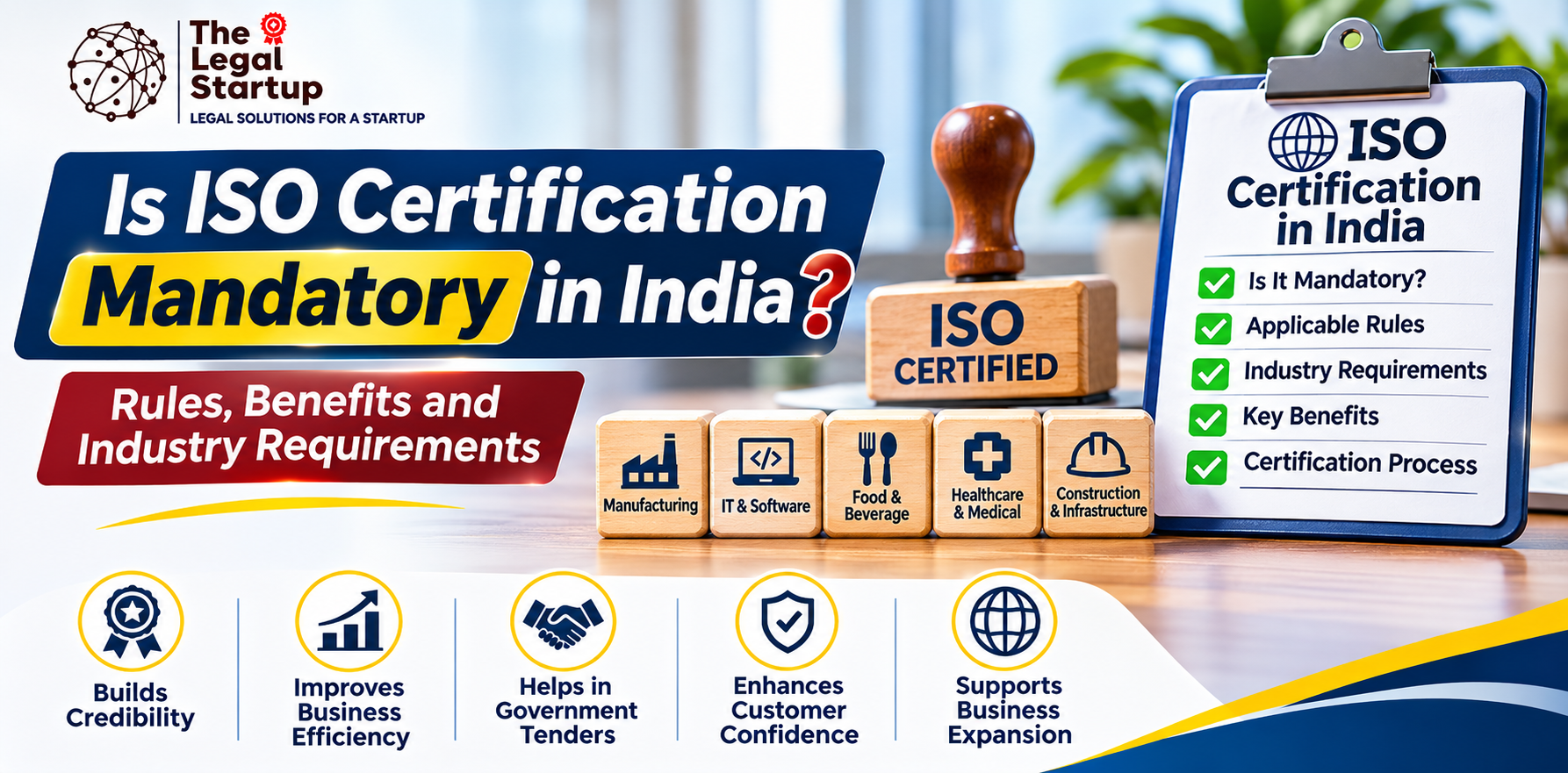
Is ISO Certification Mandatory in India Rules Benefits and Industry Requirements
05 Nov 2026
Introduction: Is ISO Certification Mandatory in India?
If you are starting a business or running an established company, you may have come across ISO certification while applying for government tenders, working with large companies or planning to expand your business.
But one common question creates confusion among business owners: Is ISO certification mandatory in India?
The straightforward answer is no. ISO certification is not compulsory for every business operating in India. Most ISO management system certifications are voluntary. However, certain industries, government tenders, regulatory requirements and customer agreements may require specific certifications or compliance with particular standards.
For example, a small digital marketing agency may operate without ISO 9001 certification. However, a manufacturing company participating in a tender that specifically requires ISO 9001 may need a valid certificate to qualify.
Similarly, medical device manufacturers have specific quality management system obligations under India's medical device regulatory framework.
Therefore, whether your business needs ISO certification depends on its industry, activities, applicable regulations and commercial requirements.
Let's understand the rules, industry requirements and benefits in detail.
Is ISO Certification Legally Mandatory for Every Business in India?
No. There is no general Indian law requiring every company, startup, shop, manufacturer or service provider to obtain ISO certification.
The International Organization for Standardization (ISO) develops international standards. It does not issue certificates directly or make certification compulsory for all businesses.
Organizations can implement ISO management system standards voluntarily to improve their processes and demonstrate their commitment to quality, safety, environmental management or information security.
However, certification may become necessary in the following situations:
-
A government tender specifically requires an ISO certificate.
-
A customer or business partner includes ISO certification in its contract.
-
An applicable industry regulation or licensing requirement specifies a particular quality management system or certification.
-
A manufacturer needs to satisfy specific regulatory or procurement conditions.
-
An international buyer requires certification as part of its supplier approval process.
Important: Do not confuse ISO management system certification with BIS product certification. BIS certification or an ISI mark may be mandatory for certain products covered by applicable Quality Control Orders (QCOs). These are separate compliance requirements.
Which Industries May Require ISO Certification in India?
ISO certification requirements differ across industries. Some businesses adopt certification voluntarily, while others may face regulatory, tender or customer-driven requirements.
1. Manufacturing Industry
Manufacturers often choose ISO 9001 to establish quality management processes, improve production consistency and reduce defects.
Certain government or corporate tenders may specifically require ISO 9001 certification from bidders or original equipment manufacturers.
For example, an electrical equipment manufacturer supplying products to a government department may need to meet both applicable BIS product requirements and tender-specific ISO certification conditions.
2. Medical Devices and Healthcare Industry
Medical device manufacturing is subject to India's Medical Devices Rules, 2017.
Quality management systems aligned with ISO 13485 are particularly important in this sector. Regulatory requirements, licensing arrangements and applicable device classifications must be reviewed before manufacturing or importing medical devices.
The exact compliance obligations depend on the device and the manufacturer's role. ISO 13485 certification should not be confused with a general hospital accreditation requirement.
3. Information Technology and Software Companies
IT companies, software developers, cloud service providers and data centres often adopt:
-
ISO 27001 for information security management.
-
ISO 9001 for quality management.
-
ISO 20000-1 for IT service management.
ISO 27001 certification may be required by enterprise customers, financial institutions or contracts involving sensitive information.
However, Indian cybersecurity regulations and CERT-In directions should be checked separately. They do not create a blanket ISO 27001 certification requirement for every IT company.
4. Food Processing and Food Businesses
Food businesses in India must follow applicable food safety laws and FSSAI licensing requirements.
ISO 22000 provides a framework for food safety management systems and can help food manufacturers, processors and suppliers establish structured food safety controls.
However, an FSSAI licence and ISO 22000 certification are different. Obtaining one does not automatically replace the other.
5. Construction and Infrastructure
Construction companies and infrastructure contractors may adopt ISO 9001, ISO 14001 and ISO 45001 to improve quality, environmental management and workplace safety.
Some government projects and private infrastructure contracts include ISO certification as a qualification or contractual condition.
Businesses should check the specific tender document rather than assuming every construction company must be ISO certified.
6. Export and International Trade
Indian exporters often obtain ISO certification to improve their credibility with international buyers.
For example, a packaging manufacturer supplying products to an overseas customer may be asked to demonstrate a certified quality management system.
ISO certification can support supplier approval, but it does not automatically replace destination-country regulations, product testing or export documentation.
Key Benefits of ISO Certification for Indian Businesses
Even when certification is not legally mandatory, it can provide meaningful business advantages.
1. Builds Business Credibility
ISO certification demonstrates that an organization's management system has been independently assessed against the relevant standard.
2. Improves Operational Efficiency
Documented procedures and clearly assigned responsibilities help reduce process errors and improve consistency.
3. Supports Government Tender Participation
Where tender conditions require ISO certification, having the appropriate valid certificate can help a business meet the specified eligibility criteria.
4. Increases Customer Confidence
Customers and corporate buyers may prefer suppliers with established quality, security or safety management systems.
5. Strengthens Risk Management
Standards such as ISO 27001 and ISO 45001 help organizations identify and manage information security and workplace safety risks.
6. Supports Business Expansion
A recognized management system can help businesses prepare for larger contracts, supplier assessments and international business opportunities.
Step-by-Step ISO Certification Process in India
Once you determine that ISO certification is suitable or required for your business, follow these steps.
Step 1: Identify the Right ISO Standard
Choose the standard according to your business activities.
Examples include:
-
ISO 9001 – Quality Management System.
-
ISO 14001 – Environmental Management System.
-
ISO 45001 – Occupational Health and Safety.
-
ISO 27001 – Information Security Management System.
-
ISO 22000 – Food Safety Management System.
-
ISO 13485 – Medical Device Quality Management System.
Step 2: Conduct a Gap Assessment
Review your existing business processes and identify what needs improvement to meet the selected standard.
Step 3: Prepare Documentation
Develop the necessary policies, procedures, records and management system documents according to your business scope.
Step 4: Implement the Management System
Put the required procedures into practice. Train employees and assign responsibilities.
Step 5: Conduct an Internal Audit
Check whether the system is properly implemented. Identify gaps and take corrective action.
Step 6: Complete the External Audit
An independent certification body evaluates the management system. The process generally includes Stage 1 and Stage 2 audit activities.
Step 7: Certification Decision and Issuance
After reviewing the audit findings and corrective actions, the certification body decides whether to grant certification.
Once certified, the organization must maintain its management system and complete applicable surveillance audits.
Documents Required for ISO Certification
Although the exact documents depend on the selected standard and business activities, commonly required information includes:
-
Business registration certificate or applicable registration proof.
-
PAN details of the organization.
-
Business address proof.
-
Company profile and business activity details.
-
Employee information and organization chart.
-
Proposed certification scope.
-
Relevant policies and procedures.
-
Operational records and work instructions.
-
Employee training records.
-
Risk assessment documents, where applicable.
-
Internal audit reports.
-
Management review records.
-
Corrective action records.
For example, an IT company applying for ISO 27001 may need information security policies and risk assessment records. A manufacturing unit applying for ISO 9001 may need production, inspection and quality control records.
Why Choose The Legal Startup for ISO Certification Assistance?
Understanding which ISO standard applies to your business can be confusing, especially when regulatory requirements, tender conditions and customer expectations differ.
The Legal Startup helps startups, MSMEs, manufacturers and established organizations understand their ISO certification requirements and prepare for the certification process.
Our assistance includes:
-
ISO standard selection: Guidance on identifying a suitable standard for your business.
-
Documentation assistance: Support with relevant management system policies and procedures.
-
Gap assessment: Identifying areas that need improvement before an external audit.
-
Implementation guidance: Helping businesses understand the practical requirements of their selected standard.
-
Audit preparation: Guidance on preparing for certification assessment.
-
Certification cost guidance: Understanding applicable consultancy, audit and certification expenses.
We focus on helping businesses understand the requirements before they invest in certification.
Certification is granted by the independent certification body after successful assessment. Businesses should verify the certification body's accreditation and scope before proceeding.
Frequently Asked Questions (FAQs)
1. Is ISO certification mandatory for all companies in India?
No. ISO certification is not mandatory for every company in India. It is generally voluntary unless a specific regulation, government tender, customer contract or industry requirement makes a particular certification necessary.
2. Is ISO 9001 certification mandatory for MSMEs in India?
No. ISO 9001 certification is generally voluntary for MSMEs. However, certain government tenders, corporate contracts and buyer requirements may make it necessary for a particular business opportunity.
3. Is ISO certification compulsory for government tenders?
Not for every government tender. Some tenders specifically require ISO 9001 or another relevant certification as an eligibility condition. Businesses must carefully check the technical qualification criteria in each tender document.
4. Is ISO 27001 mandatory for IT companies in India?
ISO 27001 is not universally mandatory for all IT companies. However, enterprise contracts, customer security requirements or specific procurement conditions may require it. Applicable cybersecurity laws and CERT-In directions must also be followed independently.
5. Can a startup operate without ISO certification in India?
Yes. A startup can generally operate without ISO certification if no applicable regulation, licence condition, tender or contractual requirement makes it necessary. However, obtaining an appropriate ISO certification can help improve business credibility and operational processes.
Conclusion: Should Your Business Get ISO Certified?
ISO certification is not a universal legal requirement in India, but it can become essential when your business enters a regulated industry, participates in specific government tenders or works with customers who demand certified management systems.
Even when certification is voluntary, it can help improve business operations, establish customer confidence and create opportunities for growth.
Before applying, identify the correct ISO standard, understand your industry's compliance requirements and verify the certification body's credentials.
Need Help Understanding ISO Certification Requirements for Your Business?
Connect with The Legal Startup for professional guidance on ISO standards, documentation, certification requirements and applicable costs.
Email: info@thelegalstartup.com
Website: https://www.thelegalstartup.com/
Share your business activity, location and certification requirements with our team to understand the appropriate ISO certification route.
Make your business more credible, organized and ready for new opportunities with The Legal Startup.