ISO 9001 2026 vs ISO 9001 2015 Key Differences Changes and Transition Guide
31 Oct 2026
Introduction
Quality plays an important role in building customer trust, improving business performance and maintaining consistent products and services. Whether you operate a manufacturing unit, IT company, construction business or service organisation, an effective Quality Management System (QMS) can make a significant difference.
The International Organization for Standardization (ISO) published the new ISO 9001:2026 edition on 16 September 2026, replacing ISO 9001:2015. The updated standard builds on the existing quality management framework while introducing clearer requirements and greater emphasis on leadership, quality culture, ethical behaviour, risks and opportunities.
For Indian businesses already holding ISO 9001:2015 certification, understanding these changes is important for a smooth transition.
In this guide, we explain ISO 9001:2026 vs ISO 9001:2015, highlight the major differences, discuss certification benefits and explain how your organisation can prepare for the updated standard.
What Is ISO 9001:2026?
ISO 9001:2026 is an international standard that provides requirements for establishing, implementing and maintaining a Quality Management System.
It helps businesses create consistent processes, improve customer satisfaction, manage operational risks and achieve continual improvement.
The standard applies to organisations of all sizes and industries, including:
-
Manufacturing and engineering companies
-
IT and software development businesses
-
Construction and infrastructure companies
-
Healthcare organisations
-
Educational institutions
-
Logistics and transportation providers
-
Small businesses and startups
The objective is not simply to maintain documentation. It is to create a working quality management system that supports better business decisions and customer satisfaction.
ISO 9001:2026 vs ISO 9001:2015: Key Differences
The 2026 revision does not completely replace the established QMS framework. Instead, it improves clarity and strengthens several important areas.
Here are the major differences businesses should understand.
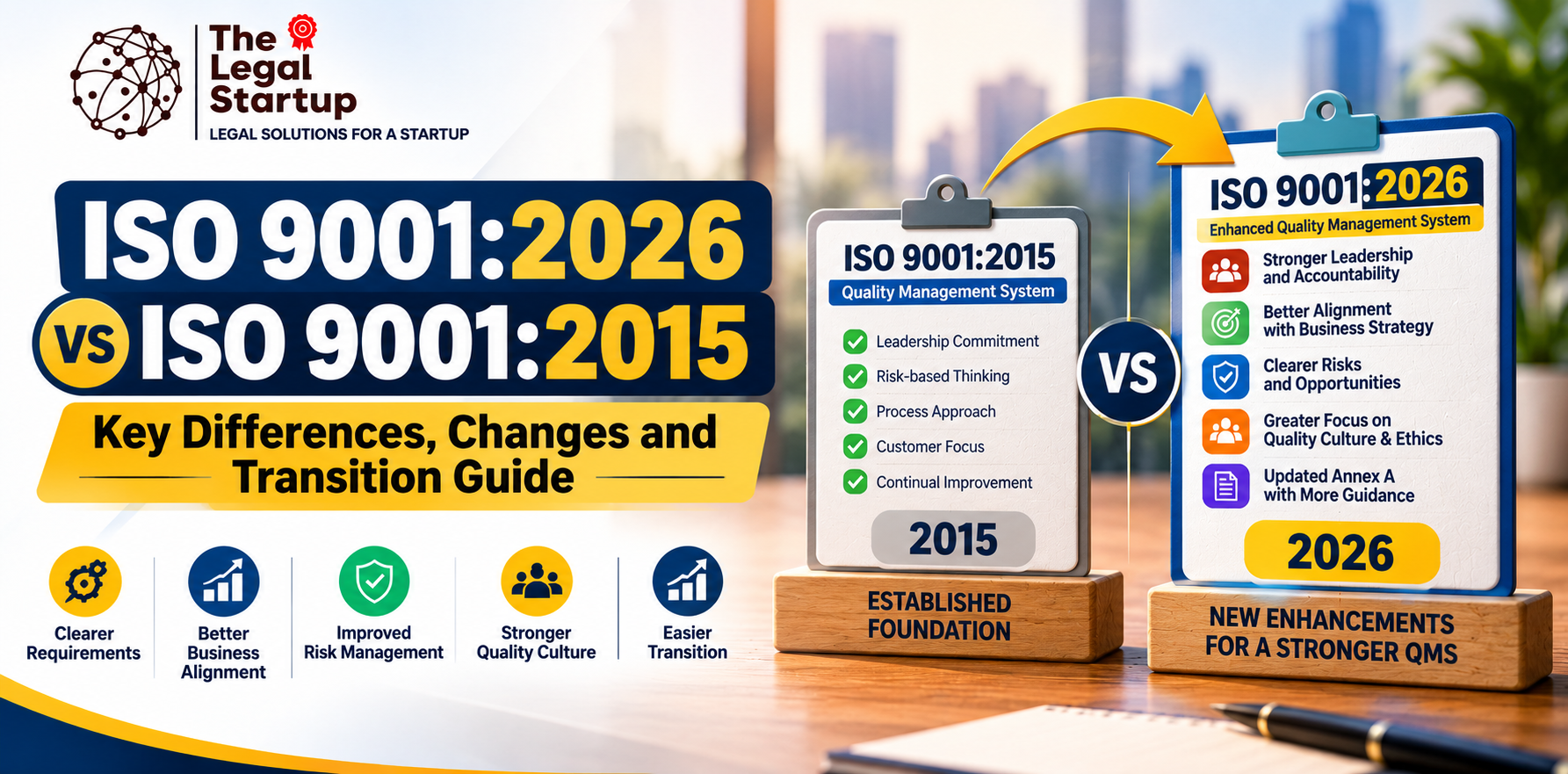
1. Stronger Focus on Leadership and Accountability
ISO 9001:2026 places greater emphasis on leadership responsibility, quality culture and ethical behaviour.
Top management must actively support quality objectives rather than treating certification as the responsibility of only the quality department.
Indian business example: A manufacturing company in Delhi should ensure that management regularly reviews product quality, customer complaints and employee involvement instead of leaving all quality-related decisions to its production supervisor.
2. Better Integration with Business Strategy
The updated standard strengthens the connection between the quality policy, organisational context and strategic direction.
Businesses should ensure that quality objectives support their actual commercial goals, such as reducing production costs, improving delivery timelines and increasing customer retention.
3. Clearer Approach to Risks and Opportunities
The revised edition provides greater clarity on identifying and addressing risks while separately considering opportunities.
For example, an Indian automotive component manufacturer may identify machine breakdowns as an operational risk and automation as an opportunity to improve productivity.
This approach encourages businesses to make informed decisions and plan improvements proactively.
4. Greater Awareness of Quality Culture and Ethical Behaviour
Quality depends on employees, management decisions and workplace practices.
ISO 9001:2026 strengthens awareness requirements so that employees understand their responsibilities towards quality, ethical behaviour and organisational performance.
5. Improved Guidance Through Annex A
The revised standard introduces an updated Annex A to explain key concepts, terminology and the intention behind requirements.
This additional guidance can help organisations understand and implement the standard more consistently.
Comparison Table: ISO 9001:2026 vs ISO 9001:2015
| Area | ISO 9001:2015 | ISO 9001:2026 |
|---|---|---|
| Leadership | Leadership commitment | Stronger focus on accountability and quality culture |
| Quality policy | Focus on quality objectives | Closer alignment with business strategy |
| Risk management | Risk-based thinking | Clearer separation of risks and opportunities |
| Employee awareness | General awareness requirements | Greater emphasis on ethical behaviour and quality culture |
| Annex A | Existing explanatory guidance | Updated clarification and guidance |
| Management systems | Existing harmonised structure | Updated alignment with ISO management system standards |
Importantly, the established principles of customer focus, process management and continual improvement remain central to both editions.
Key Benefits of ISO 9001:2026 Certification
Adopting the updated standard can help businesses improve their operations and strengthen their market reputation.
Major benefits include:
-
Improved customer satisfaction: Consistent products and services help build long-term customer relationships.
-
Better operational efficiency: Well-defined processes reduce errors, delays and unnecessary costs.
-
Stronger management control: Active leadership involvement improves accountability and decision-making.
-
Improved risk management: Businesses can identify operational challenges and explore growth opportunities.
-
Increased business credibility: ISO certification can strengthen confidence among customers, suppliers and business partners.
-
Competitive advantage: Certification may support participation in tenders and supplier qualification processes where ISO 9001 is required.
-
Continual improvement: Regular audits and performance reviews help organisations identify areas for improvement.
Step-by-Step ISO 9001:2026 Certification Process
Businesses planning to obtain new certification or transition from ISO 9001:2015 can follow a structured approach.
Step 1: Understand the Requirements
Review ISO 9001:2026 requirements and understand how they apply to your organisation's products, services and operations.
Step 2: Conduct a Gap Analysis
Compare your existing quality management system with the updated requirements. Identify areas that need changes in policies, processes, responsibilities or employee awareness.
Step 3: Prepare QMS Documentation
Develop or update the quality policy, quality objectives, process procedures, risk assessments and other relevant documented information.
Step 4: Implement the Updated System
Apply the revised processes across departments. Ensure employees understand their responsibilities and maintain appropriate operational records.
Step 5: Conduct an Internal Audit
Evaluate whether the quality management system is properly implemented. Identify non-conformities and take corrective action.
Step 6: Management Review
Top management should review audit findings, customer feedback, quality performance, risks, opportunities and improvement requirements.
Step 7: Certification Audit
Approach an appropriately accredited certification body for the external audit. The certification body evaluates whether your QMS meets the applicable ISO 9001:2026 requirements.
Step 8: Certification and Continued Improvement
After successful completion of the certification process and closure of any required findings, the certification body can issue the certificate. Continue monitoring performance and completing surveillance audits as applicable.
Documents Required for ISO 9001:2026 Certification
Documentation depends on the nature, size and complexity of your organisation. Commonly required documents and records include:
-
Company registration certificate or business incorporation documents.
-
PAN and GST registration, where applicable.
-
Organisation profile and business activity details.
-
Quality policy and quality objectives.
-
Scope of the Quality Management System.
-
Process flowcharts and operational procedures, where needed.
-
Risk and opportunity assessment records.
-
Employee roles and responsibility details.
-
Training and competency records.
-
Supplier evaluation and monitoring records.
-
Customer feedback and complaint records.
-
Internal audit reports.
-
Management review records.
-
Corrective action and non-conformity records.
-
Monitoring and measurement records, where applicable.
The organisation should maintain documented information required by the standard and evidence that its processes are operating effectively.
How to Transition from ISO 9001:2015 to ISO 9001:2026
If your business already holds ISO 9001:2015 certification, you do not need to establish an entirely new QMS.
Start by reviewing your existing system, identifying the revised requirements and updating the relevant processes.
The transition should include:
-
Reviewing the new standard and identifying changes.
-
Conducting a documented gap assessment.
-
Updating the quality policy and related processes where necessary.
-
Training employees and management.
-
Conducting an internal audit against the revised requirements.
-
Coordinating a transition audit with your certification body.
Transition deadline: The published transition arrangements provide organisations certified to ISO 9001:2015 until 30 September 2029 to complete their transition to ISO 9001:2026. Businesses should confirm applicable arrangements and audit scheduling directly with their certification body.
Why Choose The Legal Startup?
Choosing the right ISO certification consultancy can make the implementation process easier and more organised.
The Legal Startup helps businesses understand ISO requirements, prepare relevant QMS documentation and coordinate the certification process.
Our support focuses on:
-
Understanding your business activities and certification scope.
-
Identifying documentation and implementation requirements.
-
Assisting with quality management system preparation.
-
Supporting internal audit and corrective action preparation.
-
Guiding businesses through certification audit coordination.
-
Providing transition guidance for existing ISO 9001:2015-certified organisations.
We aim to make ISO certification easier to understand, practical to implement and relevant to your business operations.
Frequently Asked Questions (FAQs)
1. What is the main difference between ISO 9001:2026 and ISO 9001:2015?
The main difference is the stronger emphasis on leadership accountability, quality culture, ethical behaviour, business strategy and clearer management of risks and opportunities. The fundamental quality management framework remains familiar.
2. Is ISO 9001:2026 mandatory for Indian businesses?
ISO 9001 certification is generally voluntary in India. However, certain customers, tenders, contracts and supplier requirements may make certification necessary for particular businesses.
3. What is the last date to transition from ISO 9001:2015 to ISO 9001:2026?
Under the published transition arrangements, organisations certified to ISO 9001:2015 must complete the transition by 30 September 2029. Contact your certification body to confirm the applicable audit schedule.
4. Do businesses need new documents for ISO 9001:2026 certification?
Not necessarily. Existing documents can be retained where they remain suitable. Businesses should review and update their quality policy, risk assessments, employee awareness records and other relevant documented information to address the revised requirements.
5. Can a small business or startup apply for ISO 9001:2026 certification?
Yes. ISO 9001:2026 is suitable for businesses of all sizes. Startups and small enterprises can implement a QMS based on their business activities, operational complexity and certification scope.
Conclusion: Prepare Your Business for ISO 9001:2026
The comparison of ISO 9001:2026 vs ISO 9001:2015 shows that the latest revision focuses on improving the way organisations manage quality, leadership, business risks and continual improvement.
For Indian businesses, this is a valuable opportunity to review existing processes, improve operational efficiency and strengthen customer confidence.
Whether you are applying for ISO 9001 certification for the first time or transitioning from the 2015 edition, proper planning and expert guidance can help make the process smoother.
Get professional guidance from The Legal Startup and prepare your organisation for ISO 9001:2026.
Website: https://thelegalstartup.com/
Email: info@thelegalstartup.com
Contact our team to understand your certification requirements and receive guidance based on your business activities.