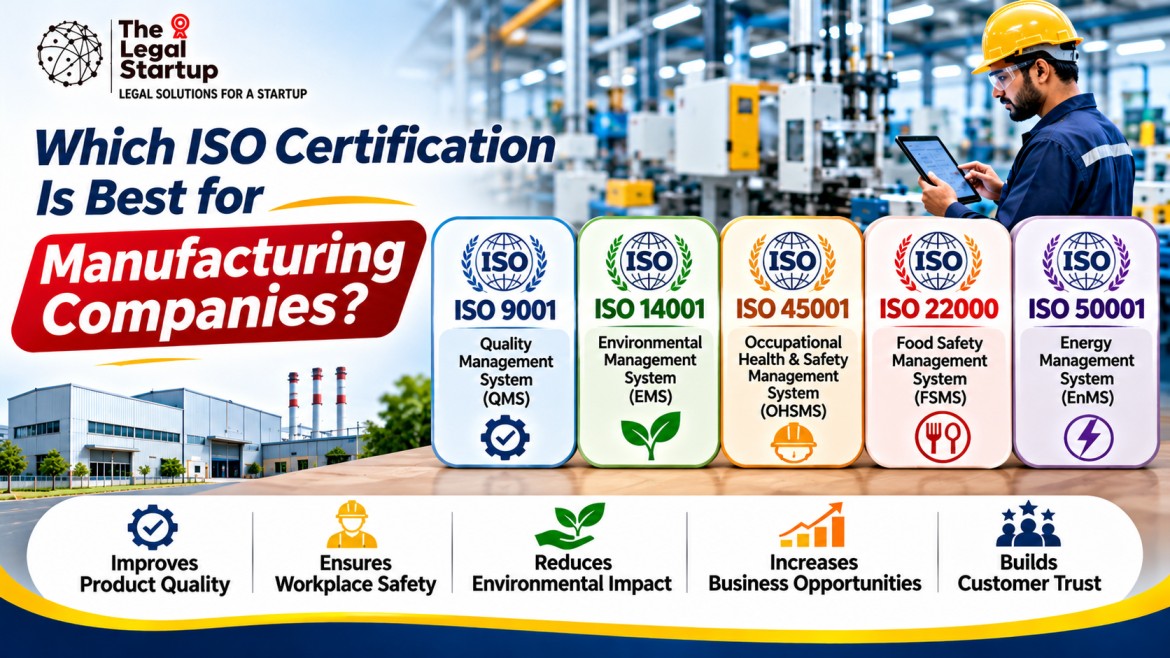
Which ISO Certification Is Best for Manufacturing Companies
21 Nov 2026
Introduction
Manufacturing companies operate in a competitive environment where product quality, workplace safety, customer satisfaction and regulatory compliance directly affect business growth. Whether you manufacture automotive components, electrical equipment, plastic products, machinery, textiles or food products, maintaining consistent standards is essential.
This is where ISO Certification for Manufacturing Companies becomes valuable. It helps businesses establish organised processes, improve production quality, manage operational risks and build trust with customers.
However, one common question among manufacturers is: Which ISO certification is best for a manufacturing company?
The answer depends on your products, production activities, customer expectations and business objectives. For most manufacturers, ISO 9001 is an excellent starting point. Businesses can also adopt ISO 14001 for environmental management and ISO 45001 for occupational health and safety.
Let's understand the most suitable ISO certifications, their benefits, requirements and certification process in India.
Which ISO Certification Is Best for Manufacturing Companies?
There is no single ISO certification that suits every manufacturing business. Different standards address different operational requirements.
Here are the most relevant ISO certifications for manufacturing industries.
1. ISO 9001:2026 – Quality Management System
ISO 9001 is one of the most important certifications for manufacturing companies. It establishes a quality management system (QMS) that helps businesses consistently meet customer requirements and improve product quality.
The latest ISO 9001:2026 edition provides an updated framework for managing quality, organisational processes and continual improvement.
It is suitable for:
-
Automobile and automotive parts manufacturers
-
Plastic and rubber product manufacturers
-
Electrical and electronic equipment manufacturers
-
Machinery and engineering companies
-
Textile and garment manufacturers
-
Packaging and consumer goods manufacturers
Example: An automobile component manufacturer can use ISO 9001 to establish inspection procedures, control production defects, monitor supplier performance and maintain product quality records.
For manufacturers looking to improve production consistency and customer confidence, ISO 9001 is generally the best starting point.
2. ISO 14001:2026 – Environmental Management System
Manufacturing activities can generate industrial waste, wastewater, emissions and high energy consumption. ISO 14001 helps organisations identify and control their environmental impacts.
It supports responsible resource management, pollution prevention and compliance with applicable environmental obligations.
It is particularly useful for:
-
Chemical manufacturers
-
Textile processing units
-
Plastic and packaging industries
-
Metal fabrication companies
-
Paper and printing industries
-
Automobile manufacturing plants
Example: A textile manufacturing unit can use ISO 14001 to monitor water consumption, manage chemical waste and improve wastewater treatment practices.
3. ISO 45001:2018 – Occupational Health and Safety
Factories involve machinery, electrical equipment, chemicals, heavy materials and other workplace hazards. ISO 45001 provides a structured system to identify workplace risks and improve employee safety.
It helps manufacturing companies establish safety procedures, conduct risk assessments, train workers and investigate workplace incidents.
It is suitable for:
-
Heavy engineering industries
-
Construction material manufacturers
-
Steel and metal industries
-
Chemical processing plants
-
Automobile factories
-
Industrial equipment manufacturers
Example: A metal fabrication company can implement machine safety procedures, provide protective equipment and conduct regular workplace safety inspections under its occupational health and safety management system.
4. ISO 22000:2018 – Food Safety Management System
ISO 22000 is designed for organisations involved in the food supply chain. It helps businesses identify food safety hazards and establish controls throughout production, storage and distribution.
It is suitable for:
-
Food processing companies
-
Dairy product manufacturers
-
Packaged food manufacturers
-
Beverage production units
-
Commercial food packaging businesses
Food manufacturers should also assess applicable FSSAI licensing and regulatory requirements. ISO 22000 does not replace statutory food licences.
5. ISO 50001:2018 – Energy Management System
Energy consumption is a major operational expense for many manufacturing businesses. ISO 50001 helps organisations monitor energy performance, identify consumption patterns and improve energy efficiency.
It is useful for:
-
Steel manufacturing units
-
Cement factories
-
Chemical industries
-
Textile mills
-
Large production facilities
-
Energy-intensive manufacturing plants
Which ISO Standard Should Your Manufacturing Business Choose?
| Business requirement | Recommended certification |
|---|---|
| Improve product quality | ISO 9001:2026 |
| Manage environmental impact | ISO 14001:2026 |
| Improve workplace safety | ISO 45001:2018 |
| Ensure food safety | ISO 22000:2018 |
| Improve energy efficiency | ISO 50001:2018 |
A manufacturing company can also implement multiple standards through an Integrated Management System (IMS), reducing duplication in documentation, audits and management reviews.
Why Choose The Legal Startup for ISO Certification?
Selecting the right certification support provider is an important step towards building an effective management system.
The Legal Startup helps businesses understand their certification requirements and prepare for the certification process.
Here is how professional assistance can help your manufacturing business:
-
Standard Selection: Identify the ISO standard according to your manufacturing activities and customer requirements.
-
Documentation Assistance: Prepare relevant policies, procedures, formats and records.
-
Implementation Guidance: Understand how to apply management system requirements to actual factory operations.
-
Audit Preparation: Identify documentation and implementation gaps before the external certification audit.
-
Compliance Support: Understand applicable management system and business requirements.
-
Certification Coordination: Get assistance in coordinating the certification process with the selected certification body.
Our objective is to make the certification journey organised, transparent and easier for business owners.
Key Benefits of ISO Certification for Manufacturing Companies
ISO certification is not simply a document to display in your factory. When properly implemented, it can improve everyday business operations.
1. Better Product Quality
Standardised production procedures and quality inspections help reduce defects, rework and customer complaints.
2. Increased Customer Confidence
An independently assessed management system can strengthen trust among buyers, distributors and business partners.
3. Improved Operational Efficiency
Clearly defined responsibilities, documented procedures and process monitoring help reduce operational confusion and unnecessary delays.
4. Better Workplace Safety
ISO 45001 encourages proactive hazard identification and risk control, helping create a safer working environment.
5. Environmental Responsibility
ISO 14001 supports better control of waste, emissions and resource consumption.
6. More Business Opportunities
Some corporate buyers, OEMs, government tenders and international customers require or prefer suppliers with relevant ISO certifications. Certification can therefore improve eligibility for certain business opportunities, subject to the buyer's requirements.
7. Continuous Business Improvement
Regular monitoring, internal audits and corrective actions help manufacturers identify problems and improve their management systems over time.
Step-by-Step ISO Certification Process in India
The ISO certification process generally involves the following steps:
Step 1: Identify the Appropriate ISO Standard
Understand your manufacturing activities, business objectives, customer requirements and applicable compliance obligations before selecting a standard.
Step 2: Apply for Certification
Share your company information, manufacturing activities, number of employees, facility details and required certification scope with your certification support provider.
Step 3: Gap Analysis
Review existing business processes against the selected ISO standard. Identify missing procedures, operational weaknesses and documentation gaps.
Step 4: Documentation Preparation
Develop the necessary management system documents, including policies, procedures, work instructions, inspection formats and records.
Step 5: Implement the Management System
Apply the documented procedures in actual manufacturing operations. Employees should understand their responsibilities and follow the defined processes.
Step 6: Conduct Internal Audit
Evaluate whether the management system is properly implemented. Identify non-conformities and take corrective action.
Step 7: Management Review
Management should review system performance, audit findings, customer feedback, objectives and opportunities for improvement.
Step 8: External Certification Audit
An independent certification body assesses the organisation against the applicable ISO requirements. The audit may include documentation review, employee interviews and factory inspections.
Step 9: Certification Decision
After satisfactory audit completion and closure of applicable non-conformities, the certification body makes its certification decision and issues the certificate if requirements are met.
Documents Required for ISO Certification
The exact documents depend on the selected ISO standard, certification scope and manufacturing activities.
Generally, manufacturing companies may need:
-
Company registration certificate or applicable business constitution documents.
-
PAN card of the business.
-
GST registration certificate, where applicable.
-
Address proof of the manufacturing facility.
-
Details of manufacturing activities and products.
-
Organisational structure and employee details.
-
Quality, environmental or occupational health and safety policy, as applicable.
-
Defined management system objectives.
-
Production and operational control records.
-
Inspection, testing and quality control records.
-
Equipment maintenance and calibration records, where applicable.
-
Employee training and competency records.
-
Supplier evaluation and purchase records.
-
Internal audit reports.
-
Management review records.
-
Corrective action and non-conformity records.
Additional documents may be required for food safety, environmental management, occupational health and safety or other specialised manufacturing activities.
Important: Documentation should reflect actual business operations. Preparing documents alone does not establish conformity with an ISO standard.
Frequently Asked Questions (FAQs)
1. Which ISO certification is best for manufacturing companies?
ISO 9001 is generally the best starting point for manufacturing companies because it focuses on product quality, process control and customer satisfaction. Depending on business activities, manufacturers may also require ISO 14001, ISO 45001 or ISO 22000.
2. Is ISO 9001 mandatory for manufacturing companies in India?
ISO 9001 is not universally mandatory for all manufacturing companies in India. However, specific customers, tenders, supply-chain agreements or industry requirements may make certification necessary.
3. Can a manufacturing company obtain multiple ISO certifications?
Yes. A manufacturing company can obtain multiple certifications, such as ISO 9001, ISO 14001 and ISO 45001. These standards can also be integrated into a single management system.
4. How long does ISO certification take for a manufacturing company?
The timeline depends on the selected standard, company size, operational complexity, existing documentation and audit readiness. The implementation and audit schedule should be confirmed with the certification body.
5. What is the cost of ISO certification for manufacturing companies in India?
The cost depends on the ISO standard, number of employees, manufacturing locations, certification scope, audit duration and certification body's fees. Businesses should obtain a quotation based on their actual requirements.
Conclusion: Choose the Right ISO Certification for Your Manufacturing Business
Choosing the right ISO certification can help your manufacturing business improve quality, manage operational risks, strengthen customer confidence and create better opportunities for growth.
For most manufacturers, ISO 9001:2026 is a practical starting point. However, businesses dealing with environmental risks, workplace hazards, food production or high energy consumption should also consider ISO 14001, ISO 45001, ISO 22000 or ISO 50001, as applicable.
The right certification should match your actual business operations rather than simply adding another certificate to your company profile.
Get Professional ISO Certification Assistance from The Legal Startup
Planning to obtain ISO certification for your manufacturing company in India?
Connect with The Legal Startup for guidance on selecting the appropriate ISO standard, understanding documentation requirements and preparing for the certification process.
Email: info@thelegalstartup.com
Website: https://thelegalstartup.com/
Contact our team today to discuss your manufacturing business requirements and take the next step towards building a reliable management system.