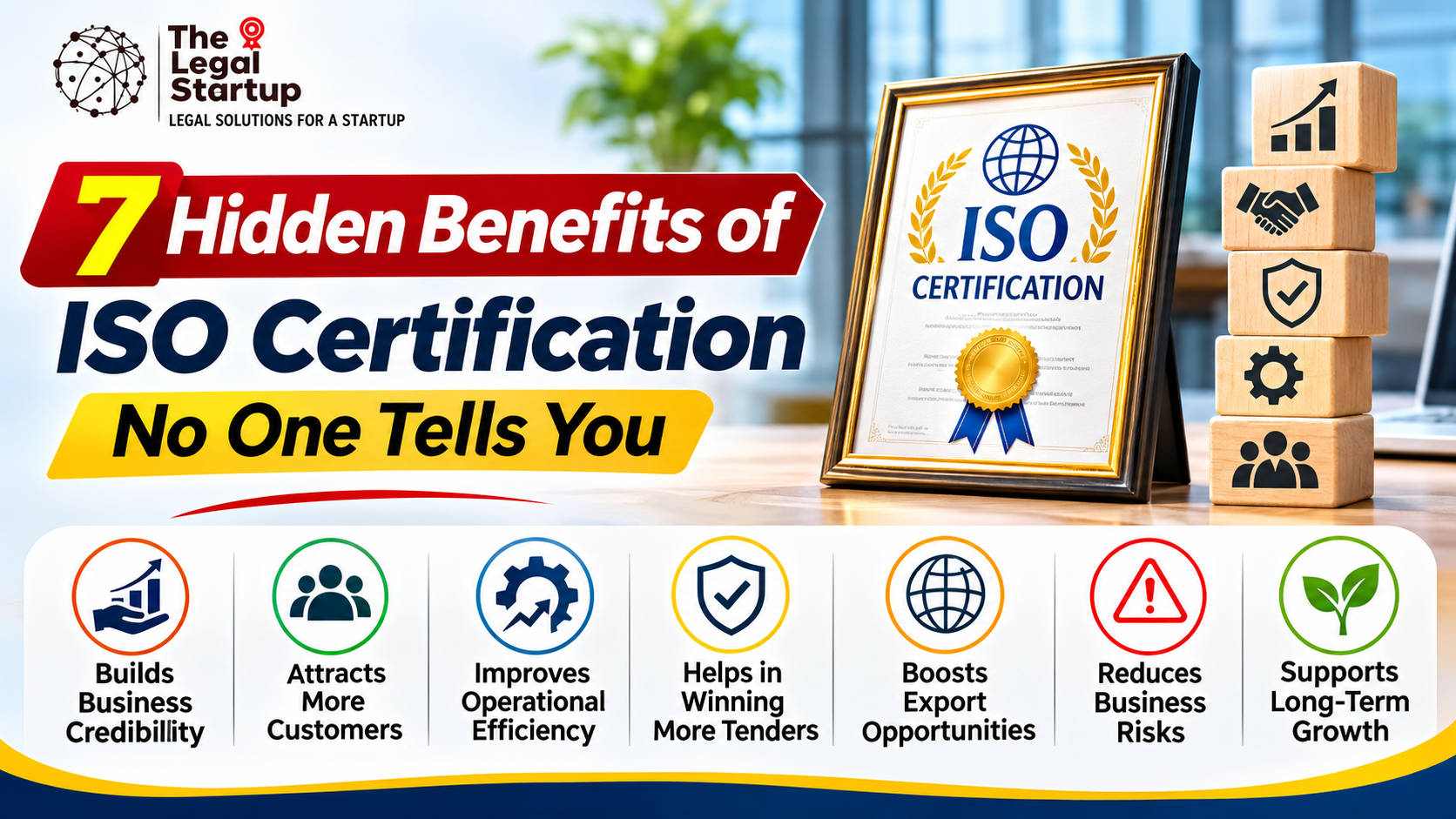
7 Hidden Benefits of ISO Certification No One Tells You
19 Nov 2026
Introduction
When Indian business owners think about ISO certification, the first thing that usually comes to mind is credibility. Having an internationally recognised certification can certainly improve your company's reputation, but its actual value goes much further.
For manufacturers, exporters, contractors, MSMEs and B2B service providers, ISO certification can help improve everyday business operations. It creates a structured way to manage quality, control risks, monitor performance and build stronger relationships with customers.
Interestingly, some of the biggest benefits of ISO certification are not immediately visible. They appear gradually through better decision-making, fewer operational mistakes, improved employee accountability and increased business opportunities.
Whether you operate a manufacturing unit in Noida, an engineering company in Pune, an export business in Gujarat or a service-based company in Delhi, understanding these advantages can help you make a better business decision.
Let's explore seven hidden benefits of ISO certification that many businesses overlook.
7 Hidden Benefits of ISO Certification No One Tells You
1. Better Chances of Winning B2B Contracts and Government Tenders
One important advantage of ISO certification is that it can help businesses qualify for more commercial opportunities.
Large companies, corporate buyers, procurement departments and government organisations often evaluate suppliers based on quality systems, operational controls and compliance requirements.
For example, an automobile component manufacturer supplying products to a large automotive company may need to demonstrate consistent quality management before becoming an approved supplier.
Similarly, certain government tenders and private procurement contracts specify ISO certification as an eligibility or evaluation requirement.
How it helps your business:
-
Strengthens your company profile during vendor registration.
-
Helps demonstrate a commitment to quality management.
-
Supports participation in tenders where relevant certification is required.
-
Improves confidence among corporate procurement teams.
However, ISO certification does not automatically guarantee a tender or contract. Buyers may have additional technical, financial and regulatory requirements.
2. Reduced Production Costs and Material Wastage
Many manufacturers lose money because of rejected products, repeated production work, incorrect measurements and inefficient processes.
ISO-based management systems encourage businesses to identify the reasons behind these problems instead of repeatedly correcting the same mistakes.
For example, a packaging manufacturer may discover that inconsistent raw material inspection is responsible for frequent product rejection. By improving supplier evaluation and incoming quality checks, the company can reduce avoidable wastage.
This can lead to:
-
Better raw material utilisation.
-
Fewer production errors.
-
Reduced rework and rejection.
-
Improved inventory management.
-
Better control over operational expenses.
Over time, these improvements can positively influence profitability.
3. Increased Customer Retention and Repeat Orders
Getting a new customer is important, but retaining existing customers is equally valuable.
Customers prefer working with businesses that deliver consistent products, communicate clearly and resolve complaints professionally.
ISO 9001 provides a framework for monitoring customer satisfaction, managing complaints and improving processes.
Consider a B2B engineering company supplying machine components to industrial clients. If it consistently meets agreed specifications and delivery requirements, customers have stronger reasons to continue the relationship.
ISO certification can therefore support customer confidence and long-term business relationships.
4. Easier Employee Management and Clear Responsibilities
In many growing companies, employees depend heavily on instructions from business owners or senior managers.
This creates confusion when responsibilities are not clearly defined.
An effective ISO management system encourages organisations to establish responsibilities, reporting structures, documented procedures and employee awareness.
For example, in a manufacturing unit, production staff should understand their responsibilities, while quality teams should know how inspections, reporting and corrective actions are handled.
The result can include:
-
Clearer employee responsibilities.
-
Better coordination between departments.
-
Improved employee accountability.
-
Reduced dependency on individual employees.
-
More consistent daily operations.
This becomes particularly useful when a company expands its workforce or opens additional branches.
5. Stronger Business Reputation in International Markets
For Indian exporters and manufacturers planning to work with international buyers, trust is a major consideration.
Overseas customers may want evidence that a supplier follows a structured management system and can consistently meet agreed requirements.
An appropriately scoped and accredited ISO management system certification can strengthen your business profile during international vendor evaluations.
For example, an Indian textile manufacturer supplying products to overseas distributors may use ISO 9001 certification to demonstrate its commitment to quality management.
Depending on the industry, other relevant standards may include ISO 14001 for environmental management, ISO 27001 for information security and ISO 22000 for food safety management.
The right certification depends on the company's activities and customer requirements.
6. Better Risk Management and Business Continuity
Every business faces risks, whether related to suppliers, employees, production, information security or customer expectations.
The problem is that many organisations identify these risks only after something goes wrong.
ISO management systems encourage businesses to identify potential problems, evaluate their impact and establish appropriate controls.
For example, an IT company may improve access controls and information-security procedures, while a manufacturing company may introduce preventive equipment maintenance and supplier monitoring.
This proactive approach can help reduce disruptions and improve business resilience.
7. A Strong Foundation for Business Expansion
One often-overlooked benefit of ISO certification is that it helps businesses prepare for growth.
When a company expands, managing employees, suppliers, production activities and customer expectations becomes more complicated.
Without structured processes, growth can create operational confusion.
ISO-based management systems encourage organisations to establish repeatable processes that can be monitored and improved as the business grows.
This is particularly valuable for:
-
Startups preparing to enter corporate markets.
-
MSMEs planning to increase production capacity.
-
Manufacturers expanding into new locations.
-
Exporters entering international supply chains.
-
B2B companies managing larger customer accounts.
ISO certification is not a guarantee of business expansion, but a properly implemented management system can provide a stronger operational foundation.
Why Choose The Legal Startup for ISO Certification?
Choosing the right ISO certification support partner is important because every business has different operational requirements.
The Legal Startup provides ISO certification consultancy and support for startups, MSMEs, manufacturers and established businesses across India.
Our approach focuses on understanding your business activities and helping you navigate the certification process.
Why businesses consider working with us:
-
Industry-focused guidance: Recommendations based on your business activities and certification requirements.
-
Documentation assistance: Support in preparing the necessary management system documents.
-
Implementation guidance: Assistance in understanding and implementing applicable ISO requirements.
-
Transparent communication: Clear information about the process, requirements and associated costs.
-
Multiple certification options: Support for standards such as ISO 9001, ISO 14001, ISO 27001, ISO 22000 and ISO 13485.
Our objective is to make the ISO certification journey easier to understand and manage.
Step-by-Step ISO Certification Process in India
Getting ISO certified involves more than submitting a few business documents. The organisation must establish and demonstrate compliance with the requirements of the selected standard.
Here is the general process:
Step 1: Select the Appropriate ISO Standard
Identify the standard relevant to your business. For example, ISO 9001 for quality management, ISO 14001 for environmental management or ISO 27001 for information security.
Step 2: Define the Certification Scope
Determine which business activities, departments, products and locations will be included.
Step 3: Documentation Preparation
Prepare applicable policies, procedures, objectives, risk assessments and operational records.
Step 4: Implement the Management System
Ensure employees understand their responsibilities and follow the established procedures.
Step 5: Internal Audit and Management Review
Evaluate whether the management system is working effectively and identify areas requiring improvement.
Step 6: Certification Audit
An independent certification body evaluates the organisation against the applicable standard.
Step 7: Certification Decision
If the audit requirements are satisfactorily met and the certification body approves the application, the certificate is issued.
Remember that ISO itself does not issue certificates. Certification is conducted by independent certification bodies.
Documents Required for ISO Certification in India
The exact documents depend on the selected ISO standard, business structure and certification scope.
Commonly required documents include:
-
Business registration proof, such as GST registration, Udyam registration, incorporation certificate or other applicable registration.
-
Company address proof.
-
PAN details, where applicable.
-
Company letterhead or visiting card.
-
Description of business activities.
-
Employee and organisational details.
-
Applicable policies and procedures.
-
Operational records and supporting documents, depending on the standard.
Additional technical documents may be required for manufacturing, food processing, healthcare, IT and other specialised industries.
Frequently Asked Questions About ISO Certification
1. What are the main benefits of ISO certification for businesses?
ISO certification can help businesses improve operational efficiency, customer satisfaction, process consistency, risk management and market credibility. It may also support vendor registration and tender participation where certification is required.
2. Is ISO certification beneficial for small businesses and MSMEs?
Yes. ISO certification can help MSMEs establish structured processes, improve quality management, build customer confidence and prepare for larger business opportunities.
3. Which ISO certification is best for manufacturing companies?
ISO 9001 is commonly suitable for quality management. Depending on business requirements, manufacturers may also consider ISO 14001, ISO 45001 or ISO 13485.
4. Does ISO certification help businesses get government tenders?
It can help when a particular tender specifies the relevant ISO certification as an eligibility or evaluation requirement. However, certification alone does not guarantee tender approval.
5. How long does it take to get ISO certification in India?
The timeline depends on the selected standard, organisation size, operational complexity, documentation readiness and audit requirements. A small organisation with an established management system may complete the process sooner than a large organisation with multiple locations.
Conclusion: Turn ISO Certification into a Business Growth Opportunity
ISO certification should not be viewed simply as a certificate to display on your office wall. When implemented properly, it can help your organisation improve processes, strengthen customer relationships, manage risks and prepare for new business opportunities.
For Indian manufacturers, exporters, MSMEs and B2B companies, these advantages can make a meaningful difference in long-term business development.
If you are planning to obtain ISO certification for your organisation, The Legal Startup can help you understand the applicable standards, documentation requirements and certification process.
Get in touch with The Legal Startup today:
Website: https://thelegalstartup.com/
Email: info@thelegalstartup.com
Take the next step towards building a more organised, credible and growth-ready business with the right ISO certification support.