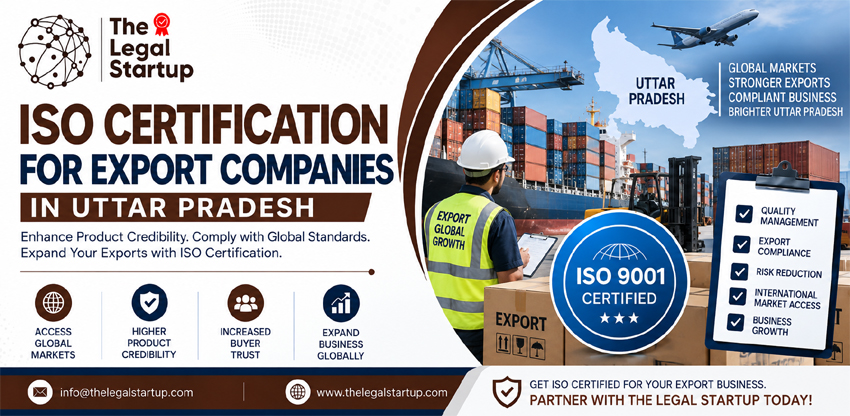
ISO Certification for Export Companies in Uttar Pradesh
Uttar Pradesh is home to a diverse export sector covering handicrafts, leather products, textiles, garments, carpets, engineering goods, food products, agricultural products, chemicals, electronics, machinery, pharmaceuticals, and other manufactured goods. As exporters increasingly work with international buyers, distributors, importers, and global supply chains, maintaining consistent quality and reliable business processes has become increasingly important.
ISO Certification for Export Companies in Uttar Pradesh provides a structured approach to quality management, information security, operational control, customer satisfaction, and continual improvement. Depending on the nature of the export business, companies can select an ISO standard that aligns with their products, processes, customer expectations, and contractual requirements.
For an export company, ISO certification can also provide documented evidence that the organization has established and implemented a management system based on an internationally recognized standard. It can support supplier evaluations, customer due diligence, tender participation, and business development where certification is specifically requested.
What Is ISO Certification for Export Companies?
ISO certification is an independent assessment of a company's management system against the requirements of a particular ISO standard. The certification scope can cover specific products, services, locations, departments, manufacturing processes, warehouses, or other business activities.
Export companies may have to manage several interconnected activities, including procurement, manufacturing, quality inspection, packaging, warehousing, documentation, logistics, customer communication, and shipment coordination. A suitable ISO management system helps organizations establish consistent procedures and responsibilities across these activities.
The appropriate certification should be selected according to the company's actual business requirements. An exporter does not necessarily need every ISO standard, and the certification scope should accurately represent the organization's operations.
Why ISO Certification Is Important for Export Companies in Uttar Pradesh
International buyers often evaluate suppliers on more than price. They may consider product quality, delivery reliability, consistency, documentation, production controls, information security, and the supplier's ability to maintain agreed requirements.
ISO certification can support export companies by providing a structured management framework for these areas.
- Improved quality consistency: Standardized processes can help reduce variation in products and services.
- Greater customer confidence: Certification can demonstrate that the company's management system has been independently assessed.
- Better process control: Defined procedures can improve procurement, production, inspection, packaging, and dispatch activities.
- Support for international customers: Some overseas buyers may request evidence of management-system certification during supplier evaluation.
- Improved documentation: Controlled processes help organizations maintain appropriate records and operational evidence.
- Risk management: Organizations can identify and address operational, quality, security, and supply-chain risks.
- Better supplier management: Structured evaluation and monitoring can help businesses manage vendors and subcontractors.
- Continual improvement: Internal audits, corrective actions, and management reviews support ongoing process improvement.
- Support for tenders and contracts: Certain procurement processes may specify particular ISO certifications as part of supplier requirements.
- Stronger business reputation: A relevant certification can communicate a company's commitment to systematic management practices.
ISO 9001 Certification for Export Companies
ISO 9001 is one of the most relevant management-system standards for many export businesses because it focuses on quality management and consistent processes.
An export company can use an ISO 9001-based quality management system to control areas such as customer requirements, purchasing, production, inspection, quality control, order processing, delivery, complaints, and corrective actions.
For manufacturers exporting products from Uttar Pradesh, ISO 9001 can provide a framework for maintaining consistent quality from incoming materials through production and final dispatch.
For trading and merchant-export businesses, the quality management system can be designed around activities such as supplier selection, order verification, product inspection, documentation, customer communication, and shipment coordination.
→ ISO 9001 Certification in Uttar Pradesh
ISO 27001 Certification for Export Companies
Export companies increasingly depend on digital systems for international orders, customer communication, payment information, logistics coordination, ERP systems, email, cloud platforms, and electronic documentation.
ISO/IEC 27001 provides a framework for establishing an Information Security Management System (ISMS). It helps organizations systematically identify information-security risks and implement controls appropriate to their business environment.
ISO 27001 can be particularly relevant for export companies handling sensitive customer information, supplier information, commercial contracts, financial records, pricing information, intellectual property, product specifications, or international business documents.
Information security is especially important when an exporter shares data with overseas customers, freight forwarders, customs-related service providers, logistics companies, and other third parties.
→ ISO 27001 Certification in Uttar Pradesh
ISO 13485 Certification for Exporters of Medical Devices
ISO 13485 is a quality management standard specifically associated with medical devices and related organizations. It is not a general-purpose ISO certification for every export company.
However, exporters involved in the manufacture, development, distribution, or other applicable activities related to medical devices may need to evaluate ISO 13485 depending on their role, product scope, regulatory obligations, and customer requirements.
Medical-device exporters should define their certification scope carefully and consider the applicable regulatory requirements in the markets where their products are supplied. ISO 13485 may be relevant where the organization's activities fall within its intended scope.
→ ISO 13485 Certification in Uttar Pradesh
OHSAS 18001 and Occupational Health & Safety for Export Companies
Export businesses involved in manufacturing, warehousing, packaging, logistics, and material handling may face a range of workplace health and safety risks.
OHSAS 18001 was previously used as an occupational health and safety management standard, but it has been superseded by ISO 45001. Organizations seeking a current occupational health and safety management standard should consider ISO 45001 based on their requirements.
An occupational health and safety management system can help export-oriented manufacturing and warehouse operations establish structured processes for identifying workplace hazards, improving employee safety, preparing for emergencies, and monitoring safety performance.
→ OHSAS 18001 Certification in Uttar Pradesh
ISO 20000 Certification for Export Companies Using IT Services
Modern export businesses often depend on ERP systems, order-management platforms, cloud applications, customer portals, logistics software, electronic documentation, and other IT services.
ISO/IEC 20000-1 focuses on IT service management. It can be relevant to export companies where structured IT service delivery and support are important to business operations.
For example, an organization operating a technology-enabled export platform may use IT service management practices to control service requests, incidents, changes, availability, support processes, and service performance.
ISO 20000-1 is particularly relevant where IT service management is a significant component of the organization's operational model rather than simply because the company uses computers or software.
→ ISO 20000 Certification in Uttar Pradesh
Key Areas Covered by ISO Systems in Export Businesses
The exact requirements depend on the ISO standard selected and the organization's certification scope. However, export companies commonly need to control several important business activities.
- Customer order requirements
- Supplier and vendor evaluation
- Raw material and product procurement
- Production and process control
- Product inspection and testing
- Packaging and labeling
- Warehouse management
- Inventory control
- Shipping and logistics coordination
- Export documentation
- Customer communication
- Complaint handling
- Corrective and preventive actions
- Information and document security
- Employee training and competence
- Internal audits and management reviews
ISO Certification Process for Export Companies in Uttar Pradesh
The ISO certification process varies according to the selected standard, organization size, operational complexity, certification scope, and existing management practices. A typical process includes the following steps.
1. Identify the Appropriate ISO Standard
The company first identifies the standard that matches its business objectives. ISO 9001 may be suitable for quality management, ISO 27001 for information security, and ISO/IEC 20000-1 for IT service management, while other standards may apply to specific industries.
2. Define the Certification Scope
The organization determines which locations, products, services, departments, processes, and activities will be covered by certification.
3. Conduct a Gap Assessment
Existing business practices are reviewed against the applicable requirements of the selected ISO standard. This helps identify areas requiring improvement before the certification audit.
4. Develop Policies and Procedures
Required policies, procedures, work instructions, forms, records, and controls are developed according to the standard and the company's actual operations.
5. Implement the Management System
The documented processes are implemented across relevant departments. Employees should understand their responsibilities and follow the established procedures.
6. Conduct Risk Assessment
The organization identifies relevant business risks and determines appropriate controls and actions. The depth and methodology depend on the selected ISO standard.
7. Maintain Records
Evidence of process implementation should be maintained. Depending on the standard, this may include inspection records, supplier evaluations, customer complaints, training records, audit reports, corrective actions, and management-review records.
8. Conduct Internal Audit
An internal audit evaluates whether the management system has been implemented effectively and whether relevant processes conform to applicable requirements.
9. Management Review and Corrective Action
Management reviews system performance and addresses identified nonconformities or improvement opportunities.
10. Certification Audit
An independent certification body conducts the applicable certification audit. If the organization meets the relevant requirements and successfully completes the certification process, certification is issued for the defined scope.
Types of Export Companies in Uttar Pradesh That Can Consider ISO Certification
Uttar Pradesh has a wide range of export-oriented businesses. Depending on their activities, the following organizations may consider suitable ISO management systems:
- Textile and garment exporters
- Leather product exporters
- Handicraft exporters
- Carpet exporters
- Engineering product exporters
- Automobile component exporters
- Electrical and electronic product exporters
- Food and agricultural product exporters
- Pharmaceutical and healthcare product exporters
- Chemical product exporters
- Furniture exporters
- Metal product exporters
- Machinery exporters
- Medical device exporters
- IT and software exporters
- Merchant exporters
ISO Certification for Manufacturing Exporters
Manufacturing exporters can use ISO management systems to establish greater consistency across production and quality-control activities. Processes such as incoming material inspection, production planning, process monitoring, final inspection, packaging, and dispatch can be incorporated into the management system.
A well-defined quality management system can also help businesses establish measurable quality objectives and use customer feedback, nonconformity data, internal audits, and corrective actions to improve operations.
ISO Certification for Merchant Exporters
Merchant exporters may not operate their own manufacturing facilities, but they still manage important processes such as supplier selection, product specifications, purchase orders, inspection, documentation, logistics, and customer communication.
An appropriate management system can help merchant exporters establish consistent supplier evaluation, order verification, product inspection, document control, complaint handling, and customer-service processes.
ISO Certification for Food Export Companies
Food exporters may require management systems that address quality, food safety, traceability, hygiene, supplier control, and applicable regulatory requirements. The exact certification needs depend on the product category, business activities, destination market, customer requirements, and applicable regulations.
Exporters should select standards based on their specific food-safety and quality requirements rather than assuming that a single ISO standard applies to every food business.
ISO Certification for Pharmaceutical and Medical Product Exporters
Pharmaceutical and medical-product exporters operate in highly controlled environments where product quality, traceability, documentation, and regulatory compliance can be important considerations.
Companies involved with medical devices may evaluate ISO 13485 where applicable. Other businesses should identify the management-system and regulatory standards relevant to their specific products, manufacturing activities, and destination markets.
ISO Certification for IT and Software Exporters
Software and IT companies exporting services from Uttar Pradesh often handle international customer data, software source code, credentials, cloud systems, contracts, and technical information.
ISO 9001 may support quality and process management, while ISO 27001 can provide a structured information-security framework. Where formal IT service management is central to service delivery, ISO/IEC 20000-1 may also be considered.
Benefits for International Buyer Relationships
International buyers often need confidence that suppliers can consistently meet agreed requirements. A relevant ISO certification can contribute to supplier credibility by providing independently assessed evidence of a management system.
However, ISO certification does not automatically guarantee product quality, regulatory compliance, or acceptance in every international market. Exporters should continue to meet destination-country regulations, product standards, contractual requirements, customs requirements, and customer specifications.
ISO Certification for Export Companies in Noida and Greater Noida
Noida and Greater Noida have a strong industrial and technology ecosystem with manufacturers, exporters, IT companies, electronics businesses, engineering companies, and service providers.
Export companies operating in these locations can evaluate ISO certification based on their products, customer requirements, supply-chain structure, quality objectives, information-security risks, and international market expectations.
ISO Certification for Export Companies in Kanpur
Kanpur is known for a range of industrial and manufacturing activities, including leather, engineering, textiles, and other product categories. Export-oriented organizations can use appropriate management systems to strengthen quality control, supplier management, production processes, documentation, and customer satisfaction.
ISO Certification for Export Companies in Agra
Agra has an established export ecosystem covering products such as handicrafts, leather goods, footwear, and other manufactured and artisanal products. Companies serving international customers can evaluate ISO certification according to their operational and customer requirements.
ISO Certification for Export Companies in Other Uttar Pradesh Cities
Export businesses in Lucknow, Ghaziabad, Meerut, Varanasi, Moradabad, Bareilly, Aligarh, Prayagraj, Gorakhpur, and other cities across Uttar Pradesh can also consider suitable ISO management systems.
The certification scope should reflect the actual operations of the organization, whether it is manufacturing products, managing a supply chain, exporting goods sourced from suppliers, or providing technology-based services to international customers.
How to Choose the Right ISO Certification for an Export Company
Before selecting an ISO standard, an export company should consider several practical factors:
- Nature of products being exported
- Destination markets
- Customer and buyer requirements
- Applicable industry requirements
- Existing quality-management processes
- Information-security risks
- Supply-chain complexity
- Manufacturing and warehouse operations
- Contractual and tender requirements
- Future international expansion plans
Companies should also ensure that the certification body selected for the audit is suitable for the relevant standard and certification scope. The certificate should accurately identify the organization, scope, and applicable standard.
How ISO Certification Supports Export Business Growth
International business requires exporters to manage multiple stakeholders, including customers, suppliers, logistics providers, inspection agencies, financial institutions, and regulatory authorities. A structured management system can help coordinate these activities and establish greater consistency.
ISO certification can also become part of an export company's supplier profile and corporate documentation when customers request evidence of management-system certification. It can therefore support business development in situations where certification is relevant to buyer evaluation or contractual requirements.
Conclusion
ISO Certification for Export Companies in Uttar Pradesh can help organizations establish systematic processes for quality management, information security, operational control, customer satisfaction, and continual improvement. The appropriate ISO standard depends on the export company's products, services, business model, industry, customer expectations, and certification objectives.
ISO 9001 can provide a quality-management framework for many export businesses, while ISO 27001 can help organizations manage information-security risks. ISO 13485 may be relevant to organizations operating within an applicable medical-device scope, and ISO/IEC 20000-1 can be considered where IT service management is a significant part of the business.
For occupational health and safety, companies should consider the current ISO 45001 standard because OHSAS 18001 has been superseded. Exporters should also remember that ISO certification does not replace destination-country regulations, product-specific requirements, customs obligations, or contractual commitments.
By selecting an appropriate standard, defining a realistic scope, implementing effective processes, conducting internal audits, and completing an independent certification audit, export companies in Uttar Pradesh can establish management systems aligned with their operational needs and international business objectives.
Frequently Asked Questions About ISO Certification for Export Companies in Uttar Pradesh
1. Is ISO certification mandatory for export companies in Uttar Pradesh?
ISO certification is not universally mandatory for every export company. However, particular customers, tenders, contracts, industries, or procurement processes may specify certification requirements. Exporters should verify the exact requirements applicable to their products and markets.
2. Which ISO certification is generally suitable for exporters?
ISO 9001 is widely applicable to organizations seeking a quality management system. Exporters may also consider ISO 27001 for information security or ISO/IEC 20000-1 for IT service management when these areas are significant to their business.
3. Can a merchant exporter obtain ISO 9001 certification?
Yes. A merchant exporter can implement ISO 9001 for applicable processes such as supplier selection, order management, product verification, inspection, documentation, customer communication, and logistics coordination, provided the certification scope accurately reflects its activities.
4. Is ISO 27001 useful for export companies?
It can be useful for exporters that manage sensitive digital information such as customer data, supplier records, pricing information, contracts, financial information, product specifications, and electronic export documentation.
5. Is ISO 13485 applicable to all exporters?
No. ISO 13485 is specifically associated with medical devices and related organizations. Its applicability depends on the organization's products, activities, certification scope, and applicable requirements.
6. Is OHSAS 18001 still applicable for new certification?
OHSAS 18001 has been superseded by ISO 45001. Organizations seeking a current occupational health and safety management certification should evaluate ISO 45001 instead.
7. Can an export company obtain more than one ISO certification?
Yes. An organization can implement multiple management systems when different standards address different business requirements. For example, an exporter may implement ISO 9001 for quality management and ISO 27001 for information security.
8. How long does ISO certification take for an export company?
The timeframe depends on the selected standard, certification scope, company size, number of locations, existing management systems, operational complexity, and readiness for the certification audit. Companies with established processes may require less implementation work than businesses starting from the beginning.
Latest Posts
- → ISO 9001 Certification in Uttar Pradesh
- → ISO 27001 Certification in Uttar Pradesh
- → ISO 13485 Certification in Uttar Pradesh
- → OHSAS 18001 Certification in Uttar Pradesh
- → ISO 20000 Certification in Uttar Pradesh
- → ISO 22000 Certification in Uttar Pradesh
- → SA 8000 Certification in Uttar Pradesh
- → ISO 50001 Certification in Uttar Pradesh
- → CE Marking Certification in Uttar Pradesh
- → HACCP Certification in Uttar Pradesh
- → GMP Certification in Uttar Pradesh
- → ISO Certification in Noida
- → ISO Certification in Lucknow
- → ISO Certification in Ghaziabad
- → ISO Certification in Kanpur
- → ISO Certification in Agra
- → ISO Certification in Uttar Pradesh