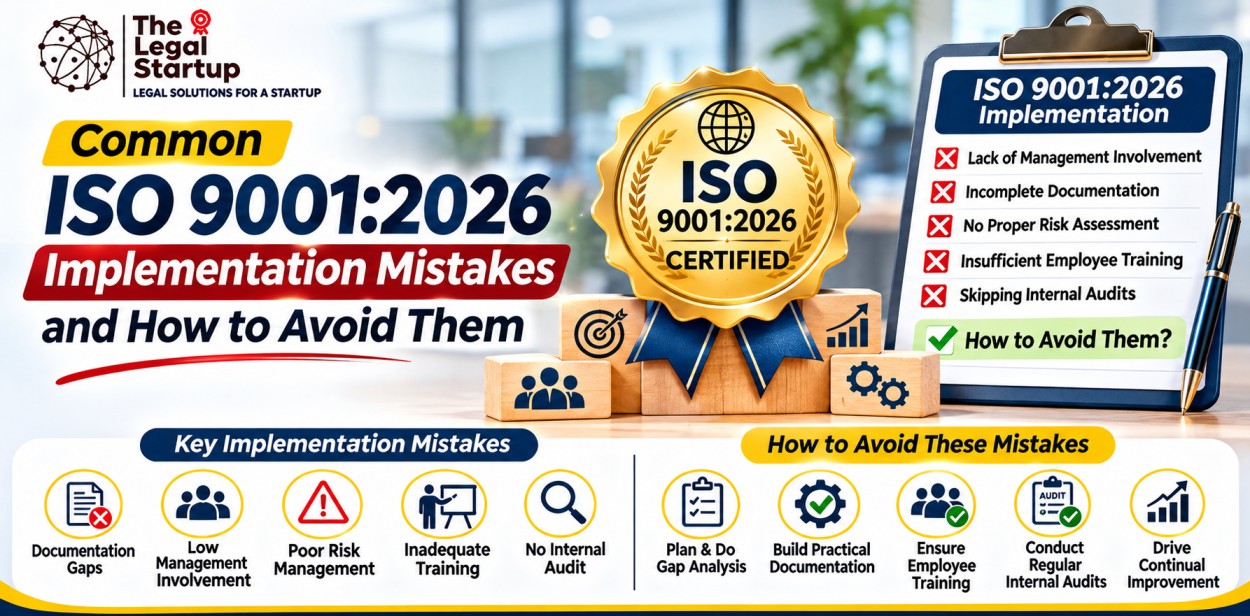
Common ISO 9001 2026 Implementation Mistakes and How to Avoid Them
14 Nov 2026
Introduction
Quality management is essential for businesses that want to maintain customer trust, improve operational efficiency and compete in today's market. Whether you operate a manufacturing company, IT firm, consultancy, food processing unit or small business, maintaining consistent quality can directly influence your growth.
The publication of ISO 9001:2026 on 16 September 2026 brings an updated framework for Quality Management Systems (QMS). The revised edition builds on the previous standard while providing greater clarity around leadership, quality culture, ethical behaviour, risks and opportunities.
However, obtaining ISO certification is not simply about preparing documents and passing an audit. Businesses must understand the requirements and apply them to their actual operations.
Many Indian companies face problems during implementation because of poor planning, outdated documentation, inadequate employee training and a lack of management involvement.
Understanding common ISO 9001:2026 implementation mistakes can help organisations avoid unnecessary delays, prepare effectively for certification and develop a quality management system that supports long-term business improvement.
1. Common ISO 9001:2026 Implementation Mistakes and How to Avoid Them
Here are some frequent implementation problems and practical ways to prevent them.
1. Treating ISO Certification as a Paperwork Exercise
One of the biggest mistakes is preparing documents only to satisfy the certification auditor. A company may have quality policies and procedures, but employees might not follow them in daily operations.
How to avoid it: Develop documentation according to actual business activities. Ensure that employees understand procedures and apply them consistently.
2. Ignoring Top Management Involvement
ISO 9001:2026 places importance on leadership, accountability and quality culture. If senior management delegates the entire implementation responsibility to one employee, the system may not work effectively.
For example, a manufacturing company may experience repeated production defects because management does not review quality reports or allocate resources for corrective action.
How to avoid it: Management should participate in quality planning, performance reviews, resource allocation and improvement activities.
3. Skipping the ISO 9001:2026 Gap Analysis
Some businesses begin implementation without reviewing their existing quality management practices. This can create unnecessary work and leave important compliance gaps unidentified.
How to avoid it: Conduct a gap analysis before implementation. Compare existing processes with the published ISO 9001:2026 requirements and identify areas that need improvement.
4. Using Outdated ISO 9001:2015 Documentation
Businesses transitioning from ISO 9001:2015 sometimes assume their existing documents are automatically sufficient.
Although the revised edition builds on the established framework, organisations must evaluate the updated requirements.
How to avoid it: Review quality policies, objectives, risk management, leadership responsibilities and documented information. Update the relevant documents without unnecessarily replacing effective existing processes.
5. Providing Insufficient Employee Training
Employees play an important role in maintaining quality. Without proper awareness, workers may ignore inspection procedures, make operational mistakes or fail to maintain records.
For example, an Indian packaging company may experience incorrect labelling because employees have not received adequate training.
How to avoid it: Conduct department-wise training, maintain attendance records and evaluate employee understanding of their quality responsibilities.
6. Weak Risk and Opportunity Management
Identifying risks only for documentation purposes is another common mistake. Businesses should connect risk assessment with real operational challenges.
How to avoid it: Evaluate supplier delays, equipment breakdowns, customer complaints, production defects and changing customer requirements. Also identify opportunities for automation and process improvement.
7. Not Conducting Regular Internal Audits
Waiting until the external certification audit to evaluate the QMS can result in unexpected nonconformities.
How to avoid it: Prepare an internal audit schedule, review departmental processes and identify problems early. Maintain audit reports and track corrective actions.
8. Failing to Implement Corrective Actions
Identifying a problem does not automatically solve it. Businesses must investigate the root cause and prevent the same issue from happening again.
How to avoid it: Record nonconformities, investigate their causes, assign responsibility and verify whether corrective measures are effective.
2. Key Benefits of Proper ISO 9001:2026 Implementation
When implemented effectively, ISO 9001:2026 can support business improvement in several ways.
-
Consistent product and service quality: Standardised processes help reduce variations and improve reliability.
-
Higher customer satisfaction: Better complaint management and quality controls improve customer confidence.
-
Reduced operational waste: Identifying defects and unnecessary activities helps improve efficiency.
-
Clear employee responsibilities: Defined roles make accountability easier across departments.
-
Better risk management: Businesses can identify operational challenges and take appropriate action.
-
Improved business credibility: ISO certification can support supplier evaluations, tender requirements and business relationships.
-
Continual improvement: Regular audits and management reviews help organisations identify opportunities for better performance.
For example, an Indian automobile component manufacturer can use a properly implemented QMS to monitor raw materials, production activities, inspection results and customer feedback. This helps establish better operational control and reduce recurring quality problems.
3. Step-by-Step ISO 9001:2026 Certification Process
Businesses should follow a systematic approach to implement the standard and prepare for certification.
Step 1: Understand Your Business Requirements
Identify your products, services, departments, customer expectations and certification scope.
Step 2: Conduct a Gap Analysis
Compare your current business processes with ISO 9001:2026 requirements and identify improvement areas.
Step 3: Prepare Required Documentation
Develop relevant quality policies, objectives, procedures, process records and supporting documents.
Step 4: Implement the Quality Management System
Apply the documented procedures across relevant departments and business activities.
Step 5: Provide Employee Training
Educate employees about quality responsibilities, process controls and documentation requirements.
Step 6: Conduct an Internal Audit
Evaluate the implemented QMS, identify nonconformities and take corrective action.
Step 7: Conduct a Management Review
Management should evaluate quality performance, customer feedback, audit findings, risks and improvement opportunities.
Step 8: Complete the Certification Audit
A competent independent certification body evaluates the organisation's QMS against the applicable ISO 9001:2026 requirements.
Step 9: Obtain Certification and Maintain the QMS
After successful assessment and certification review, the organisation receives its certificate. It must continue maintaining its QMS and undergo applicable surveillance audits.
Important for existing certificate holders: Organisations certified to ISO 9001:2015 should plan their transition to the 2026 edition. The published transition deadline is 30 September 2029. Businesses should coordinate with their certification body regarding the applicable audit arrangements.
4. Documents Required for ISO 9001:2026 Certification
The documentation required depends on the organisation's size, activities, processes and certification scope.
Commonly maintained documents and records include:
-
Business registration certificate or incorporation documents.
-
Business address proof.
-
Organisation structure and responsibilities.
-
Quality policy and measurable quality objectives.
-
Scope of the Quality Management System.
-
Process flowcharts and operational procedures, where required.
-
Risk and opportunity assessment records.
-
Supplier evaluation and monitoring records.
-
Employee training and competency records.
-
Product inspection and quality control records.
-
Customer feedback and complaint records.
-
Internal audit reports.
-
Management review records.
-
Nonconformity and corrective action records.
Note: ISO 9001:2026 does not require every organisation to maintain an identical set of documents. Documented information should be appropriate to the business and the applicable requirements.
5. Why Choose The Legal Startup for ISO 9001:2026 Assistance?
Implementing a Quality Management System requires proper planning, documentation and practical understanding of the standard. Professional guidance can help businesses organise the process and avoid common implementation problems.
The Legal Startup provides ISO certification and compliance assistance to startups, MSMEs and established organisations across India.
Our support focuses on understanding business requirements and helping organisations prepare for their certification journey.
Businesses can benefit from assistance with:
-
Understanding ISO 9001:2026 requirements.
-
Identifying documentation and implementation gaps.
-
Preparing relevant QMS documentation.
-
Understanding employee training requirements.
-
Preparing for internal and external audits.
-
Planning the transition from ISO 9001:2015.
-
Understanding certification and audit arrangements.
With industry experience, a customer-focused approach and transparent service practices, The Legal Startup aims to make ISO certification more organised and accessible.
Our objective is to help businesses establish a quality management system that reflects their actual operations rather than treating certification as a paperwork exercise.
6. How to Prepare for the ISO 9001:2015 to ISO 9001:2026 Transition
Existing certificate holders should begin preparing early rather than waiting until the final transition deadline.
A practical transition plan includes:
-
Review the published ISO 9001:2026 standard.
-
Conduct a gap analysis of the existing QMS.
-
Identify changes required in documentation and operational processes.
-
Train employees and management.
-
Conduct internal audits and address identified gaps.
-
Coordinate with the certification body regarding transition audit requirements.
Early preparation gives businesses sufficient time to understand the revised requirements and make improvements without disrupting regular operations.
7. Frequently Asked Questions About ISO 9001:2026 Implementation
Q1. What are the most common ISO 9001:2026 implementation mistakes?
Common mistakes include poor documentation, inadequate employee training, lack of management involvement, weak risk assessment, skipping internal audits and failing to implement corrective actions.
Q2. Is ISO 9001:2015 still valid after ISO 9001:2026 was published?
ISO 9001:2026 is the latest published edition. Organisations already certified to ISO 9001:2015 have until 30 September 2029 to complete the transition, subject to applicable certification arrangements.
Q3. Is a gap analysis necessary before ISO 9001:2026 certification?
Yes. A gap analysis identifies differences between existing business processes and the latest standard requirements. It helps organisations prepare a practical implementation plan.
Q4. What documents are required for ISO 9001:2026 certification?
Common documents include quality policies, objectives, process records, risk assessments, training records, internal audit reports, management review records and corrective action evidence, depending on the organisation's activities.
Q5. How long does ISO 9001:2026 certification take in India?
The timeline depends on employee strength, business complexity, existing processes, documentation readiness and certification audit arrangements. Smaller organisations with established systems may require less preparation than larger businesses.
Conclusion: Avoid Common Mistakes and Build a Strong Quality Management System
ISO 9001:2026 implementation is an opportunity for Indian businesses to improve operational efficiency, strengthen customer relationships and establish consistent quality standards.
However, successful implementation requires more than preparing documents or obtaining a certificate. Businesses must focus on management involvement, employee awareness, effective risk management, internal audits and continual improvement.
Whether you are applying for ISO certification for the first time or transitioning from ISO 9001:2015, proper planning and professional guidance can make the process more manageable.
Looking for professional ISO 9001:2026 certification assistance in India?
Connect with The Legal Startup for guidance on ISO certification, QMS documentation, implementation and transition planning.
Contact The Legal Startup
Website: https://thelegalstartup.com/
Email: info@thelegalstartup.com
Get the right guidance to prepare your business for ISO 9001:2026 certification and build a quality management system that supports long-term growth.