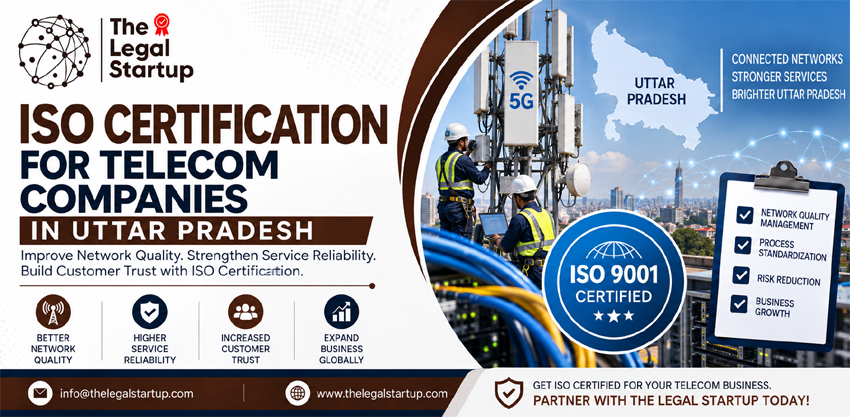
ISO Certification for Telecom Companies in Uttar Pradesh
ISO Certification for Telecom Companies in Uttar Pradesh helps telecommunications organizations establish structured management systems for service quality, information security, IT operations, customer service, infrastructure management, and business continuity. Telecom companies operate in a highly technology-driven environment where network availability, data protection, service reliability, and customer satisfaction are important aspects of business operations.
Telecom businesses in Uttar Pradesh may be involved in mobile and internet services, broadband connectivity, fiber-optic networks, telecom infrastructure, network maintenance, communication technology, data services, enterprise connectivity, and related support services. Implementing suitable ISO standards can help these organizations standardize processes, identify risks, improve operational controls, and demonstrate their commitment to recognized management practices.
Depending on the company's services, technology infrastructure, workforce, customer requirements, and operational risks, one or more ISO management system standards may be relevant.
What Is ISO Certification for Telecom Companies?
ISO certification demonstrates that an organization's management system has been independently assessed against the requirements of a particular ISO standard. The appropriate standard depends on the nature of the telecom company's operations and the management objectives it wants to achieve.
For telecom organizations, ISO management systems may address areas such as:
- Telecom service quality
- Network and infrastructure management
- Information security
- Customer data protection
- IT service management
- Business continuity and operational resilience
- Employee health and safety
- Supplier and contractor management
- Customer complaint management
- Process monitoring and continual improvement
Why ISO Certification Is Important for Telecom Companies in Uttar Pradesh
Telecom companies manage complex technology infrastructure and provide services where interruptions, security incidents, process failures, or poor customer support can affect business operations and customer experience.
An ISO-based management system provides a structured approach to defining responsibilities, documenting processes, identifying risks, monitoring performance, managing incidents, and implementing corrective actions.
ISO certification can also help telecom companies demonstrate to customers, enterprise clients, suppliers, contractors, and other business partners that their management processes are based on a recognized framework.
ISO 9001 Certification for Telecom Companies
ISO 9001 is a Quality Management System (QMS) standard that can help telecom companies establish consistent processes for service delivery, customer support, complaint handling, supplier management, performance monitoring, and continual improvement.
Quality management can be relevant across different telecom activities, including network installation, service activation, maintenance, technical support, billing support, customer service, and infrastructure-related operations.
ISO 9001 can help telecom organizations establish processes for:
- Customer requirement management
- Service quality monitoring
- Complaint and feedback handling
- Supplier evaluation
- Network service processes
- Corrective and preventive actions
- Internal audits
- Continual improvement
Telecom companies interested in quality management certification can explore:
→ ISO 9001 Certification in Uttar Pradesh
ISO 27001 Certification for Telecom Companies
ISO 27001 is particularly relevant to telecom companies because telecommunications businesses process and manage significant amounts of digital information. Customer information, network information, authentication data, business records, technical information, and other sensitive data may require appropriate security controls.
ISO 27001 provides a framework for establishing an Information Security Management System (ISMS). It follows a risk-based approach to identifying information security risks and implementing suitable controls.
For telecom companies, ISO 27001 may support information security management in areas such as:
- Customer information
- Network and infrastructure information
- Employee and contractor data
- Enterprise customer records
- Billing and transaction information
- Cloud and IT infrastructure
- Access control systems
- Digital communication platforms
- Information security incident management
Telecom organizations looking to strengthen their information security management can explore:
→ ISO 27001 Certification in Uttar Pradesh
ISO 13485 Certification for Telecom Companies
ISO 13485 is specifically designed for quality management systems related to medical devices and associated organizations. It is therefore not a general ISO certification requirement for telecommunications companies.
However, a telecom organization that is directly involved in a medical-device-related supply chain or provides services connected with applicable medical-device operations may need to evaluate whether ISO 13485 is relevant to its defined scope.
The applicability of ISO 13485 should be determined according to the company's actual products, services, responsibilities, and applicable regulatory requirements.
For organizations involved in relevant medical-device activities, more information can be found here:
→ ISO 13485 Certification in Uttar Pradesh
OHSAS 18001 and Occupational Health & Safety in Telecom
Telecom operations can involve field technicians, tower and infrastructure maintenance, electrical work, equipment installation, cable work, elevated work, vehicle movement, and other occupational activities. Appropriate health and safety management is therefore an important part of many telecom operations.
OHSAS 18001 was previously used as an occupational health and safety management standard. It has been superseded by ISO 45001, which is the current international standard for occupational health and safety management systems.
Organizations researching the former OHSAS 18001 standard can refer to:
→ OHSAS 18001 Certification in Uttar Pradesh
Telecom companies seeking a current occupational health and safety management system should evaluate ISO 45001 based on their workplace activities and risks.
ISO 20000 Certification for Telecom Companies
Telecommunications companies depend heavily on IT systems, network monitoring platforms, customer management systems, service platforms, cloud infrastructure, and technical support systems. Maintaining reliable IT services can therefore be an important part of telecom operations.
ISO/IEC 20000-1 focuses on IT Service Management (ITSM). It provides a framework for managing IT service delivery, service performance, incidents, service continuity, and continual improvement.
ISO 20000 may be relevant to telecom organizations that:
- Operate large-scale IT infrastructure
- Provide technology-based services
- Manage enterprise IT services
- Operate cloud-based service platforms
- Provide managed IT or communication services
- Require structured IT service management processes
For telecom businesses interested in IT service management certification, explore:
→ ISO 20000 Certification in Uttar Pradesh
Benefits of ISO Certification for Telecom Companies
Implementing suitable ISO management systems can provide several operational and business benefits to telecom organizations in Uttar Pradesh.
- Improved service quality: Standardized processes can help organizations deliver services more consistently.
- Better customer satisfaction: Structured customer service and complaint-handling processes can improve responsiveness.
- Improved information security: ISO 27001 provides a systematic framework for managing information security risks.
- Better risk management: Organizations can identify and address operational and technology-related risks.
- Improved IT service management: ISO 20000-1 can help structure IT service processes.
- Better supplier management: Telecom companies can establish structured processes for evaluating vendors and contractors.
- Improved documentation: Defined processes and records can make operations easier to monitor and control.
- Enhanced employee safety: Appropriate occupational safety management can help address workplace risks.
- Support for continual improvement: Audits, performance monitoring, corrective actions, and management reviews support ongoing improvement.
- Greater customer confidence: Certification can demonstrate the organization's commitment to recognized management practices.
ISO Certification Process for Telecom Companies in Uttar Pradesh
The ISO certification process generally follows a series of structured steps. The exact requirements depend on the selected standard, certification scope, organization size, and certification body.
1. Identify the Applicable ISO Standard
The telecom company first identifies the standard or standards relevant to its business objectives. ISO 9001, ISO 27001, ISO 45001, ISO 20000-1, and other applicable standards may be considered based on the organization's activities.
2. Define the Certification Scope
The organization defines the services, departments, locations, technology systems, and business activities that will be covered by the management system.
3. Conduct a Gap Assessment
A gap assessment identifies differences between the organization's existing processes and the requirements of the selected ISO standard.
4. Develop Policies and Procedures
The company establishes suitable policies, procedures, responsibilities, controls, documentation, and performance indicators according to its operational requirements.
5. Implement the Management System
The documented processes are implemented across relevant telecom operations. Employees and responsible teams are made aware of their roles within the management system.
6. Employee Training and Awareness
Employees, technicians, IT teams, network engineers, customer support staff, managers, and other relevant personnel may receive appropriate awareness or role-specific training.
7. Conduct Internal Audit
An internal audit is performed to assess whether the management system has been implemented effectively and whether applicable requirements are being followed.
8. Corrective Action
If nonconformities or process gaps are identified, the organization investigates their causes and implements appropriate corrective actions.
9. Certification Audit
An independent certification body conducts the certification audit to evaluate the organization's management system against the requirements of the applicable standard.
10. Certification and Continual Improvement
After successful completion of the certification process, the organization receives certification. The management system should continue to be monitored, audited, reviewed, and improved.
Types of Telecom Companies That Can Consider ISO Certification
Different types of telecommunications and communication technology organizations can evaluate ISO certification according to their business activities.
- Telecom service providers
- Internet service providers
- Broadband service providers
- Fiber-optic network companies
- Telecom infrastructure companies
- Network installation and maintenance companies
- Managed communication service providers
- Enterprise connectivity providers
- Data communication service providers
- Telecom equipment service companies
- Network monitoring and technical support companies
- Communication technology solution providers
ISO Certification for Telecom Infrastructure Companies
Telecom infrastructure organizations may manage network equipment, towers, fiber-optic systems, cables, power systems, technical sites, and field maintenance operations. Such businesses can benefit from structured processes for project management, service quality, contractor management, equipment maintenance, documentation, and workplace safety.
Depending on the company's operations, ISO 9001 can support quality management, ISO 45001 can address occupational health and safety, and ISO 27001 can support information security management where sensitive information and digital systems are involved.
ISO Certification for Telecom Companies Handling Customer Data
Telecom companies often process customer and business information through digital systems. Customer records, service information, account details, billing information, technical information, and enterprise customer data may require appropriate security controls.
ISO 27001 can provide a structured framework for identifying information security risks, implementing controls, defining responsibilities, monitoring security processes, and continually improving information security management.
ISO Certification for IT and Network Operations
Telecom network operations depend on reliable technology and support systems. Service monitoring, incident handling, infrastructure maintenance, system availability, and technical support can all contribute to service performance.
ISO 20000-1 may be relevant where an organization requires a formal IT Service Management framework. The standard can help organizations establish structured approaches to service management, incident handling, service continuity, performance monitoring, and continual improvement.
ISO Certification for Small and Medium-Sized Telecom Companies
ISO certification is not limited to large telecom operators. Small and medium-sized telecom service providers, network installation companies, internet service providers, technical support companies, and infrastructure contractors can also implement management systems.
A properly scoped management system can help smaller organizations define responsibilities, standardize operational processes, improve customer service, manage risks, maintain documentation, and prepare for business growth.
ISO Certification for Telecom Companies in Major Cities of Uttar Pradesh
Telecom and communication technology businesses operating across Uttar Pradesh can consider ISO certification according to their services and operational requirements.
Companies in locations such as Noida, Greater Noida, Ghaziabad, Lucknow, Kanpur, Agra, Meerut, Varanasi, Bareilly, Moradabad, Prayagraj, Gorakhpur, and Aligarh can evaluate suitable ISO management systems based on their quality, information security, IT service management, and workplace safety requirements.
How to Choose the Right ISO Certification for a Telecom Company
The right ISO certification should be selected based on the organization's actual activities, risks, customers, and business objectives. Important factors include:
- Nature of telecom services
- Network and infrastructure complexity
- Customer and contractual requirements
- Information security risks
- Dependence on IT systems
- Field and workplace safety requirements
- Supplier and contractor relationships
- Regulatory and industry requirements
- Business continuity needs
- Future expansion plans
For example, a telecom company focused on service quality may consider ISO 9001. A company managing substantial customer and network information may also consider ISO 27001. Organizations with significant IT service management requirements may consider ISO 20000-1, while companies with field-based occupational risks should evaluate ISO 45001.
Conclusion
ISO Certification for Telecom Companies in Uttar Pradesh can help telecommunications organizations establish structured systems for quality management, information security, IT service management, workplace safety, customer service, and continual improvement.
The appropriate ISO standard should be selected according to the organization's actual services, technology infrastructure, operational risks, customer requirements, and business objectives. With clearly defined processes, regular monitoring, internal audits, corrective actions, and continual improvement, telecom companies can create a more controlled and reliable management system.
Frequently Asked Questions About ISO Certification for Telecom Companies
Is ISO certification mandatory for telecom companies in Uttar Pradesh?
ISO certification is not universally mandatory for every telecom company. However, specific customers, contracts, tenders, business partners, or industry requirements may require particular certifications. Organizations should evaluate the requirements applicable to their specific services and contracts.
Which ISO certification is best suited for a telecom company?
There is no single ISO standard applicable to every telecom company. ISO 9001 may be relevant for quality management, while ISO 27001, ISO 45001, and ISO 20000-1 may address information security, occupational health and safety, and IT service management requirements respectively.
Why is ISO 27001 important for telecom companies?
ISO 27001 can be relevant because telecom companies may manage customer information, network information, billing data, enterprise records, IT infrastructure, and other sensitive digital information.
Can a telecom company obtain multiple ISO certifications?
Yes. A telecom organization can implement multiple management systems where different standards address different operational requirements. These systems may also be integrated where appropriate.
Is OHSAS 18001 still the current safety standard?
No. OHSAS 18001 has been superseded by ISO 45001. Telecom companies seeking a current occupational health and safety management system should evaluate ISO 45001 based on their activities and workplace risks.
Can small telecom companies obtain ISO certification?
Yes. Small and medium-sized telecom companies can implement ISO management systems. The scope and complexity of the system should be appropriate to the company's size, services, risks, and customer requirements.
How can ISO certification help telecom customer service?
An ISO-based management system can establish defined processes for customer requirements, complaints, service monitoring, corrective actions, and continual improvement, helping organizations manage customer service activities more consistently.
Latest Posts
- → ISO 9001 Certification in Uttar Pradesh
- → ISO 27001 Certification in Uttar Pradesh
- → ISO 13485 Certification in Uttar Pradesh
- → OHSAS 18001 Certification in Uttar Pradesh
- → ISO 20000 Certification in Uttar Pradesh
- → ISO 22000 Certification in Uttar Pradesh
- → SA 8000 Certification in Uttar Pradesh
- → ISO 50001 Certification in Uttar Pradesh
- → CE Marking Certification in Uttar Pradesh
- → HACCP Certification in Uttar Pradesh
- → GMP Certification in Uttar Pradesh
- → ISO Certification in Noida
- → ISO Certification in Lucknow
- → ISO Certification in Ghaziabad
- → ISO Certification in Kanpur
- → ISO Certification in Agra
- → ISO Certification in Uttar Pradesh