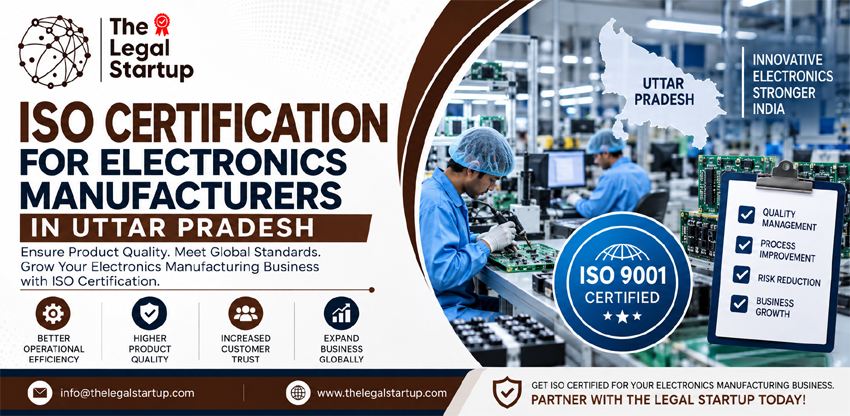
ISO Certification for Electronics Manufacturers in Uttar Pradesh
The electronics manufacturing industry requires consistent product quality, controlled production processes, reliable suppliers, accurate testing, information security, and continual improvement. Electronics manufacturers in Uttar Pradesh serve industries such as consumer electronics, industrial electronics, telecommunications, automotive electronics, electrical equipment, medical electronics, and other technology-driven sectors.
ISO Certification for Electronics Manufacturers in Uttar Pradesh provides a structured framework for managing quality, production processes, information security, workplace safety, IT services, and continual improvement. Depending on the organization's activities and requirements, standards such as ISO 9001, ISO 27001, ISO 45001, ISO 13485, and ISO 20000-1 may be relevant.
Electronics manufacturers operating in Noida, Greater Noida, Ghaziabad, Lucknow, Kanpur, Agra, Meerut, Aligarh, Moradabad, and other industrial areas of Uttar Pradesh can evaluate suitable ISO certification according to their products, processes, customer requirements, and business objectives.
What Is ISO Certification for Electronics Manufacturers?
ISO certification is an independent assessment of an organization's management system against the requirements of a specific ISO standard. The applicable standard depends on the organization's business activities, products, risks, customers, and intended certification scope.
For electronics manufacturers, ISO management systems can address areas such as quality management, information security, occupational health and safety, IT service management, and specialized product-related quality requirements.
Commonly considered standards include:
- ISO 9001 – Quality Management System
- ISO 27001 – Information Security Management System
- ISO 45001 – Occupational Health and Safety Management System
- ISO 13485 – Quality Management System for Medical Devices
- ISO 20000-1 – IT Service Management System
An electronics manufacturer does not necessarily require all of these standards. The appropriate certification should be selected according to its actual operations and business requirements.
Why ISO Certification Is Important for Electronics Manufacturers
Electronics manufacturing involves detailed production and quality-control processes. Small variations in components, assembly, soldering, testing, calibration, or handling can affect product performance and reliability.
Manufacturers also depend on suppliers for electronic components, raw materials, PCBs, connectors, semiconductors, cables, packaging materials, and specialized services.
An ISO management system can help organizations establish documented processes, defined responsibilities, process controls, performance monitoring, risk assessment, internal audits, corrective actions, and continual improvement.
Improved Product Quality
Quality management systems help electronics manufacturers establish consistent production and inspection processes while monitoring customer and product requirements.
Better Production Control
Documented work instructions, process monitoring, inspection procedures, testing, equipment controls, and corrective actions can support consistent manufacturing operations.
Improved Supplier Management
Electronics manufacturers often depend on multiple suppliers for critical components. Structured supplier evaluation and monitoring can help manage quality and supply-related risks.
Reduced Product Defects
Systematic inspection, testing, nonconformity management, root-cause analysis, and corrective action can help organizations address recurring quality issues.
Better Customer Satisfaction
Consistent manufacturing processes and structured complaint-handling procedures can help organizations respond effectively to customer requirements and feedback.
Improved Information Security
Modern electronics manufacturers use ERP systems, CAD software, product designs, engineering data, cloud platforms, supplier portals, and digital production records. ISO 27001 can provide a structured framework for managing associated information-security risks.
ISO 9001 Certification for Electronics Manufacturers
ISO 9001 is a widely recognized Quality Management System standard. It provides a framework for managing customer requirements, manufacturing processes, risks, performance, and continual improvement.
Electronics manufacturers can apply ISO 9001 principles to areas such as:
- Production planning
- Incoming component inspection
- PCB assembly
- Component testing
- Product inspection
- Testing and measurement
- Equipment maintenance
- Supplier evaluation
- Nonconformity management
- Customer complaints
- Corrective actions
- Process improvement
→ ISO 9001 Certification in Uttar Pradesh
ISO 27001 Certification for Electronics Manufacturers
ISO 27001 focuses on Information Security Management Systems. It can be relevant to electronics manufacturers that handle confidential engineering information, product designs, customer data, supplier information, intellectual property, production data, and digital business records.
An ISO 27001-based information-security management system can help organizations systematically address risks involving:
- Engineering and product-design data
- Customer information
- Supplier information
- Production data
- ERP systems
- Cloud services
- Access control
- Information assets
- Security incidents
- Third-party service providers
→ ISO 27001 Certification in Uttar Pradesh
ISO 13485 Certification for Medical Electronics Manufacturers
ISO 13485 is specifically associated with quality management systems for medical devices and related organizations. It is not a general standard for all electronics manufacturers.
However, electronics companies manufacturing applicable medical devices, medical electronic equipment, or relevant components may consider ISO 13485 where the standard is appropriate to their products and certification scope.
Medical electronics manufacturers should also evaluate applicable regulatory and product-specific requirements in addition to the ISO management system.
→ ISO 13485 Certification in Uttar Pradesh
OHSAS 18001 Certification for Electronics Manufacturers
OHSAS 18001 was an occupational health and safety management standard. It has been superseded by ISO 45001.
Electronics manufacturers looking for a current occupational health and safety management system should generally consider ISO 45001 rather than pursuing a new OHSAS 18001 certification.
ISO 45001 can provide a framework for identifying workplace hazards, assessing occupational risks, establishing controls, improving worker awareness, managing incidents, and continually improving occupational health and safety performance.
→ OHSAS 18001 Certification in Uttar Pradesh
ISO 20000 Certification for Electronics Manufacturers
ISO/IEC 20000-1 focuses on IT Service Management. It may be relevant to electronics manufacturers with significant internal IT operations, digital manufacturing systems, technology service departments, or IT service environments.
ISO 20000-1 can support structured processes for:
- IT service delivery
- Incident management
- Problem management
- Change management
- Service availability
- Service continuity
- Performance monitoring
- IT service improvement
→ ISO 20000 Certification in Uttar Pradesh
Benefits of ISO Certification for Electronics Manufacturers
1. Improved Quality Management
ISO 9001 can help manufacturers establish structured processes for managing product and process quality.
2. Better Production Consistency
Documented processes, work instructions, inspection procedures, and process monitoring can help improve manufacturing consistency.
3. Reduced Defects and Nonconformities
Systematic inspection, testing, root-cause analysis, corrective actions, and performance monitoring can help organizations address quality problems.
4. Stronger Supplier Management
Structured supplier evaluation and monitoring can help manufacturers manage risks associated with externally supplied components and services.
5. Improved Customer Satisfaction
Consistent processes and structured complaint-handling mechanisms can support reliable customer service.
6. Better Information Security
ISO 27001 can help organizations establish a systematic approach to protecting sensitive engineering, production, customer, and business information.
7. Improved Workplace Safety
ISO 45001 can provide a framework for identifying and controlling occupational health and safety risks within electronics manufacturing facilities.
8. Continual Improvement
Internal audits, management reviews, corrective actions, performance monitoring, and risk assessments support continual improvement.
ISO Certification Process for Electronics Manufacturers in Uttar Pradesh
Step 1: Select the Appropriate ISO Standard
The organization identifies the standard that best matches its products, processes, risks, customer requirements, and business objectives.
Step 2: Define the Certification Scope
The company determines which products, manufacturing facilities, processes, departments, and locations will be covered by the management system.
Step 3: Conduct a Gap Assessment
Existing processes are reviewed against the requirements of the selected ISO standard to identify gaps and improvement opportunities.
Step 4: Develop the Management System
Required policies, procedures, work processes, risk assessments, controls, records, and responsibilities are established or improved.
Step 5: Implement the System
The management system is implemented across relevant areas such as production, quality control, procurement, testing, maintenance, warehousing, IT, and administration.
Step 6: Employee Training and Awareness
Employees are trained on relevant procedures, quality requirements, information-security responsibilities, workplace safety controls, and other applicable management-system requirements.
Step 7: Internal Audit
An internal audit is conducted to evaluate whether the management system is implemented effectively and meets the applicable requirements.
Step 8: Management Review
Top management reviews performance, audit findings, customer feedback, risks, opportunities, corrective actions, and improvement requirements.
Step 9: Certification Audit
An independent certification body conducts an audit against the requirements of the selected ISO standard.
Step 10: Corrective Action and Certification
If nonconformities are identified, the organization addresses them through appropriate corrective actions. After successful completion of the certification process, the certification body can issue the applicable ISO certificate.
ISO Certification for Different Electronics Manufacturing Industries
ISO management systems may be relevant to various electronics manufacturing segments depending on their products and processes.
- Consumer electronics manufacturing
- Industrial electronics manufacturing
- Automotive electronics manufacturing
- Telecommunication equipment manufacturing
- Electronic component manufacturing
- PCB manufacturing and assembly
- Electrical and electronic equipment manufacturing
- Medical electronics manufacturing
- Control-panel manufacturing
- Electronic instrumentation manufacturing
- Power electronics manufacturing
- Electronic accessories manufacturing
ISO Certification for PCB and Electronic Component Manufacturers
PCB manufacturers and electronic component suppliers need consistent control over materials, production processes, inspection, testing, storage, packaging, and delivery.
Quality management processes can include incoming material inspection, production monitoring, testing and measurement, equipment maintenance, traceability, nonconformity management, supplier evaluation, and final product inspection.
ISO 9001 can provide a structured framework for managing these processes. Where sensitive engineering information or digital production systems are involved, ISO 27001 may also be considered according to the organization's information-security requirements.
ISO Certification for Small and Medium Electronics Manufacturers
ISO certification is not limited to large electronics manufacturers. Small and medium-sized businesses can also implement management systems according to their size, processes, risks, customer requirements, and business objectives.
A clearly defined certification scope can focus on the organization's actual manufacturing activities and relevant processes without unnecessarily including unrelated business operations.
ISO Certification for Electronics Exporters
Electronics manufacturers supplying products to international customers may encounter customer-specific quality requirements, contractual conditions, product specifications, documentation requirements, and other market-specific obligations.
An ISO management system can provide a structured approach to managing relevant business processes and demonstrating systematic quality or information-security practices. However, ISO certification alone does not guarantee acceptance in every market or by every customer.
ISO Certification in Major Industrial Locations of Uttar Pradesh
Electronics manufacturers operating across Uttar Pradesh can evaluate ISO certification according to their business activities and manufacturing requirements.
- Noida
- Greater Noida
- Ghaziabad
- Lucknow
- Kanpur
- Agra
- Meerut
- Aligarh
- Moradabad
- Varanasi
- Prayagraj
- Bareilly
- Gorakhpur
Organizations operating multiple facilities should establish an appropriate certification scope and discuss audit arrangements with the certification body.
How to Choose the Right ISO Certification?
The appropriate ISO certification depends on the organization's products, processes, risks, customer requirements, and business objectives.
For quality management: ISO 9001 can provide a framework for managing and improving electronics manufacturing processes.
For information security: ISO 27001 can help manage risks associated with engineering data, product designs, customer information, IT infrastructure, and digital business records.
For occupational health and safety: ISO 45001 can provide a framework for managing workplace health and safety risks.
For medical electronics: ISO 13485 may be relevant where the organization manufactures applicable medical devices or related products.
For IT service management: ISO 20000-1 can be considered where significant IT service-management activities are included within the organization's scope.
Conclusion
ISO Certification for Electronics Manufacturers in Uttar Pradesh can help organizations establish structured systems for quality management, production control, supplier management, information security, workplace safety, IT services, and continual improvement.
Electronics manufacturers should select ISO standards according to their actual products, manufacturing processes, customer requirements, operational risks, and intended certification scope.
A properly implemented ISO management system can help create consistent processes, clearer responsibilities, improved monitoring, better risk management, and a systematic approach to continual improvement. ISO certification should complement applicable legal, regulatory, contractual, customer, and industry-specific requirements.
Frequently Asked Questions
Is ISO certification mandatory for electronics manufacturers?
ISO certification is not automatically mandatory for every electronics manufacturer. Applicability can depend on customer requirements, contracts, applicable regulations, industry requirements, and business objectives.
Which ISO certification is commonly used by electronics manufacturers?
ISO 9001 is widely used for quality management. ISO 27001, ISO 45001, ISO 20000-1, and ISO 13485 may also be relevant depending on the organization's specific activities.
Why is ISO 9001 important for electronics manufacturers?
ISO 9001 provides a framework for managing quality, production processes, customer requirements, supplier controls, performance monitoring, corrective actions, and continual improvement.
Can PCB manufacturers obtain ISO certification?
Yes. PCB manufacturers and assembly organizations can implement applicable ISO management systems according to their products, processes, customer requirements, and certification scope.
Is ISO 27001 useful for electronics companies?
Yes. Electronics manufacturers may handle sensitive engineering designs, intellectual property, production data, customer information, and digital records. ISO 27001 can provide a structured framework for managing related information-security risks.
Is OHSAS 18001 still available for new certification?
OHSAS 18001 has been superseded by ISO 45001. Organizations seeking a current occupational health and safety management standard should consider ISO 45001.
Can an electronics manufacturer obtain multiple ISO certifications?
Yes. An organization can implement multiple management systems where they are relevant to its operations. For example, an electronics manufacturer may implement ISO 9001 for quality, ISO 27001 for information security, and ISO 45001 for occupational health and safety.
How long does ISO certification take for an electronics manufacturer?
The timeframe depends on the organization's size, number of locations, manufacturing complexity, certification scope, existing processes, documentation, and implementation readiness.
Latest Posts
- → ISO 9001 Certification in Uttar Pradesh
- → ISO 27001 Certification in Uttar Pradesh
- → ISO 13485 Certification in Uttar Pradesh
- → OHSAS 18001 Certification in Uttar Pradesh
- → ISO 20000 Certification in Uttar Pradesh
- → ISO 22000 Certification in Uttar Pradesh
- → SA 8000 Certification in Uttar Pradesh
- → ISO 50001 Certification in Uttar Pradesh
- → CE Marking Certification in Uttar Pradesh
- → HACCP Certification in Uttar Pradesh
- → GMP Certification in Uttar Pradesh
- → ISO Certification in Noida
- → ISO Certification in Lucknow
- → ISO Certification in Ghaziabad
- → ISO Certification in Kanpur
- → ISO Certification in Agra
- → ISO Certification in Uttar Pradesh