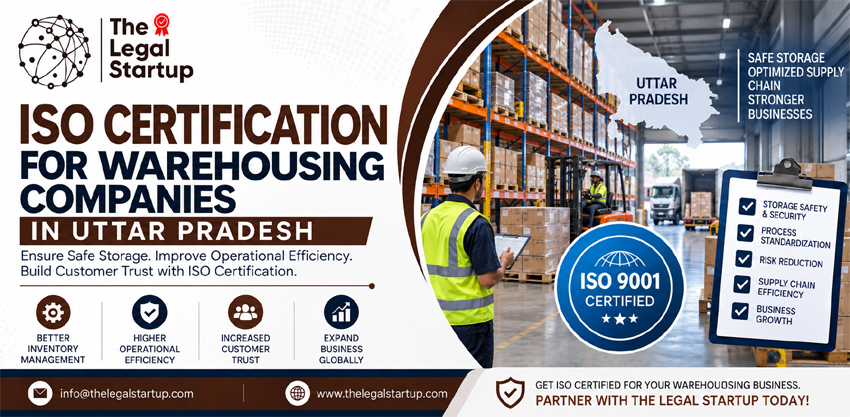
ISO Certification for Warehousing Companies in Uttar Pradesh
ISO Certification for Warehousing Companies in Uttar Pradesh helps warehouse operators establish structured processes for inventory control, storage, material handling, documentation, employee safety, customer service, and information security. As warehousing operations become increasingly connected with logistics, e-commerce, manufacturing, retail, and supply chain networks, maintaining consistent and controlled processes has become essential for business growth.
Warehouses in Uttar Pradesh handle a wide range of activities, including receiving goods, inspection, storage, picking, packing, inventory tracking, dispatch, transportation coordination, and returns management. A systematic management approach can help organizations reduce operational errors, improve process consistency, protect business information, and provide reliable services to customers.
Depending on the nature of operations, customer requirements, and business objectives, warehousing companies can implement different ISO management system standards to strengthen their overall operational framework.
What Is ISO Certification for Warehousing Companies?
ISO certification confirms that an organization's management system has been assessed against the requirements of a specific ISO standard by an independent certification body. For warehousing companies, the appropriate standard depends on the organization's services, operational risks, technology usage, workforce requirements, and customer expectations.
An ISO-based management system can help warehouse operators establish documented and repeatable processes for:
- Goods receiving and inspection
- Inventory management
- Material storage and handling
- Picking and packing
- Order processing
- Dispatch and delivery coordination
- Supplier and vendor management
- Customer complaint handling
- Information and data protection
- Employee health and safety
- IT service management
- Continuous improvement
Why ISO Certification Is Important for Warehousing Companies in Uttar Pradesh
Warehouse operations involve the movement and storage of large quantities of products and materials. Errors in inventory records, improper storage, damaged goods, delayed dispatches, or ineffective communication can affect both customer satisfaction and business performance.
ISO management systems provide a structured approach to defining responsibilities, controlling processes, identifying risks, monitoring performance, maintaining records, and implementing corrective actions.
For warehousing companies, certification can also demonstrate to customers, suppliers, manufacturers, retailers, and other business partners that the organization follows a formally established management system.
ISO 9001 Certification for Warehousing Companies
ISO 9001 provides a framework for implementing a Quality Management System (QMS). It is particularly relevant to warehousing businesses because warehouse service quality depends on consistent processes, accurate documentation, timely order fulfillment, effective communication, and proper handling of customer requirements.
With an ISO 9001-based system, a warehouse can establish processes for receiving materials, checking goods, managing inventory, handling customer orders, controlling documentation, monitoring service performance, managing complaints, and addressing nonconformities.
ISO 9001 can be useful for:
- Third-party warehouses
- Distribution centers
- E-commerce fulfillment warehouses
- Cold-chain warehouses
- Manufacturing warehouses
- Retail warehouses
- Storage and fulfillment service providers
For businesses interested in quality management certification, explore:
→ ISO 9001 Certification in Uttar Pradesh
ISO 27001 Certification for Warehousing Companies
Modern warehouses increasingly depend on digital technologies. Warehouse Management Systems (WMS), barcode scanners, RFID systems, cloud platforms, ERP software, inventory databases, CCTV systems, access-control systems, and customer portals may all process important business information.
ISO 27001 provides a framework for establishing an Information Security Management System (ISMS). It helps organizations identify information security risks and implement appropriate controls to protect information and technology resources.
ISO 27001 may be particularly relevant to warehouses that manage:
- Customer and supplier information
- Inventory databases
- Shipment and order information
- Electronic warehouse records
- Financial and billing information
- Employee information
- Cloud-based warehouse systems
- Integrated ERP and WMS platforms
Organizations looking to strengthen their information security management can explore:
→ ISO 27001 Certification in Uttar Pradesh
ISO 13485 Certification for Warehousing Companies
ISO 13485 is a quality management standard specifically designed for organizations involved in medical devices and related activities. It is therefore not a general-purpose certification for every warehousing company.
However, specialized warehouses involved in the storage, handling, distribution, or supply chain activities associated with medical devices may need to consider applicable quality and regulatory requirements. The suitability of ISO 13485 depends on the organization's role within the medical-device supply chain and the requirements applicable to its operations.
For organizations involved in relevant medical-device-related activities, more information can be found here:
→ ISO 13485 Certification in Uttar Pradesh
OHSAS 18001 and Occupational Safety in Warehousing
Warehouse environments can involve various occupational risks, including forklift movement, loading and unloading activities, material handling, heavy equipment, storage racks, lifting operations, slips and falls, and vehicle movement.
OHSAS 18001 was previously used as an occupational health and safety management standard. It has since been superseded by ISO 45001, which is the current standard for occupational health and safety management systems.
Warehousing companies researching the former OHSAS 18001 framework can refer to:
→ OHSAS 18001 Certification in Uttar Pradesh
For current occupational health and safety certification requirements, organizations should evaluate ISO 45001 based on their workplace risks and business activities.
ISO 20000 Certification for Warehousing Companies
Technology plays an important role in modern warehouse operations. Warehouse Management Systems, inventory platforms, cloud applications, barcode technologies, automated systems, and integrated business software support many day-to-day activities.
ISO/IEC 20000-1 focuses on IT Service Management (ITSM). It can be relevant to warehousing organizations where IT services are critical to business operations or where the company provides technology-driven warehouse and supply chain services.
ISO 20000 can help organizations establish structured processes for IT service delivery, incident management, service monitoring, service continuity, and continual improvement.
For more information about IT service management certification, explore:
→ ISO 20000 Certification in Uttar Pradesh
Benefits of ISO Certification for Warehousing Companies
Implementing an appropriate ISO management system can provide several operational and business benefits for warehousing organizations.
- Improved inventory control: Defined processes can help improve consistency in receiving, storage, picking, and dispatch operations.
- Better service quality: Standardized processes can support consistent service delivery.
- Reduced operational errors: Process monitoring can help identify and address recurring mistakes.
- Improved customer satisfaction: Better control over warehouse activities can contribute to more reliable service.
- Better documentation: Defined records help organizations monitor and trace important warehouse activities.
- Improved risk management: Organizations can identify operational, safety, and information security risks.
- Enhanced information security: ISO 27001 provides a structured framework for managing information security risks.
- Improved workplace safety: A formal safety management approach can help organizations control workplace hazards.
- Better supplier management: Structured evaluation processes can help monitor suppliers and service providers.
- Continuous improvement: Internal audits, performance monitoring, corrective actions, and reviews support ongoing improvement.
ISO Certification Process for Warehousing Companies in Uttar Pradesh
The ISO certification process generally follows a structured sequence. The exact requirements can vary depending on the selected standard, scope, organization size, and certification body.
1. Select the Applicable ISO Standard
The organization first identifies the management system standard relevant to its operations. ISO 9001, ISO 27001, ISO 45001, ISO 20000-1, and other standards may be considered depending on business requirements.
2. Define the Certification Scope
The company determines which warehouse locations, services, departments, and processes will be included within the management system.
3. Conduct a Gap Assessment
A gap assessment evaluates the organization's existing practices against the requirements of the selected ISO standard and identifies areas requiring improvement.
4. Develop Policies and Procedures
The company establishes appropriate policies, procedures, work instructions, responsibilities, records, and controls based on its operational requirements.
5. Implement the Management System
The documented procedures are implemented across relevant warehouse activities. Employees are informed about their roles and responsibilities.
6. Employee Training and Awareness
Warehouse staff, supervisors, managers, IT personnel, quality teams, and other relevant employees may receive awareness or role-specific training.
7. Conduct Internal Audit
An internal audit evaluates whether the management system has been implemented effectively and whether processes comply with the selected ISO standard.
8. Correct Nonconformities
If gaps or nonconformities are identified, the organization determines their causes and implements suitable corrective actions.
9. Certification Audit
An independent certification body conducts the applicable certification audit to assess the organization's management system.
10. Certification and Continual Improvement
After successful completion of the certification process, the organization receives certification. The management system must continue to be monitored, reviewed, audited, and improved.
Types of Warehousing Companies That Can Consider ISO Certification
Different types of warehouse operators can consider ISO certification depending on their operational requirements.
- Third-party logistics warehouses
- E-commerce fulfillment centers
- Distribution warehouses
- Cold storage facilities
- Food and beverage warehouses
- Pharmaceutical storage facilities
- Automobile parts warehouses
- Electronics warehouses
- Retail warehouses
- Manufacturing warehouses
- Import and export storage facilities
- Inventory and fulfillment service providers
ISO Certification for Cold Storage and Specialized Warehouses
Specialized warehouses may have additional process requirements depending on the type of products stored. Cold-chain operations, pharmaceutical storage, food-related warehousing, medical-device storage, and chemical storage can involve specific operational, quality, safety, or regulatory considerations.
Organizations should identify the standards applicable to their products and services rather than selecting an ISO certification solely based on the type of warehouse.
ISO Certification for E-Commerce Warehouses
E-commerce fulfillment centers handle large numbers of orders and depend heavily on accurate inventory records, fast picking and packing, order processing, returns management, and technology systems.
An ISO-based management system can help e-commerce warehouses establish consistent processes for order handling, inventory management, customer requirements, complaint management, performance monitoring, and continual improvement.
Where significant customer or business information is processed digitally, information security management may also be an important consideration.
ISO Certification for Small and Medium-Sized Warehouses
ISO certification is not limited to large warehouse operators. Small and medium-sized warehousing businesses can also establish management systems that match their size, operational complexity, and customer requirements.
A structured management system can help smaller warehouses define employee responsibilities, standardize daily operations, improve documentation, monitor service quality, and identify operational risks.
The management system should remain practical and relevant to the organization's actual operations rather than creating unnecessary documentation.
ISO Certification for Warehousing Companies in Major Cities of Uttar Pradesh
Warehousing businesses operating in different parts of Uttar Pradesh can consider ISO certification according to their business activities and customer requirements.
Organizations in locations such as Noida, Greater Noida, Ghaziabad, Lucknow, Kanpur, Agra, Meerut, Varanasi, Bareilly, Moradabad, Prayagraj, Gorakhpur, and Aligarh can evaluate appropriate management system standards based on their warehousing, distribution, technology, safety, and customer requirements.
How to Choose the Right ISO Certification for a Warehouse
The appropriate ISO certification should be selected after considering the company's actual activities and business objectives. Important factors include:
- Type of products stored
- Nature of warehouse services
- Customer and contractual requirements
- Inventory and material handling processes
- Information security requirements
- Workplace health and safety risks
- Use of warehouse management software
- Supplier and third-party management
- Applicable regulatory requirements
- Business expansion plans
For example, ISO 9001 may be suitable for a warehouse seeking to strengthen its quality management system. A technology-intensive warehouse may additionally consider ISO 27001, while organizations with significant IT service management requirements may consider ISO 20000-1. Occupational health and safety requirements can be addressed through ISO 45001.
Conclusion
ISO Certification for Warehousing Companies in Uttar Pradesh can help organizations establish structured processes for inventory management, material handling, customer service, information security, workplace safety, and technology management. The appropriate certification depends on the warehouse's activities, operational risks, customer expectations, and business objectives.
By implementing standardized procedures, monitoring performance, conducting internal audits, managing risks, and taking corrective actions, warehousing companies can build a more controlled and efficient management system while supporting long-term business growth.
Frequently Asked Questions About ISO Certification for Warehousing Companies
Is ISO certification mandatory for warehousing companies?
ISO certification is not universally mandatory for every warehouse. However, particular customers, contracts, tenders, industries, or business partners may require specific certifications. The applicable requirements should be evaluated according to the organization's business activities.
Which ISO certification is suitable for a warehousing company?
ISO 9001 is commonly relevant for quality management. Depending on the warehouse's operations, ISO 27001, ISO 45001, ISO 20000-1, or other applicable standards may also be considered.
Can a warehouse obtain more than one ISO certification?
Yes. A warehouse can implement multiple management systems when different standards address different business requirements. For example, quality management and information security systems can be implemented together where appropriate.
Is ISO 27001 useful for warehouses?
ISO 27001 can be useful for warehouses that process sensitive customer information, inventory data, shipment records, financial information, or operate cloud-based WMS, ERP, and other digital systems.
Is OHSAS 18001 still applicable?
OHSAS 18001 has been superseded by ISO 45001. Organizations seeking a current occupational health and safety management system should evaluate ISO 45001 according to their workplace risks and requirements.
Can a small warehouse get ISO certification?
Yes. Small and medium-sized warehouses can implement ISO management systems. The scope and documentation should be proportionate to the organization's size, operations, risks, and customer requirements.
How does ISO certification improve warehouse operations?
An ISO management system can help establish consistent processes, define responsibilities, improve documentation, monitor performance, identify risks, manage nonconformities, and support continual improvement.
Latest Posts
- → ISO 9001 Certification in Uttar Pradesh
- → ISO 27001 Certification in Uttar Pradesh
- → ISO 13485 Certification in Uttar Pradesh
- → OHSAS 18001 Certification in Uttar Pradesh
- → ISO 20000 Certification in Uttar Pradesh
- → ISO 22000 Certification in Uttar Pradesh
- → SA 8000 Certification in Uttar Pradesh
- → ISO 50001 Certification in Uttar Pradesh
- → CE Marking Certification in Uttar Pradesh
- → HACCP Certification in Uttar Pradesh
- → GMP Certification in Uttar Pradesh
- → ISO Certification in Noida
- → ISO Certification in Lucknow
- → ISO Certification in Ghaziabad
- → ISO Certification in Kanpur
- → ISO Certification in Agra
- → ISO Certification in Uttar Pradesh