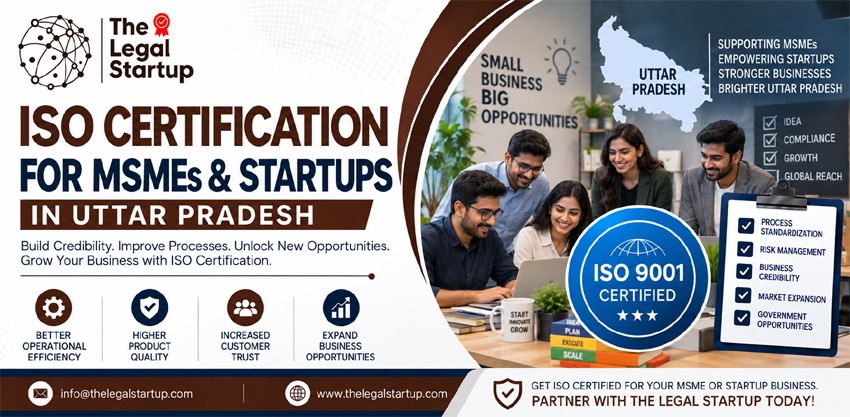
ISO Certification for MSMEs & Startups in Uttar Pradesh
Uttar Pradesh has a rapidly growing ecosystem of MSMEs, startups, technology companies, manufacturers, service providers, traders, exporters, and emerging businesses. As these organizations grow, customers, enterprise buyers, investors, vendors, and government procurement processes may increasingly expect businesses to demonstrate consistent quality, reliable processes, information security, and responsible operations.
ISO Certification for MSMEs & Startups in Uttar Pradesh can help small and growing businesses establish structured management systems without losing the flexibility that is important during the early stages of business development. Depending on the company's activities, an appropriate ISO standard can provide a framework for quality management, information security, IT service management, occupational health and safety, or industry-specific quality requirements.
ISO certification is not limited to large organizations. An MSME or startup can pursue certification when it has a clearly defined scope and has implemented the applicable requirements of the selected standard. The right certification should be chosen according to the organization's actual business activities, customer expectations, risks, and future objectives.
What Is ISO Certification for MSMEs & Startups?
ISO certification is an independent assessment of a management system against the requirements of a specific ISO standard. The certification process evaluates whether the organization's relevant processes are established, implemented, maintained, and continually improved according to the applicable requirements.
For an MSME or startup, the management system can be designed around the company's actual size and operations. A small software company, for example, may focus on information security and software quality, while a manufacturing startup may need stronger controls for production, purchasing, inspection, suppliers, and customer requirements.
The certification scope should be realistic and should clearly identify the activities, locations, products, and services covered by the management system.
Why ISO Certification Is Important for MSMEs & Startups in Uttar Pradesh
Growing businesses often compete with established organizations for customers, tenders, partnerships, and supply contracts. A structured management system can help an MSME or startup demonstrate that its operations are based on defined processes rather than relying entirely on informal practices.
- Builds customer confidence: A relevant ISO certification can provide evidence that the organization's management system has been independently assessed.
- Improves process consistency: Documented procedures can help teams perform important activities consistently.
- Supports business growth: Defined processes can make it easier to manage increasing customers, employees, suppliers, and operational complexity.
- Helps with enterprise customers: Some larger customers may request ISO certification during supplier onboarding or evaluation.
- Supports tender participation: Certain tenders and procurement processes may specify particular certifications.
- Strengthens risk management: Organizations can identify operational, quality, information-security, and workplace risks systematically.
- Improves internal accountability: Clearly assigned responsibilities help employees understand who manages each process.
- Encourages continual improvement: Internal audits, corrective actions, and management reviews create a structured improvement cycle.
- Supports market expansion: A recognized management system can help businesses communicate their process maturity to customers and partners.
- Improves organizational discipline: Policies, procedures, records, and performance monitoring can create a stronger operational foundation.
ISO 9001 Certification for MSMEs & Startups
ISO 9001 is a quality management standard that can be relevant to a wide range of MSMEs and startups. It focuses on establishing processes that help organizations consistently meet customer and applicable requirements while supporting continual improvement.
For a manufacturing startup, ISO 9001 may cover purchasing, production, inspection, testing, supplier management, product delivery, customer complaints, and corrective actions.
For a service-based startup, the quality management system may focus on customer requirements, service delivery, project management, employee competence, customer feedback, complaint handling, and process improvement.
ISO 9001 can therefore be adapted to different types of organizations as long as the management system reflects the company's actual activities and certification scope.
→ ISO 9001 Certification in Uttar Pradesh
ISO 27001 Certification for MSMEs & Startups
Information security is increasingly important for startups and MSMEs, particularly businesses operating through cloud platforms, SaaS applications, digital payments, e-commerce systems, mobile applications, customer portals, or technology services.
ISO/IEC 27001 provides a framework for establishing an Information Security Management System (ISMS). It helps organizations identify information-security risks and implement controls appropriate to their business environment.
An MSME or startup may need to protect customer information, employee data, business contracts, financial records, source code, intellectual property, login credentials, databases, cloud infrastructure, and other information assets.
ISO 27001 can help establish systematic practices around areas such as access management, information classification, incident management, supplier relationships, business continuity, security policies, and risk treatment.
→ ISO 27001 Certification in Uttar Pradesh
ISO 13485 Certification for Medical Device Startups
ISO 13485 is specifically associated with quality management systems for medical devices and related organizations. It is not a general-purpose certification for every startup or MSME.
However, a startup developing, manufacturing, distributing, or otherwise operating within an applicable medical-device-related scope may need to evaluate ISO 13485 based on its products, intended use, regulatory requirements, responsibilities, and customer expectations.
Medical technology startups should carefully define their product and certification scope and evaluate applicable regulatory requirements before selecting ISO 13485.
→ ISO 13485 Certification in Uttar Pradesh
OHSAS 18001 and Occupational Health & Safety for MSMEs
Manufacturing MSMEs, construction businesses, warehouses, workshops, engineering companies, and other organizations may face workplace health and safety risks as they expand their operations.
OHSAS 18001 was previously used for occupational health and safety management systems but has been superseded by ISO 45001. Organizations seeking a current occupational health and safety management standard should evaluate ISO 45001 according to their needs.
An occupational health and safety management system can help organizations identify workplace hazards, establish safety procedures, prepare for emergencies, train employees, investigate incidents, and continually improve safety performance.
→ OHSAS 18001 Certification in Uttar Pradesh
ISO 20000 Certification for Technology Startups
Technology startups and IT-enabled MSMEs often depend on reliable digital services to deliver products and support customers. For organizations where formal IT service management is a significant part of operations, ISO/IEC 20000-1 can provide a structured framework for managing IT services.
ISO 20000-1 can be relevant to businesses managing service requests, incidents, changes, availability, service performance, customer support, and continual service improvement.
It may be particularly useful for IT service providers, managed service providers, SaaS businesses, cloud-service organizations, and technology companies where service management forms a significant part of their customer delivery model.
→ ISO 20000 Certification in Uttar Pradesh
Key Areas Where ISO Standards Can Help Startups
Startups often grow rapidly, which can create challenges when responsibilities and processes are not clearly defined. A suitable management system can help establish consistency in important areas.
- Customer requirement management
- Product and service development
- Quality control
- Supplier evaluation
- Procurement management
- Employee training and competence
- Information security
- Data and document management
- Customer complaints
- Risk management
- Incident management
- Business continuity
- Internal audits
- Corrective actions
- Management reviews
- Continual improvement
ISO Certification Process for MSMEs & Startups in Uttar Pradesh
The certification process depends on the selected standard, business size, existing processes, certification scope, number of locations, and operational complexity. A typical process includes the following stages.
1. Identify the Right ISO Standard
The startup should first identify the standard that addresses its most important business requirements. ISO 9001 may support quality management, ISO 27001 can address information security, and ISO/IEC 20000-1 may be considered for formal IT service management.
2. Define the Certification Scope
The organization should identify the products, services, locations, departments, systems, and processes that will be included in the certification scope.
3. Conduct a Gap Assessment
Existing processes are compared with the applicable requirements of the selected ISO standard. This helps identify missing policies, procedures, controls, records, and improvement areas.
4. Develop the Required Management System
Relevant policies, procedures, work instructions, forms, records, and controls are established based on the selected standard and the actual operations of the business.
5. Implement the Processes
The management system is implemented across relevant departments. Employees should understand their responsibilities and follow the established processes.
6. Identify and Manage Risks
Relevant risks are identified and evaluated. Appropriate controls and improvement actions are implemented according to the selected ISO standard.
7. Maintain Evidence and Records
The organization maintains appropriate evidence showing that the management system is being implemented. Records may include training, inspections, supplier evaluations, complaints, incidents, corrective actions, and audit results.
8. Conduct an Internal Audit
An internal audit evaluates whether the management system is implemented effectively and conforms to the applicable requirements.
9. Management Review
Top management reviews the performance of the management system, evaluates objectives and risks, and determines appropriate improvement actions.
10. Certification Audit
An independent certification body conducts the applicable audit. If the organization successfully demonstrates conformity with the selected standard within the defined scope, certification can be issued.
ISO Certification for Different Types of MSMEs in Uttar Pradesh
MSMEs operate across almost every major business sector in Uttar Pradesh. The appropriate ISO standard can differ depending on the organization's activities.
- Manufacturing MSMEs: May consider ISO 9001 for quality and process management.
- IT startups: May consider ISO 27001 and, where relevant, ISO/IEC 20000-1.
- Export businesses: May use ISO 9001 to strengthen quality management and evaluate other standards according to customer requirements.
- Food businesses: May need quality and food-safety management systems appropriate to their activities.
- Healthcare startups: Organizations within an applicable medical-device scope may evaluate ISO 13485.
- Engineering companies: May use ISO 9001 for structured quality management and evaluate occupational safety requirements.
- Construction businesses: May consider quality and occupational health and safety management systems.
- Consulting companies: Can implement quality processes around service delivery, customer requirements, competence, and feedback.
- SaaS startups: May evaluate ISO 27001 for information security and ISO 9001 for quality management.
ISO Certification for Startups Seeking Enterprise Customers
Startups often begin by serving small businesses or individual customers and later target larger enterprises. Enterprise customers may conduct detailed supplier assessments covering information security, quality, business continuity, data management, and operational controls.
A relevant ISO certification can provide independently assessed evidence of a management system and may support supplier onboarding where certification is part of the customer's requirements.
However, certification should not be treated as a replacement for customer-specific security assessments, contractual obligations, regulatory compliance, or product requirements.
ISO Certification for Government Tenders and Procurement
Government and institutional procurement processes can sometimes specify management-system certifications as part of eligibility or technical requirements. The exact requirements vary from one tender or procurement process to another.
MSMEs should carefully review the relevant tender document rather than assuming that a particular ISO certificate is required for every government contract.
ISO Certification for MSMEs in Noida and Greater Noida
Noida and Greater Noida have a large ecosystem of technology companies, manufacturers, service providers, startups, exporters, electronics businesses, engineering companies, and other MSMEs.
Businesses operating in these areas can evaluate ISO certification based on customer requirements, industry practices, operational risks, tender requirements, and future growth plans.
ISO Certification for MSMEs in Lucknow
Lucknow has a diverse business ecosystem covering services, manufacturing, technology, education, healthcare, food businesses, and emerging startups. MSMEs in the city can use appropriate management systems to improve process consistency, customer satisfaction, quality management, and information security.
ISO Certification for MSMEs in Kanpur
Kanpur has a strong industrial and manufacturing base. Manufacturing MSMEs can use structured quality-management processes to control purchasing, production, inspection, supplier performance, customer complaints, and corrective actions.
ISO Certification for MSMEs Across Uttar Pradesh
MSMEs and startups in Ghaziabad, Agra, Meerut, Varanasi, Bareilly, Moradabad, Aligarh, Prayagraj, Gorakhpur, and other cities across Uttar Pradesh can evaluate suitable ISO management systems based on their business needs.
The certification scope should accurately describe the organization's actual operations, whether it provides services, manufactures products, exports goods, develops software, operates warehouses, or manages technology infrastructure.
How Startups Can Choose the Right ISO Certification
Choosing an ISO standard should be based on business needs rather than simply obtaining the largest number of certificates. Startups and MSMEs should consider:
- Business model and industry
- Products and services offered
- Customer expectations
- Information and data handled
- Operational risks
- Supplier and outsourcing arrangements
- Number of employees and locations
- Government tender requirements
- Enterprise customer requirements
- Export and international business plans
- Future growth objectives
A business should also ensure that the certification body selected for the audit is appropriate for the relevant ISO standard and certification scope.
ISO Certification and Business Growth for MSMEs
As an MSME grows, informal processes can become difficult to manage. New employees, multiple customers, additional suppliers, larger production volumes, and increased documentation can create operational complexity.
A suitable management system can provide a repeatable framework for managing these activities. It can also help management monitor performance, identify recurring problems, assign responsibilities, and implement corrective actions.
For startups, the objective should be to build a practical management system that supports the business rather than creating unnecessary documentation. Processes should be proportionate to the organization's size, complexity, risks, and certification requirements.
Common Mistakes MSMEs Make During ISO Certification
Businesses can improve their certification preparation by avoiding several common mistakes:
- Choosing an ISO standard without evaluating its relevance to the business
- Defining an overly broad or inaccurate certification scope
- Creating documentation that does not reflect actual operations
- Failing to train employees on relevant procedures
- Ignoring internal audits
- Not maintaining objective evidence of implementation
- Failing to address corrective actions
- Assuming certification replaces regulatory compliance
- Selecting a certification body without checking its suitability for the required scope
Conclusion
ISO Certification for MSMEs & Startups in Uttar Pradesh can help growing businesses establish structured processes, improve operational consistency, manage risks, strengthen customer confidence, and prepare for larger business opportunities.
ISO 9001 can provide a quality-management framework for many startups and MSMEs, while ISO 27001 can help technology-focused businesses manage information-security risks. ISO 13485 may be relevant to organizations operating within an applicable medical-device scope, while ISO/IEC 20000-1 can be considered by businesses where formal IT service management is a significant part of their operations.
For occupational health and safety, organizations should consider the current ISO 45001 standard because OHSAS 18001 has been superseded. Businesses should also verify customer, tender, contractual, regulatory, and industry-specific requirements before selecting a certification.
With an appropriately defined scope, practical implementation, employee involvement, internal audits, management reviews, and an independent certification audit, MSMEs and startups in Uttar Pradesh can establish management systems that support their current operations and future growth.
Frequently Asked Questions About ISO Certification for MSMEs & Startups in Uttar Pradesh
1. Can a startup get ISO certification?
Yes. Startups can pursue ISO certification when they have defined the applicable scope and implemented the requirements of the selected ISO standard. The management system should reflect the startup's actual products, services, locations, and operations.
2. Is ISO certification mandatory for MSMEs in Uttar Pradesh?
ISO certification is not universally mandatory for every MSME. However, specific customers, tenders, contracts, industries, or procurement processes may request particular certifications. Businesses should verify the exact requirements applicable to their situation.
3. Which ISO certification is suitable for a startup?
The appropriate standard depends on the startup's business model. ISO 9001 can support quality management, ISO 27001 can address information security, and ISO/IEC 20000-1 may be relevant to organizations where IT service management is a significant part of their operations.
4. Can a small company obtain ISO 9001 certification?
Yes. ISO 9001 can be implemented by organizations of different sizes. The management system should be appropriate to the organization's activities, complexity, risks, products, services, and certification scope.
5. Is ISO 27001 useful for technology startups?
It can be particularly relevant to technology startups that manage customer data, cloud infrastructure, software applications, source code, credentials, intellectual property, or other sensitive information.
6. Is ISO 13485 required for every healthcare startup?
No. ISO 13485 is specifically associated with medical devices and related organizations. Its applicability depends on the company's products, activities, regulatory classification, responsibilities, and certification scope.
7. Is OHSAS 18001 still used for new certification?
OHSAS 18001 has been superseded by ISO 45001. Organizations seeking a current occupational health and safety management standard should evaluate ISO 45001 instead.
8. Can an MSME obtain multiple ISO certifications?
Yes. An MSME can implement multiple management systems when different standards address different business requirements. For example, a technology MSME may implement ISO 9001 for quality management and ISO 27001 for information security.
9. Does ISO certification help startups win customers?
ISO certification can support customer confidence and supplier evaluations where a customer specifically values or requires the certification. However, certification does not guarantee that a startup will win a contract; product quality, pricing, capabilities, service, compliance, and customer requirements also influence purchasing decisions.
10. How long does ISO certification take for an MSME or startup?
The timeframe depends on the selected standard, certification scope, organization size, existing processes, number of locations, operational complexity, and readiness for the certification audit. A business with mature processes may require less implementation work than one starting from the beginning.
Latest Posts
- → ISO 9001 Certification in Uttar Pradesh
- → ISO 27001 Certification in Uttar Pradesh
- → ISO 13485 Certification in Uttar Pradesh
- → OHSAS 18001 Certification in Uttar Pradesh
- → ISO 20000 Certification in Uttar Pradesh
- → ISO 22000 Certification in Uttar Pradesh
- → SA 8000 Certification in Uttar Pradesh
- → ISO 50001 Certification in Uttar Pradesh
- → CE Marking Certification in Uttar Pradesh
- → HACCP Certification in Uttar Pradesh
- → GMP Certification in Uttar Pradesh
- → ISO Certification in Noida
- → ISO Certification in Lucknow
- → ISO Certification in Ghaziabad
- → ISO Certification in Kanpur
- → ISO Certification in Agra
- → ISO Certification in Uttar Pradesh