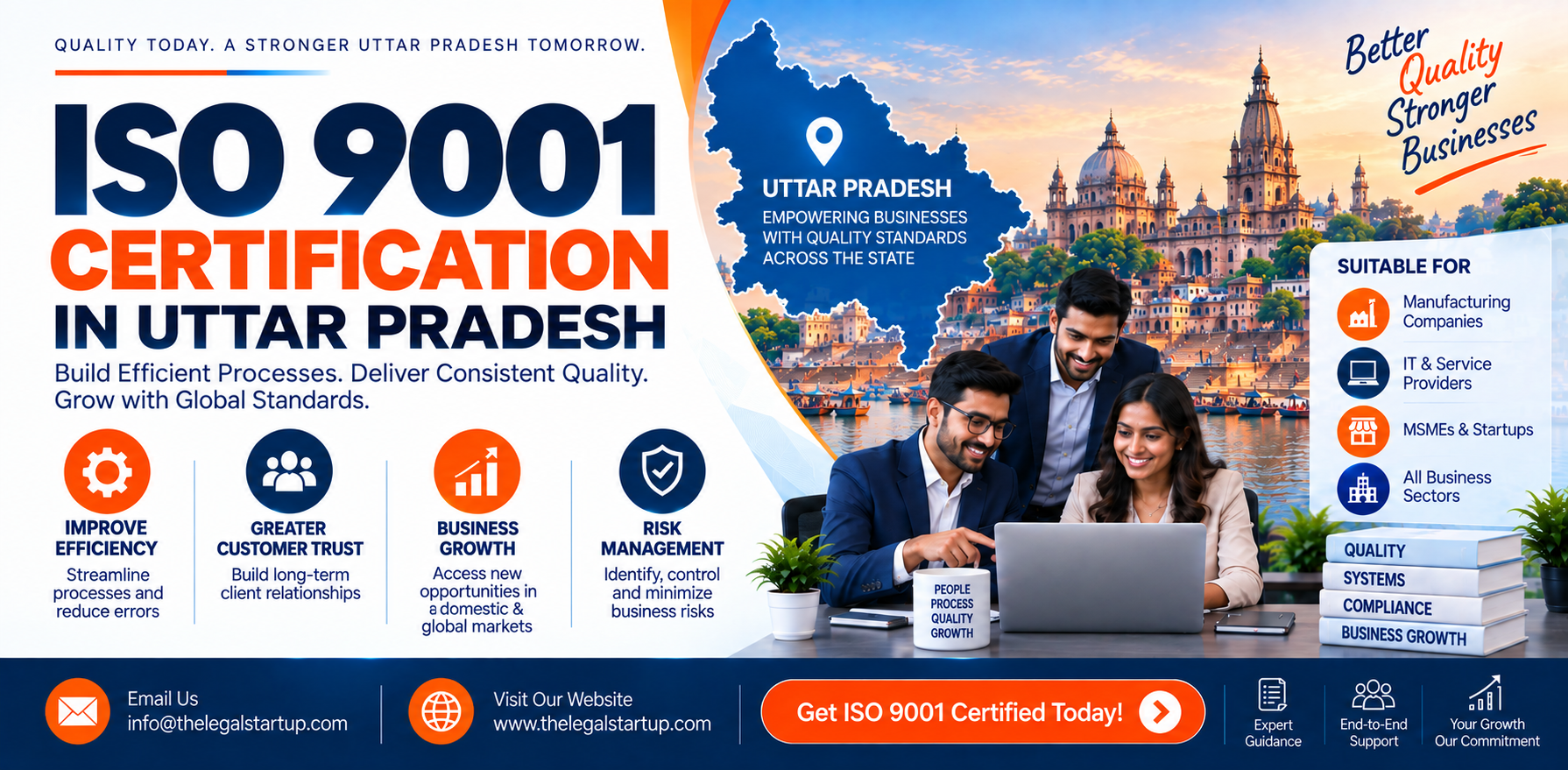
ISO 9001 Certification in Uttar Pradesh
21 Sep 2026
Introduction
Businesses in Uttar Pradesh are growing rapidly across manufacturing, IT, healthcare, construction, education, logistics, food processing, trading, and professional services. As competition increases, customers and business partners want more than a good product or attractive price—they want consistency, reliability, and confidence.
This is where ISO 9001 Certification in Uttar Pradesh can make a meaningful difference.
ISO 9001 is an internationally recognized quality management standard designed to help organizations establish consistent processes, improve customer satisfaction, manage risks, reduce errors, and continually improve performance. It can be applied to organizations of different sizes and sectors.
For a growing business in cities such as Noida, Greater Noida, Ghaziabad, Lucknow, Kanpur, Agra, Meerut, Varanasi, Prayagraj, or other parts of Uttar Pradesh, ISO 9001 certification can strengthen operational credibility and demonstrate a structured approach to quality.
What Is ISO 9001 Certification?
ISO 9001 is a standard for a Quality Management System (QMS). Instead of focusing only on inspecting the final product, it encourages organizations to control and improve the processes that produce products or services.
In practical terms, this means defining responsibilities, understanding customer requirements, controlling documents and records, monitoring processes, handling complaints, evaluating suppliers, conducting internal audits, and taking corrective action when something goes wrong.
ISO explains that the standard is intended to help organizations consistently provide products and services that meet customer and applicable requirements while improving customer satisfaction and the effectiveness of the quality management system.
Certification itself is not mandatory. An organization can implement ISO 9001 without becoming certified. If certification is chosen, an independent certification body assesses the organization's management system. ISO itself does not issue ISO 9001 certificates.
Why Choose Us for ISO 9001 Certification in Uttar Pradesh?
Getting ISO certified should not feel like a paperwork exercise. A useful certification journey should help your business understand its processes and build a management system that can actually work in day-to-day operations.
At The Legal Startup, we help businesses approach ISO certification in a structured and practical manner.
Our approach includes:
- Understanding your business activities and certification requirements
- Identifying the appropriate ISO 9001 scope
- Helping organize required quality documents
- Supporting Quality Management System implementation
- Identifying process gaps and improvement areas
- Preparing teams for internal and certification audits
- Supporting corrective-action preparation
- Coordinating the certification process with the appropriate certification body
- Providing guidance throughout the certification journey
Whether you are a startup, MSME, manufacturer, service provider, exporter, consultant, contractor, or established company, the certification approach should be aligned with the actual size and complexity of your organization.
Key Benefits of ISO 9001 Certification
1. Builds Customer Confidence
Customers are more comfortable working with businesses that demonstrate a structured quality management approach. ISO 9001 certification can act as an additional trust signal during vendor selection and business negotiations.
2. Improves Business Processes
ISO 9001 encourages organizations to identify how work is performed, who is responsible, what controls are required, and how performance is measured.
This can reduce unnecessary repetition, delays, process confusion, and avoidable mistakes.
3. Helps Improve Customer Satisfaction
Customer requirements are central to ISO 9001. Organizations are expected to understand customer needs, monitor satisfaction, address complaints, and continually improve their processes.
4. Supports Consistent Product and Service Quality
A business should not depend entirely on individual employees to maintain quality. Clearly defined processes and responsibilities make it easier to deliver consistent results.
5. Strengthens Internal Control
A properly implemented Quality Management System creates greater visibility into operational responsibilities, records, suppliers, risks, complaints, and corrective actions.
6. Supports Business Growth
For an expanding company, informal processes can become difficult to manage. ISO 9001 provides a structured framework that can help businesses establish repeatable processes as they grow.
7. Can Support Tender and Vendor Requirements
Some customers, procurement processes, tenders, and supply-chain relationships may ask suppliers to demonstrate specific quality-management credentials. ISO 9001 certification can help organizations meet such requirements where applicable.
ISO 9001 Certification Process in Uttar Pradesh
The exact timeline depends on the organization's size, scope, preparedness, and complexity. However, the certification journey generally follows a structured process.
Step 1: Initial Business Assessment
The first step is understanding your organization, products or services, locations, processes, employees, customers, and operational activities.
This information helps establish an appropriate certification scope.
Step 2: Gap Assessment
Existing processes are reviewed against the applicable ISO 9001 requirements.
The objective is to identify areas that need documentation, implementation, monitoring, or improvement before the certification audit.
Step 3: Documentation and QMS Development
Relevant quality-management documents and records are prepared according to the organization's actual operations.
Depending on the business, these may cover areas such as:
- Quality objectives
- Process controls
- Roles and responsibilities
- Supplier evaluation
- Customer requirements
- Complaint handling
- Risk and opportunity management
- Internal audit
- Corrective action
- Performance monitoring
The goal should be useful documentation—not unnecessary paperwork.
Step 4: Implementation
The Quality Management System is put into practice.
Employees need to understand their responsibilities, processes need to operate as defined, and appropriate records should be maintained.
For example, a manufacturing company in Noida may focus heavily on production controls, inspection, supplier evaluation, equipment, and customer complaints. A software company in Lucknow may have a greater focus on project delivery, requirements management, customer feedback, and service processes.
Step 5: Internal Audit
An internal audit helps determine whether the QMS is being effectively implemented and maintained.
Any identified nonconformities or weaknesses should be addressed through appropriate corrective action.
Step 6: Management Review
Management reviews the performance of the Quality Management System and considers issues such as objectives, customer feedback, audit results, process performance, risks, opportunities, and improvement requirements.
Step 7: Certification Audit
An independent certification body conducts the certification assessment.
Depending on the certification arrangement and organization, the audit may involve different stages of assessment.
If the system meets the applicable requirements and any findings are appropriately addressed, certification can be issued by the certification body.
Documents Required for ISO 9001 Certification
The documents required depend on the organization's activities and scope. Common information and records may include:
- Business registration details
- Organization profile
- Address and operational details
- Scope of the Quality Management System
- Organization structure
- Quality policy
- Quality objectives
- Process information
- Customer requirement records
- Supplier and vendor information
- Risk and opportunity information
- Internal audit records
- Management review records
- Corrective-action records
- Training and competency records
- Monitoring and measurement records
- Applicable statutory or regulatory information
Not every organization will require the same documentation. A practical ISO 9001 system should reflect the organization's real operations rather than copying generic templates.
Who Can Apply for ISO 9001 Certification in Uttar Pradesh?
ISO 9001 can be relevant to organizations across a wide range of sectors, including:
- Manufacturing companies
- MSMEs and startups
- IT and software companies
- Construction companies
- Engineering businesses
- Healthcare organizations
- Educational institutions
- Logistics companies
- Exporters and suppliers
- Food and packaging businesses
- Trading companies
- Consultants and professional service providers
- Maintenance and technical service companies
The standard is designed to be applicable across different organization sizes and types.
ISO 9001:2015 and the 2026 Revision
Businesses searching for ISO 9001 Certification in Uttar Pradesh should also be aware of the upcoming revision.
ISO has stated that the new ISO 9001 edition is scheduled for publication in September 2026 and will replace ISO 9001:2015. Organizations already certified to ISO 9001:2015 will have a transition period to move to the revised edition, with details to be handled through their certification body.
Therefore, businesses planning certification or transition should confirm the applicable edition, certification arrangements, and transition requirements with their certification body before making a final decision.
Why ISO 9001 Matters for Uttar Pradesh Businesses
Uttar Pradesh has a diverse business ecosystem, from industrial clusters and MSMEs to technology companies and service organizations.
For a growing business, quality management is not simply about obtaining a certificate. It is about creating processes that employees can follow, customers can trust, and management can improve.
Consider a small manufacturer supplying components to a larger company. If production, inspection, supplier management, and complaint handling depend on informal instructions, problems can become difficult to trace.
A structured Quality Management System creates clearer processes and records, making it easier to identify where an issue occurred and what should be improved.
That practical value is often more important than the certificate itself.
Frequently Asked Questions
1. What is ISO 9001 Certification in Uttar Pradesh?
ISO 9001 Certification in Uttar Pradesh is independent certification that confirms an organization's Quality Management System has been assessed against the applicable ISO 9001 requirements. It can help businesses demonstrate a structured approach to quality, customer satisfaction, and continual improvement.
2. How can I get ISO 9001 Certification in Uttar Pradesh?
The usual process includes understanding the business scope, conducting a gap assessment, developing and implementing the Quality Management System, performing internal audit and management review, and completing the certification audit through an appropriate certification body.
3. Is ISO 9001 certification mandatory for businesses in Uttar Pradesh?
No. ISO 9001 certification is generally voluntary. However, particular customers, tenders, contracts, or supply-chain requirements may request certification. ISO also confirms that organizations can implement the standard without pursuing certification.
4. What documents are required for ISO 9001 certification?
Typical documentation can include the QMS scope, quality policy, objectives, process information, risk-related information, supplier records, customer-related records, internal audit records, management review records, corrective-action records, and relevant operational records. The exact requirements depend on the organization.
5. How long does ISO 9001 certification take?
There is no single fixed timeline. The duration depends on factors such as company size, number of locations, business complexity, existing processes, documentation, employee involvement, and audit readiness. A small organization with established processes may be ready faster than a large or highly complex organization.
Conclusion
ISO 9001 Certification in Uttar Pradesh can be a valuable step for businesses that want to improve quality, strengthen processes, increase customer confidence, and build a more organized management system.
The real benefit is not simply displaying an ISO certificate. The stronger outcome is having a Quality Management System that helps your business understand customer requirements, control important processes, identify problems, take corrective action, and continually improve.
If you are planning ISO 9001 certification for your startup, MSME, manufacturing unit, service company, or established organization, professional guidance can make the process more structured and easier to manage.
Start Your ISO 9001 Certification Journey
For assistance with ISO 9001 Certification in Uttar Pradesh, connect with The Legal Startup to discuss your business requirements and certification needs.
Email: info@thelegalstartup.com
Website: www.thelegalstartup.com
Take the next step toward a more systematic, customer-focused, and quality-driven business.