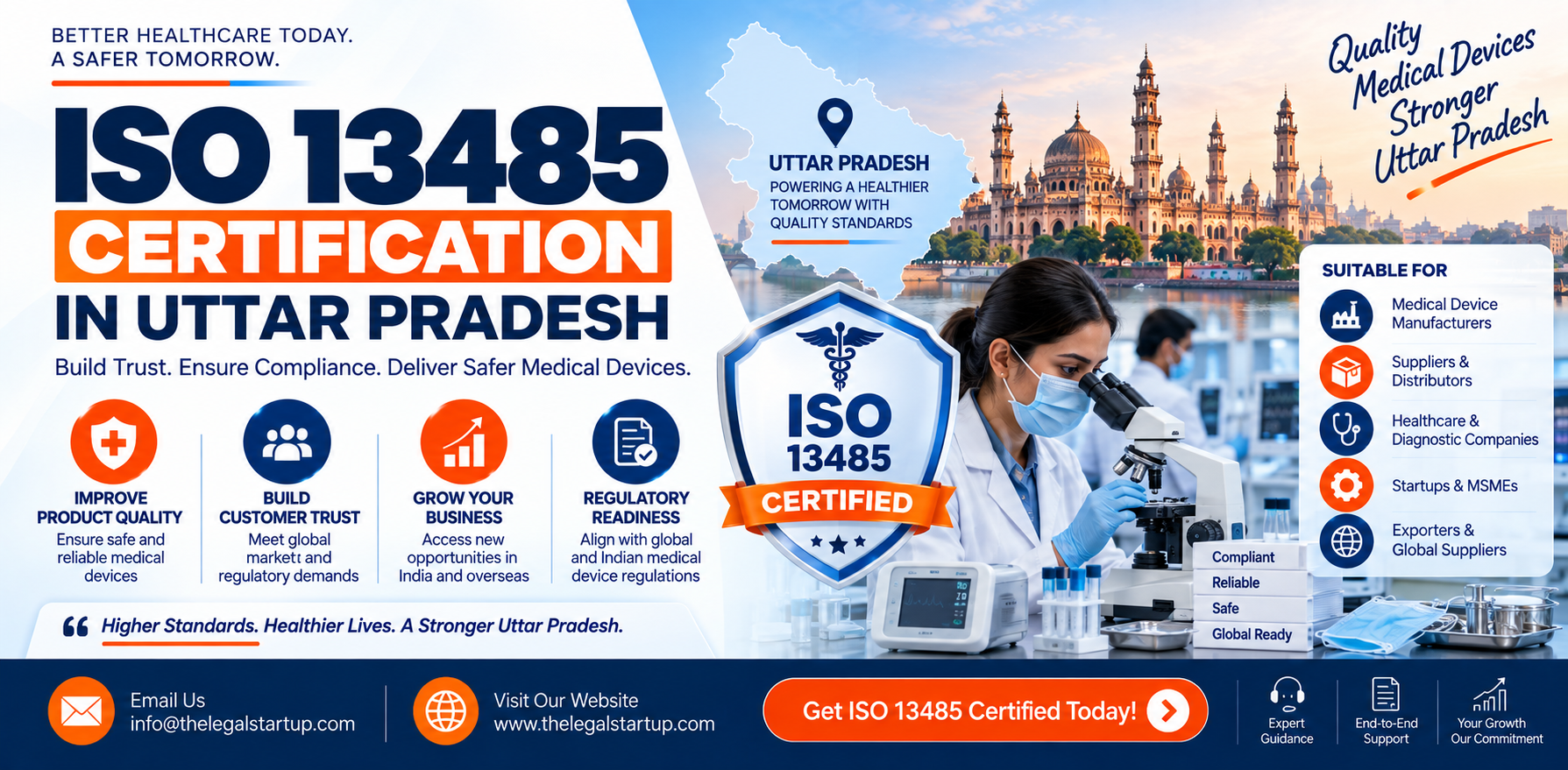
ISO 13485 Certification in Uttar Pradesh
25 Sep 2026
Introduction
ISO 13485 Certification in Uttar Pradesh helps medical device manufacturers, suppliers, importers, distributors, and related organizations build a structured quality management system focused on product quality, regulatory requirements, risk management, and patient safety.
For businesses operating in Noida, Greater Noida, Ghaziabad, Lucknow, Kanpur, Agra, Meerut and other industrial locations across Uttar Pradesh, ISO 13485 can strengthen quality processes and support access to demanding customers and markets.
ISO 13485:2016 is the internationally recognized standard specifically designed for quality management systems in the medical device industry. ISO states that the standard addresses customer and regulatory requirements and places strong emphasis on risk management and regulatory expectations. The 2016 edition remains the current confirmed edition.
What Is ISO 13485 Certification?
ISO 13485 Certification demonstrates that an organization's quality management system has been assessed against the requirements of ISO 13485:2016 by an appropriate independent certification body.
Unlike general quality standards, ISO 13485 is specifically designed around the needs of the medical device sector. It can apply to organizations involved in the design, production, installation, servicing, and related activities associated with medical devices.
For example, a medical device manufacturer in Noida may need controlled production processes, supplier controls, traceability, complaint handling, risk management, documented procedures and effective corrective actions.
ISO 13485 brings these activities into a systematic Medical Device Quality Management System (QMS).
Why Choose The Legal Startup for ISO 13485 Certification in Uttar Pradesh?
Medical device compliance is more than preparing a few documents. Your QMS needs to reflect what your organization actually does.
At The Legal Startup, the focus should be on making the certification process practical for your business rather than creating unnecessary paperwork.
Our support can cover:
- Initial gap assessment
- ISO 13485:2016 implementation guidance
- Quality management system documentation
- Risk-management support
- Process identification and documentation
- Supplier and purchasing controls
- Internal audit preparation
- Management review preparation
- Corrective and preventive action support
- Certification audit coordination
- Post-certification improvement guidance
This approach is particularly useful for MSMEs, startups and growing medical device businesses that may not have a dedicated regulatory or quality-management team.
Key Benefits of ISO 13485 Certification
1. Stronger Medical Device Quality Management
ISO 13485 creates a structured framework for controlling processes that influence medical device quality and safety.
This can help businesses reduce inconsistent processes and improve operational discipline.
2. Better Regulatory Readiness
Medical device companies operate in a highly regulated environment. A properly implemented QMS helps an organization identify and control processes relevant to applicable regulatory requirements.
In India, the CDSCO's Medical Devices Rules, 2017 include specific quality-management requirements for manufacturers of medical devices and in-vitro diagnostic medical devices.
3. Improved Risk Management
Risk management is a major consideration in medical device quality.
An effective system helps organizations identify potential problems, evaluate risks and establish appropriate controls throughout relevant processes.
4. Greater Customer Confidence
Healthcare organizations, distributors and business customers often want evidence that a supplier follows controlled and repeatable quality processes.
ISO 13485 certification can provide an internationally recognized quality credential that supports that conversation.
5. Better Supplier and Process Control
Medical device quality can depend heavily on suppliers and outsourced activities.
ISO 13485 encourages organizations to establish appropriate controls over purchasing, suppliers and externally provided processes.
6. Support for Market Expansion
For an Uttar Pradesh manufacturer looking to serve customers outside its local market, a recognized medical-device QMS can strengthen its quality credentials.
ISO notes that ISO 13485 can help facilitate market access and build confidence among stakeholders.
Who Needs ISO 13485 Certification?
ISO 13485 Certification in Uttar Pradesh can be relevant to organizations involved in:
- Medical device manufacturing
- Medical equipment manufacturing
- Diagnostic device manufacturing
- IVD-related businesses
- Surgical instrument manufacturing
- Medical consumables
- Orthopaedic devices
- Dental devices
- Healthcare equipment
- Medical device software
- Medical device components
- Installation and servicing
- Medical device distribution and supply
- Contract manufacturing
- Organizations supporting the medical-device supply chain
ISO specifically identifies organizations involved in the design, production, installation and servicing of medical devices and related services as potential users of ISO 13485.
Step-by-Step ISO 13485 Certification Process
Step 1: Understand Your Certification Scope
The first step is defining what products, processes, locations and activities will be covered by the QMS.
A clear scope prevents confusion later during implementation and certification.
Step 2: Conduct a Gap Assessment
Your existing quality processes are compared with the applicable ISO 13485 requirements.
This identifies areas that require improvement, documentation or implementation.
Step 3: Develop the Quality Management System
The organization establishes the required QMS structure, including appropriate procedures, responsibilities, records and controls.
The system should be practical and relevant to the actual business.
Step 4: Implement the QMS
Documentation alone is not enough.
Employees need to follow the established processes and generate appropriate records demonstrating that the system is operating effectively.
Step 5: Conduct Internal Audit
An internal audit evaluates whether the QMS has been properly implemented and identifies nonconformities or improvement opportunities.
Step 6: Management Review
Management reviews the performance of the QMS, including relevant objectives, audit findings, customer feedback, process performance, corrective actions and improvement needs.
Step 7: Certification Audit
An independent certification body evaluates the organization's QMS against the applicable requirements.
If the audit requirements are satisfactorily addressed, certification can be issued according to the certification body's process.
Documents Required for ISO 13485 Certification
The exact documentation depends on your organization, products and certification scope. Typical QMS documentation may include:
- Quality manual or documented QMS information
- Quality policy and objectives
- QMS scope
- Organizational responsibilities
- Document and record control procedures
- Risk-management records
- Product realization procedures
- Design and development records, where applicable
- Supplier evaluation records
- Purchasing controls
- Production and process-control records
- Validation records, where applicable
- Identification and traceability records
- Complaint-handling procedures
- Nonconformity and corrective-action records
- Internal audit records
- Management review records
- Training and competency records
- Monitoring and measurement records
- Regulatory requirements and applicable records
The CDSCO quality-management requirements also address activities such as design and development, manufacturing, packaging, labelling, testing, installation and servicing, depending on what activities the manufacturer performs.
ISO 13485 for Medical Device Startups and MSMEs
A common misconception is that ISO 13485 is only suitable for large medical-device manufacturers.
That is not the case.
ISO explains that the standard is intended for medical-device organizations regardless of size or activity.
For an MSME in Noida or Greater Noida, for example, implementation can help establish documented processes before the company begins handling larger customer contracts.
For a startup developing a healthcare device or medical software product, establishing quality controls early can also make future growth easier.
The important point is to build the QMS around the organization's actual activities rather than copying a generic set of documents.
ISO 13485 Certification in Major Uttar Pradesh Business Hubs
The Legal Startup can target organizations looking for ISO 13485 Certification in Uttar Pradesh, including businesses located in:
- Noida
- Greater Noida
- Ghaziabad
- Lucknow
- Kanpur
- Agra
- Meerut
- Varanasi
- Bareilly
- Moradabad
Noida and Greater Noida are particularly relevant for medical-device, electronics, technology and manufacturing businesses, while Lucknow and other major cities have growing healthcare and medical-service ecosystems.
Frequently Asked Questions
1. What is ISO 13485 Certification in Uttar Pradesh?
ISO 13485 Certification in Uttar Pradesh demonstrates that a medical-device organization's quality management system has been independently assessed against the requirements of ISO 13485:2016. It focuses on quality, regulatory requirements, risk management and controlled processes.
2. Who needs ISO 13485 Certification?
Medical-device manufacturers and organizations involved in design, production, installation, servicing and related medical-device activities can use ISO 13485. Suppliers and other organizations supporting the medical-device supply chain may also benefit from an appropriate QMS.
3. Is ISO 13485 mandatory for medical device companies in India?
ISO 13485 certification should not be treated as a universal substitute for India's regulatory requirements. Medical devices are regulated under India's Medical Devices Rules, 2017, and organizations must assess the specific regulatory requirements applicable to their products and activities.
4. What is the current version of ISO 13485?
The current published edition is ISO 13485:2016. ISO's official information indicates that the 2016 edition was reviewed and confirmed in 2025 and remains current.
5. How long does ISO 13485 certification take?
The timeline varies according to the organization's size, certification scope, number of locations, existing QMS maturity and level of preparation. A small organization with established processes may require less implementation work than a manufacturer developing a comprehensive QMS from the beginning.
Conclusion: Build a Quality System That Supports Growth
ISO 13485 Certification in Uttar Pradesh is more than a certificate on the wall. For a medical-device business, it can help create disciplined processes for quality, risk management, regulatory readiness and continual improvement.
Whether you are an established manufacturer in Noida, a medical-device startup in Greater Noida, or a growing healthcare business elsewhere in Uttar Pradesh, the right implementation strategy can make the certification journey far more manageable.
Ready to strengthen your medical-device quality management system?
Get professional guidance from The Legal Startup for ISO 13485 implementation and certification support.
📧 Email: info@thelegalstartup.com
🌐 Website: www.thelegalstartup.com
Start your ISO 13485 certification journey today and build a stronger foundation for quality, compliance and business growth.