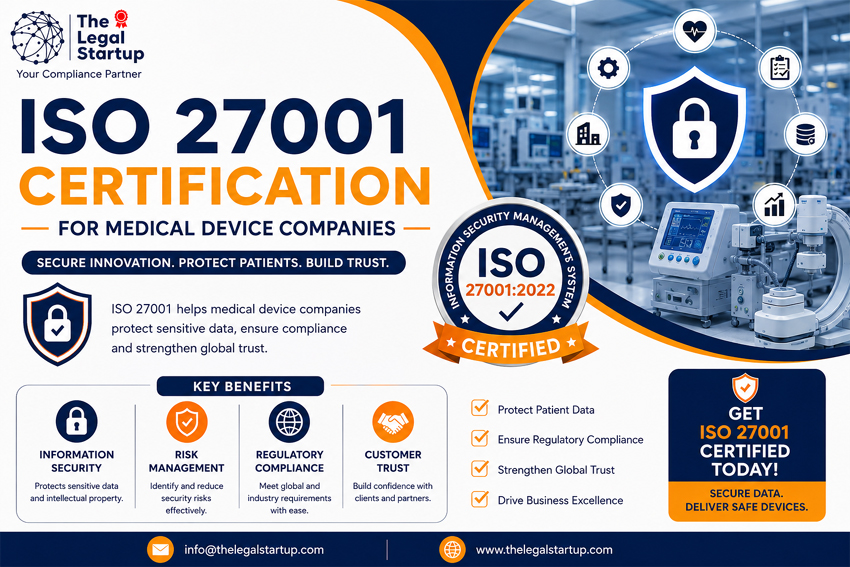
ISO 27001 Certification for Medical Device Companies in Uttar Pradesh
06 Aug 2026
Introduction
Medical device companies operate at the intersection of healthcare, technology, manufacturing, and regulation. They may handle product designs, clinical information, customer records, software code, supplier information, test results, quality records, and confidential intellectual property.
As medical devices become more connected and software-driven, information security is becoming increasingly important.
A connected medical device, cloud-based platform, diagnostic application, or remote-monitoring solution may process or transmit sensitive information. A security weakness can therefore affect not only business operations but also customer confidence and, depending on the product and context, broader safety and regulatory considerations.
This is where ISO 27001 Certification for Medical Device Companies in Uttar Pradesh can provide value.
ISO/IEC 27001:2022 is the international standard for an Information Security Management System (ISMS). It defines requirements for establishing, implementing, maintaining, and continually improving an ISMS and can be applied by organizations of different sizes and sectors.
For a medical device manufacturer in Noida, a healthcare technology company in Lucknow, or a medical-device software business in Greater Noida, ISO 27001 can provide a structured approach to managing information-security risks.
Why Information Security Matters in the Medical Device Industry
Medical device businesses may handle information such as:
-
Product designs and specifications
-
Software source code
-
Device configuration information
-
Clinical and testing data
-
Customer information
-
Supplier records
-
Quality-management records
-
Regulatory documentation
-
Intellectual property
-
Connected-device data
-
Service and maintenance information
A company may already have strong quality controls, but information security requires its own risk-management framework.
ISO/IEC 27001 takes a holistic approach involving people, policies, technology, and risk management. It is designed to protect the confidentiality, integrity, and availability of information.
It is also important to understand that ISO 27001 and ISO 13485 serve different purposes. ISO 13485:2016 is the medical-device-specific quality management standard and addresses quality-management requirements for regulatory purposes.
For many medical device businesses, ISO 27001 can therefore complement rather than replace their quality-management and regulatory frameworks.
Why Choose The Legal Startup?
Medical device companies can have complex operations involving R&D, manufacturing, software development, testing, quality assurance, regulatory affairs, suppliers, service teams, and connected technologies.
A generic ISO documentation package may not reflect these realities.
The Legal Startup can help businesses approach ISO certification based on their actual operations, information assets, risks, and certification scope.
Our support can include:
-
Understanding your medical-device business and operations
-
Defining the appropriate ISMS scope
-
Reviewing existing information-security practices
-
Conducting a gap assessment
-
Supporting ISMS documentation
-
Guiding information-security risk assessment
-
Supporting implementation of relevant processes
-
Helping establish employee security responsibilities
-
Preparing for internal audits
-
Supporting corrective-action planning
-
Preparing the organization for the certification audit
The goal should be to build an ISMS that employees can actually use.
For example, a connected-device manufacturer may need particular attention to software development, device data, cloud platforms, authentication, remote access, supplier security, vulnerability management, and incident response.
Key Benefits of ISO 27001 Certification for Medical Device Companies
1. Protects Sensitive Business Information
Medical device companies invest heavily in research, engineering, software, testing, and product development.
ISO 27001 provides a structured approach to identifying risks associated with information and establishing appropriate controls.
This can help protect:
-
Product designs
-
Engineering documents
-
Source code
-
Test results
-
Customer information
-
Regulatory records
-
Supplier information
-
Intellectual property
2. Strengthens Medical Device Cybersecurity
Modern medical devices can include software, connectivity, cloud services, mobile applications, wireless communication, or remote-management features.
Cybersecurity risks may therefore extend beyond the organization's office network.
An ISMS helps the organization consider information-security risks across people, processes, technology, and external relationships.
3. Builds Customer and Partner Confidence
Hospitals, distributors, healthcare organizations, technology partners, and enterprise customers may evaluate a medical device company's information-security practices before entering into a business relationship.
ISO 27001 certification can provide independent evidence that the organization's ISMS has been assessed against the applicable standard requirements.
4. Supports Intellectual Property Protection
Medical device companies often spend years developing proprietary technology.
Loss or unauthorized disclosure of:
-
Product designs
-
Algorithms
-
Firmware
-
Source code
-
Manufacturing information
-
Research results
can create significant commercial risks.
A risk-based ISMS can help management identify where sensitive information exists and determine how it should be protected.
5. Improves Access Management
Different teams need different information.
R&D engineers may need product-development data, while quality teams need controlled records and regulatory teams may require access to specific documentation.
A structured access-management process can help organizations manage:
-
User accounts
-
Privileged access
-
Authentication
-
Access reviews
-
Employee transfers
-
Employee exits
-
Third-party access
-
Remote access
6. Strengthens Supplier and Third-Party Risk Management
Medical device companies commonly depend on suppliers, contract manufacturers, software providers, cloud platforms, laboratories, logistics companies, and technical service providers.
Third parties can introduce information-security risks.
An ISMS can provide a structured method for identifying and managing relevant supplier risks.
7. Improves Incident Response
A medical device company needs to know what happens when a security incident occurs.
Examples may include compromised credentials, malware, unauthorized access, data exposure, software vulnerabilities, or loss of a company device containing sensitive information.
A documented incident-management process helps define responsibilities, reporting, response, investigation, corrective action, and follow-up.
8. Supports Business Continuity
Manufacturing, software development, testing, quality activities, and customer support can all depend on digital systems.
A structured information-security management system can help organizations identify risks to information availability and prepare appropriate response and recovery processes.
9. Encourages Continuous Improvement
Cybersecurity risks change as products, software, suppliers, technologies, and threats evolve.
ISO/IEC 27001 requires organizations to maintain and continually improve their ISMS.
For medical device companies, this provides a useful management structure for keeping information-security practices aligned with changing business and technology risks.
Step-by-Step ISO 27001 Certification Process
Step 1: Define the ISMS Scope
First, determine what part of the medical device business will be covered.
The scope could include:
-
Medical device manufacturing
-
Product R&D
-
Software development
-
Connected-device platforms
-
Cloud services
-
Quality and regulatory operations
-
Customer support
-
Selected business locations
A clearly defined scope makes implementation and auditing easier to manage.
Step 2: Conduct a Gap Assessment
Existing policies, processes, security controls, responsibilities, and technology practices are reviewed against the applicable ISO 27001 requirements.
The assessment identifies areas that need improvement before certification.
Step 3: Identify Information Assets and Risks
The organization identifies important information assets and evaluates relevant risks.
Examples include:
-
Product designs
-
Software repositories
-
Firmware
-
Clinical or testing data
-
Customer records
-
Regulatory documentation
-
Quality records
-
Cloud platforms
-
Supplier databases
-
Employee information
The organization then determines suitable risk-treatment measures.
Step 4: Develop the ISMS Documentation
Relevant policies, procedures, objectives, responsibilities, risk-management information, and records are established.
Documentation should reflect the actual medical device business rather than being copied from a generic template.
Step 5: Implement the ISMS
The organization puts its defined processes and controls into operation.
Employees need to understand their information-security responsibilities, while management should monitor the effectiveness of the ISMS.
Step 6: Conduct an Internal Audit
An internal audit evaluates whether the ISMS has been implemented and maintained effectively.
Any identified nonconformities should be addressed before the certification audit.
Step 7: Management Review
Top management reviews the ISMS performance, including:
-
Information-security risks
-
Audit findings
-
Incidents
-
Objectives
-
Corrective actions
-
Changes affecting the organization
-
Improvement opportunities
Step 8: Certification Audit
An independent certification body conducts the external audit.
If the organization demonstrates conformity with the applicable ISO 27001 requirements, the certification body can issue the certificate.
ISO distinguishes between implementing ISO/IEC 27001 and obtaining certification. Independent certification can provide additional assurance to customers and other interested parties.
Documents Required for ISO 27001 Certification
The exact documentation depends on the organization's size, products, technology environment, risks, and certification scope.
Common documents and records may include:
-
Company registration documents
-
Company profile
-
Organizational structure
-
ISMS scope
-
Information-security policy
-
Information-security objectives
-
Risk assessment methodology
-
Risk assessment records
-
Risk treatment information
-
Asset-related records
-
Access-control procedures
-
Incident-management procedures
-
Backup and recovery procedures
-
Business continuity information
-
Supplier-management records
-
Employee security-awareness records
-
Internal audit records
-
Management review records
-
Corrective-action records
-
Applicable legal and contractual requirements
Medical Device-Specific Evidence
Depending on the business and ISMS scope, additional evidence may relate to:
-
Product-development information
-
Software development and source-code controls
-
Device configuration data
-
Connected-device security
-
Cloud platforms
-
Customer information
-
Supplier access
-
Vulnerability management
-
Security incident response
-
Remote access
-
Backup and recovery
-
Intellectual-property protection
-
Regulatory and contractual information
Remember that ISO 27001 documentation should complement, not automatically replace, medical-device quality and regulatory requirements.
In India, medical devices are regulated under the Drugs & Cosmetics Act, 1940 and the Medical Devices Rules, 2017.
For quality-management requirements specific to medical devices, ISO identifies ISO 13485:2016 as the applicable international standard. It covers quality-management systems for medical-device organizations and was confirmed as current in 2025.
Which Medical Device Companies Can Apply for ISO 27001?
ISO/IEC 27001 can be applied by organizations of different sizes and sectors.
It can be particularly relevant to:
-
Medical device manufacturers
-
Diagnostic-device manufacturers
-
Connected medical-device companies
-
Medical software companies
-
Digital health businesses
-
Medical-device technology providers
-
Healthcare IoT companies
-
Medical equipment service providers
-
Medical device distributors
-
Medical technology startups
-
Contract manufacturers handling sensitive product information
ISO 27001 may be especially valuable where the company develops connected devices, software, cloud platforms, remote-monitoring solutions, or other technology that handles sensitive information.
ISO 27001 Certification for Medical Device Companies in Major Uttar Pradesh Locations
Medical device and healthcare technology businesses operating in Uttar Pradesh can consider ISO 27001 as part of their broader information-security strategy.
Relevant business locations include:
-
Noida
-
Greater Noida
-
Ghaziabad
-
Lucknow
-
Kanpur
-
Agra
-
Meerut
Companies serving hospitals, diagnostic laboratories, healthcare networks, distributors, international customers, or technology partners may encounter information-security questionnaires and vendor due-diligence requirements.
A properly implemented ISMS can help demonstrate that information security is being managed systematically.
Internal Linking Suggestions for The Legal Startup
For stronger topical authority and internal navigation, consider adding contextual links to relevant pages on The Legal Startup.
Recommended Internal Links
-
ISO 27001 Certification → Link to the dedicated ISO 27001 service page.
-
ISO 13485 Certification → Highly relevant for medical device quality-management requirements.
-
ISO Certification Services → Link to the main ISO certification services page.
-
ISO 9001 Certification → Useful when discussing broader quality-management systems.
-
ISO 14001 Certification → Relevant for environmental-management requirements in manufacturing.
-
ISO 45001 Certification → Relevant for occupational health and safety in manufacturing environments.
-
Business Registration Services → Useful for medical-device startups and newly established businesses.
A strong internal-link strategy should use natural, descriptive anchor text rather than repeating one exact-match keyword on every page.
External Authority Reference
For information-security claims, the strongest external reference is the official International Organization for Standardization (ISO) page for ISO/IEC 27001:2022. It explains the standard's purpose, applicability, risk-management approach, and benefits.
For medical-device quality management, reference ISO's official ISO 13485:2016 page. ISO describes ISO 13485 as the internationally recognized quality-management standard for medical devices and notes its relevance to regulatory requirements, risk management, safety, and market access.
For India-specific regulatory context, the Central Drugs Standard Control Organization (CDSCO) provides official information on medical devices and the Medical Devices Rules, 2017.
Recommended authority references:
Frequently Asked Questions
1. What is ISO 27001 certification for medical device companies?
ISO 27001 certification demonstrates that a medical device company's Information Security Management System has been independently assessed against applicable ISO/IEC 27001 requirements. It provides a structured framework for managing information-security risks.
2. Is ISO 27001 mandatory for medical device companies in Uttar Pradesh?
ISO 27001 is not universally mandatory for every medical device company. However, customers, contracts, enterprise procurement processes, business partners, or specific security requirements may make formal information-security management or certification valuable.
Medical device companies must also separately assess applicable Indian medical-device regulatory requirements. CDSCO states that medical devices in India are regulated under the Drugs & Cosmetics Act, 1940 and Medical Devices Rules, 2017.
3. Is ISO 27001 the same as ISO 13485 for medical device companies?
No. ISO 27001 focuses on information-security management, while ISO 13485 is specifically focused on quality-management systems for medical devices. ISO 13485 addresses requirements relevant to consistently providing medical devices that meet customer and regulatory requirements.
A medical device company may use both standards when its business requirements justify them.
4. What documents are required for ISO 27001 certification for medical device companies?
Typical documentation includes the ISMS scope, information-security policy, risk assessment and treatment information, applicable procedures, internal audit records, management review information, and evidence that relevant security processes have been implemented.
5. Can a medical technology startup in Uttar Pradesh get ISO 27001 certification?
Yes. ISO/IEC 27001 can be applied by organizations of different sizes. A medical technology startup can establish an ISMS appropriate to its products, software, information assets, business activities, and risks.
Conclusion
Medical device companies increasingly depend on software, connected technologies, cloud platforms, digital records, and information-intensive development processes. Protecting this information is therefore an important part of modern business risk management.
ISO 27001 Certification for Medical Device Companies in Uttar Pradesh provides a recognized framework for managing information-security risks across people, processes, technology, suppliers, and business operations.
Whether you operate a medical device manufacturing company in Noida, a connected-health technology business in Greater Noida, a medical software company in Lucknow, or a healthcare technology startup elsewhere in Uttar Pradesh, a properly scoped ISMS can strengthen your information-security governance and demonstrate a serious commitment to protecting sensitive information.
It is also important to select the right standard for the right purpose. ISO 27001 addresses information security, while ISO 13485 addresses quality management specifically for medical devices. Depending on the business model and regulatory requirements, these standards may work alongside one another rather than serve as substitutes.
Ready to Start Your ISO 27001 Certification?
Do not wait until an enterprise customer, hospital, distributor, or business partner asks how your company manages information security.
Contact The Legal Startup to discuss your medical device company's ISO 27001 requirements and determine the appropriate certification approach.
Email: info@thelegalstartup.com
Website: www.thelegalstartup.com