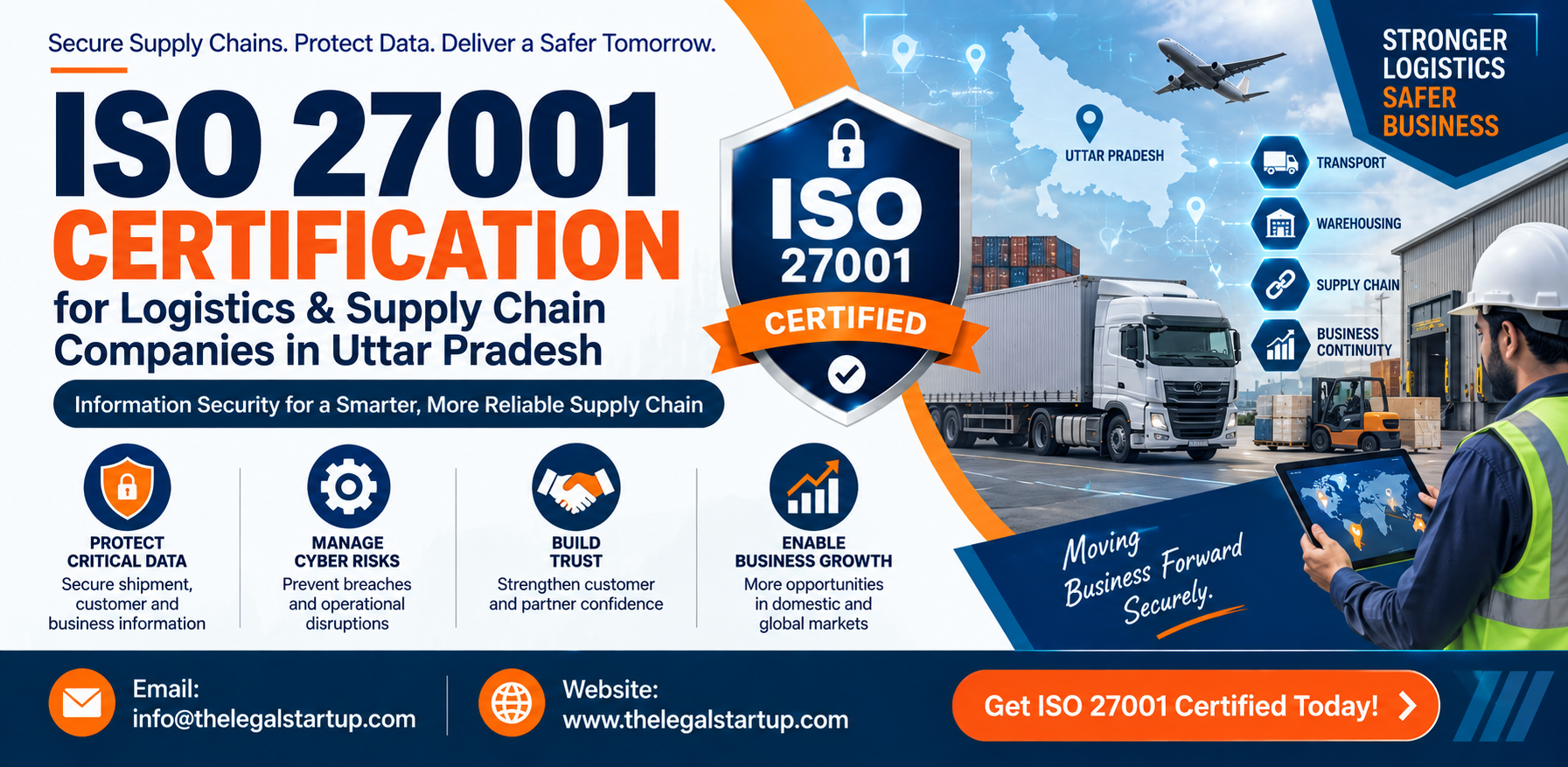
ISO 27001 Certification for Logistics and Supply Chain Companies in Uttar Pradesh
01 Sep 2026
Introduction
Modern logistics is powered by information. From shipment details and warehouse records to customer addresses, invoices, GPS data, vendor contracts, and digital proof of delivery, logistics companies depend on accurate and secure information every day.
A data breach or system outage can quickly affect deliveries, customer relationships, and revenue.
ISO 27001 Certification for Logistics & Supply Chain Companies in Uttar Pradesh provides a structured approach to identifying information-security risks and protecting critical business information. ISO/IEC 27001:2022 is the current international standard for Information Security Management Systems (ISMS), and it is applicable to organizations across sectors and of different sizes.
For logistics companies operating across cities such as Noida, Greater Noida, Ghaziabad, Lucknow, Kanpur, Agra, Meerut, and other industrial locations in Uttar Pradesh, information security is increasingly becoming a business requirement rather than an optional IT concern.
What Is ISO 27001 Certification for Logistics Companies?
ISO 27001 certification demonstrates that a company has established an Information Security Management System (ISMS) to systematically manage information-security risks.
A logistics or supply chain company may handle:
- Customer and consignee information
- Delivery and shipment records
- Warehouse management data
- GPS and vehicle tracking information
- Vendor and transporter details
- Purchase and sales information
- Financial and invoice records
- Employee information
- Cloud-based logistics platforms
- ERP and transportation management systems
For example, imagine a logistics company in Noida managing shipments for several manufacturing companies. If its transportation management system becomes unavailable or customer shipment information is exposed, multiple deliveries could be disrupted.
ISO 27001 helps businesses take a risk-based approach to protecting such information and supports the confidentiality, integrity, and availability of data.
Why Logistics & Supply Chain Companies Need ISO 27001
Supply chains involve many connected parties. A single shipment can involve a manufacturer, warehouse, transporter, driver, distributor, customer, and technology provider.
This creates multiple points where information can be accessed, transferred, stored, or exposed.
Common risks include:
- Phishing and business email attacks
- Unauthorized access to shipment systems
- Stolen employee credentials
- Ransomware and malware
- Loss of laptops or mobile devices
- Insecure cloud applications
- Data leakage through third-party vendors
- Poor backup and recovery practices
- Unauthorized changes to logistics records
- Weak controls over warehouse information
ISO explains that ISO/IEC 27001 uses a holistic approach involving people, policies, and technology, while helping organizations proactively identify and address information-security weaknesses.
Key Benefits of ISO 27001 Certification
1. Protect Customer and Shipment Data
Logistics companies regularly handle sensitive customer, consignee, shipment, and commercial information. ISO 27001 helps establish appropriate controls around access, storage, sharing, and handling of information.
2. Reduce Cybersecurity Risks
A formal risk-management process allows management to identify vulnerabilities and decide how those risks should be treated.
3. Improve Supply Chain Security
Your own systems may be secure, but suppliers, transporters, software providers, and other third parties can also create risks. ISO 27001 encourages organizations to consider information security across business relationships.
4. Minimize Operational Disruption
A logistics company depends on information being available when it is needed. Backup, recovery, incident management, and continuity arrangements can improve the organization's ability to respond to disruptions.
5. Build Customer Confidence
Large manufacturers, e-commerce companies, retailers, and corporate clients may want suppliers to demonstrate mature information-security practices. Certification can provide an independent signal of commitment.
6. Strengthen Internal Controls
Defined policies and responsibilities help employees understand who can access specific information and how that information should be protected.
7. Support Business Expansion
As logistics businesses add warehouses, vehicles, employees, customers, software, and delivery partners, a structured ISMS can help information-security practices scale with the organization.
ISO specifically notes that ISO/IEC 27001 can be adapted to an organization's size, objectives, processes, and structure.
Why Choose The Legal Startup?
ISO certification should not become an exercise in creating complicated documents that nobody uses.
At The Legal Startup, the focus is on helping businesses understand certification requirements and build practical systems around their actual operations.
For logistics and supply chain businesses, the certification approach can be aligned with areas such as:
- Warehouse operations
- Transportation management
- Customer information
- Vendor management
- Employee access
- Cloud platforms
- IT infrastructure
- Data backup
- Incident management
- Business continuity
The goal is to help your organization prepare for certification while developing information-security practices that make sense for everyday operations.
Whether you operate a regional transport business, third-party logistics company, warehouse network, freight operation, or technology-enabled supply chain business, the ISMS should reflect your actual risk environment.
Step-by-Step ISO 27001 Certification Process
Step 1: Initial Consultation
The process starts by understanding your organization, locations, services, departments, technology, information assets, and certification objectives.
Step 2: Define the ISMS Scope
The scope determines which business functions, locations, systems, and processes are covered by the Information Security Management System.
For a logistics company, this might include headquarters, warehouses, transportation operations, IT systems, or selected business units.
Step 3: Conduct a Risk Assessment
Information assets and potential threats are identified.
For example, risks could involve unauthorized access to a transportation management system, loss of warehouse data, phishing attacks, or inadequate controls over third-party logistics partners.
Step 4: Develop Required Documentation
Relevant policies, procedures, risk records, asset information, access controls, incident-management processes, backup procedures, and other ISMS documentation are prepared according to the organization's scope.
Step 5: Implement Security Controls
The organization puts the planned controls into operation.
This may involve access management, password controls, backup systems, employee awareness, supplier controls, incident response, secure information handling, and physical security measures.
Step 6: Employee Awareness Training
Employees are an important part of information security. Training can cover phishing, passwords, document handling, device security, access responsibilities, and incident reporting.
Step 7: Internal Audit
An internal audit checks whether the ISMS is implemented effectively and identifies areas requiring corrective action before the certification audit.
Step 8: Management Review and Certification Audit
Management reviews the ISMS and outstanding issues are addressed. An independent certification body then assesses the organization's management system against the applicable requirements.
ISO states that certification can demonstrate an organization's commitment and ability to manage information securely, with certification from an accredited conformity assessment body providing additional confidence.
Documents Required for ISO 27001 Certification
The exact documentation depends on the organization's size, scope, technology, and risk profile.
Commonly required information may include:
- Company registration details
- ISMS scope
- Information-security policy
- Information-security objectives
- Risk assessment records
- Risk treatment plan
- Information asset inventory
- Access-control procedures
- Password and authentication controls
- Incident-management procedures
- Backup and recovery procedures
- Business continuity arrangements
- Supplier-security records
- Employee training records
- Internal audit reports
- Management review records
- Corrective-action records
Good documentation should describe how the company actually operates. Simply preparing paperwork for an audit without implementing the related practices can weaken the effectiveness of the ISMS.
Who Can Benefit From ISO 27001 Certification?
ISO 27001 Certification for Logistics & Supply Chain Companies in Uttar Pradesh can benefit:
- Third-party logistics (3PL) companies
- Freight forwarding companies
- Transport and fleet operators
- Warehousing companies
- Distribution businesses
- Courier and delivery companies
- E-commerce logistics providers
- Cold-chain logistics companies
- Supply chain management companies
- Transportation technology companies
It can be especially valuable for organizations handling large volumes of customer, shipment, financial, operational, or commercially sensitive information.
ISO 27001 and Supply Chain Risk Management
Supply chain security does not stop at the company's office or warehouse.
A logistics business may share information with transporters, technology providers, customers, contractors, and other partners. Therefore, information-security risks can extend beyond the organization's direct employees.
An effective ISMS encourages businesses to understand these relationships and establish appropriate controls based on identified risks.
This is particularly important for logistics companies serving large manufacturers, retailers, exporters, pharmaceutical businesses, automotive companies, and e-commerce platforms.
Frequently Asked Questions
1. What is ISO 27001 Certification for Logistics & Supply Chain Companies in Uttar Pradesh?
It is certification of an organization's Information Security Management System against ISO/IEC 27001 requirements, helping logistics businesses systematically manage information-security risks.
2. Is ISO 27001 useful for logistics companies?
Yes. Logistics businesses handle customer information, shipment records, vendor data, financial information, warehouse records, and technology systems. ISO 27001 provides a structured approach to protecting this information.
3. How does ISO 27001 improve supply chain security?
It helps organizations identify information-security risks involving people, processes, technology, information assets, and relevant third-party relationships, followed by appropriate risk treatment and controls.
4. What documents are required for ISO 27001 certification?
Documents can include the ISMS scope, information-security policy, risk assessment, risk treatment plan, asset inventory, access controls, incident-management procedures, training records, internal audits, and management reviews.
5. How can a logistics company get ISO 27001 certification in Uttar Pradesh?
The company generally needs to define its ISMS scope, assess information-security risks, establish and implement appropriate controls, conduct internal audits and management reviews, address gaps, and undergo an independent certification audit.
Conclusion
Information is now one of the most important assets in the logistics and supply chain industry.
A missed delivery can cost money. A system outage can delay hundreds of shipments. A data breach can damage customer confidence and business relationships.
ISO 27001 Certification for Logistics & Supply Chain Companies in Uttar Pradesh provides a structured framework for managing these information-security risks and building stronger controls around people, processes, technology, and data.
The current published international standard is ISO/IEC 27001:2022, which ISO describes as a standard for establishing, implementing, maintaining, and continually improving an Information Security Management System.
If your logistics or supply chain business is planning ISO 27001 certification, The Legal Startup can help you understand the requirements and prepare your organization for the certification journey.
Ready to secure your logistics business?
Email: info@thelegalstartup.com
Website: www.thelegalstartup.com
Get in touch with The Legal Startup today and take the next step toward ISO 27001 certification.