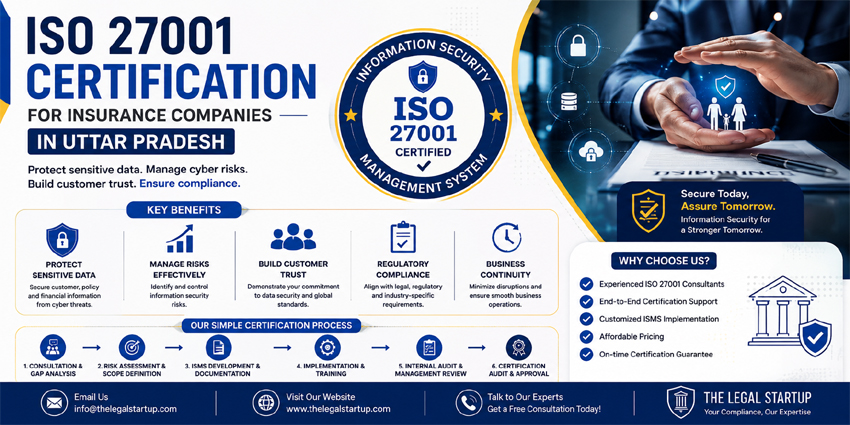
ISO 27001 Certification for Insurance Companies in Uttar Pradesh
20 Aug 2026
Introduction
Insurance companies handle a large volume of confidential information every day. Policyholder names, addresses, identity documents, medical records, financial details, claims information, payment records, and employee data all need appropriate protection.
At the same time, insurers are increasingly dependent on digital platforms, mobile applications, cloud systems, online policy services, insurance intermediaries, third-party technology providers, and remote work environments. This expanding digital ecosystem also creates more opportunities for cyber threats and information-security incidents.
ISO 27001 Certification for Insurance Companies in Uttar Pradesh provides a structured way to manage these information-security risks.
ISO/IEC 27001 is the internationally recognized standard for an Information Security Management System (ISMS). It uses a risk-based approach to help organizations identify information-security risks, establish appropriate controls, monitor their effectiveness, and continually improve the ISMS.
For an insurance company operating in Noida, Lucknow, Ghaziabad, Kanpur, Agra, Meerut, Varanasi, or another part of Uttar Pradesh, ISO 27001 certification can provide an organized framework for protecting important business and customer information.
What Is ISO 27001 Certification for Insurance Companies?
ISO 27001 certification confirms that an organization has established and maintains an Information Security Management System that meets the requirements of the standard.
For insurance businesses, information security extends beyond the IT department. It can involve employees, claims teams, agents, brokers, customer service departments, vendors, applications, physical offices, cloud platforms, and business processes.
An insurance company's ISMS may cover information such as:
- Policyholder and customer information
- KYC and identity documents
- Claims records
- Payment and banking information
- Insurance policy databases
- Employee records
- Agent and broker information
- Customer communication records
- Underwriting information
- Cloud and application data
- Business and financial records
- Backup and disaster-recovery information
The objective is to ensure that sensitive information remains appropriately confidential, accurate, and available to authorized users.
Why Insurance Companies in Uttar Pradesh Need Strong Information Security
Insurance operations increasingly depend on digital information.
Consider an insurance company in Noida that receives policy applications online. Customer documents may pass through websites, internal applications, cloud infrastructure, payment gateways, employees, and external service providers.
If access controls are weak or sensitive information is not properly managed, the organization may face unnecessary security and operational risks.
Similarly, a claims-processing company in Lucknow may rely on multiple employees and third-party systems to handle customer documents. A well-designed ISMS helps the organization identify where sensitive information exists, who can access it, what risks exist, and which controls are needed.
ISO 27001 does not replace insurance-sector laws, regulations, or requirements issued by the relevant authorities. Instead, it provides a management framework that can help an organization systematically address information-security risks.
For insurance businesses, this distinction is important: certification is not just about having cybersecurity tools; it is about managing information security as an organized business process.
Key Benefits of ISO 27001 Certification for Insurance Companies
1. Protects Sensitive Policyholder Information
Insurance companies process highly confidential customer data. ISO 27001 encourages organizations to establish appropriate controls for protecting information from unauthorized access, disclosure, loss, or alteration.
2. Improves Cyber Risk Management
A structured risk assessment helps insurers identify potential threats and prioritize risks based on their likelihood and business impact.
This allows management to focus resources on the risks that matter most.
3. Builds Customer Confidence
Customers want to know that their personal and financial information is being handled responsibly.
An internationally recognized ISO 27001 certification can demonstrate that information security is supported by a formal management system.
4. Strengthens Third-Party Risk Management
Insurance companies may work with brokers, agents, TPAs, technology providers, cloud providers, payment processors, and other external organizations.
ISO 27001 can help establish clearer expectations for information security when managing these relationships.
5. Supports Business Continuity
Cyberattacks, system failures, data loss, and other incidents can interrupt policy administration and claims operations.
An ISMS supports structured planning around incident response, backup, recovery, and business continuity.
6. Improves Internal Accountability
Defined responsibilities, documented procedures, access controls, training, audits, and management reviews make information-security responsibilities clearer across the organization.
7. Creates a Competitive Advantage
Security expectations are becoming increasingly important in enterprise partnerships and procurement.
ISO 27001 certification can help an insurance organization demonstrate a formal commitment to information-security management when dealing with customers, partners, and vendors.
Step-by-Step ISO 27001 Certification Process
The certification process varies according to the company's size, scope, existing systems, and level of preparedness. A typical implementation journey includes the following stages.
Step 1: Initial Consultation and Gap Assessment
The first stage is to understand the insurance company's current security practices.
A gap assessment identifies areas where existing processes and controls differ from ISO 27001 requirements.
Step 2: Define the ISMS Scope
The organization decides what will be covered by the Information Security Management System.
The scope could include:
- Head office
- Branch operations
- Claims processing
- IT infrastructure
- Customer portals
- Insurance applications
- Cloud systems
- Specific business units
A clearly defined scope prevents confusion during implementation and certification.
Step 3: Identify Information Assets and Risks
The organization identifies important information assets and evaluates the risks associated with them.
For example, customer databases, claims documents, laptops, applications, servers, cloud services, and paper records may all require consideration.
Step 4: Develop the Risk Treatment Plan
After assessing risks, the organization determines how each significant risk should be treated.
Depending on the circumstances, risks may be reduced, transferred, avoided, or accepted according to the organization's established approach.
Step 5: Prepare ISMS Documentation
The organization develops policies, procedures, records, and controls appropriate to its scope.
The documentation should describe how information security actually operates within the company rather than simply being created for the audit.
Step 6: Implement Security Controls
Relevant controls are implemented across people, processes, technology, and physical environments.
Examples can include access management, authentication, asset management, incident management, supplier controls, backup procedures, security awareness, and other applicable measures.
Step 7: Employee Awareness and Training
Employees are a critical part of information security.
Training can cover phishing, password security, data handling, incident reporting, access responsibilities, and safe use of company systems.
Step 8: Internal Audit
An internal audit evaluates whether the ISMS has been properly implemented and whether processes are working as intended.
Any nonconformities should be addressed through corrective actions.
Step 9: Management Review
Top management reviews the ISMS performance, including audit results, risks, incidents, objectives, corrective actions, and improvement opportunities.
Step 10: Certification Audit
An independent certification body conducts the external audit.
If the organization meets the applicable requirements, certification is issued for the defined ISMS scope.
Documents Required for ISO 27001 Certification
Documentation depends on the organization's size, scope, risks, and processes. Common documents and records may include:
- ISMS scope document
- Information-security policy
- Information-security objectives
- Risk assessment methodology
- Information-security risk assessment
- Risk treatment plan
- Statement of Applicability (SoA)
- Asset inventory
- Access-control policy
- Password and authentication procedures
- Incident-management procedure
- Backup and recovery procedures
- Business continuity procedures
- Supplier-security procedures
- Employee security policies
- Information-security awareness records
- Internal audit reports
- Corrective action records
- Management review records
- Applicable legal and regulatory requirements
- Evidence of implemented security controls
The important point is that documents should be supported by actual implementation and evidence.
An insurance company should not simply prepare policies for an audit and leave them unused. Effective ISO 27001 implementation connects documentation with everyday business operations.
Why Choose The Legal Startup?
Selecting the right certification support partner can make the implementation process easier to understand and manage.
The Legal Startup helps businesses with ISO certification consultancy, documentation support, implementation guidance, audit preparation, and certification coordination.
For insurance companies, the approach should be based on the organization's actual information assets, technology environment, business processes, risks, and certification scope.
Whether the organization is an established insurer, insurance service provider, claims-processing business, insurance technology company, or another related organization, professional guidance can help identify implementation requirements and prepare for the certification process.
The goal should not be to create unnecessary paperwork. The goal is to build an ISMS that can work effectively in the organization's real operating environment.
Frequently Asked Questions
1. What is ISO 27001 Certification for Insurance Companies in Uttar Pradesh?
ISO 27001 certification demonstrates that an insurance company has established an Information Security Management System for identifying, managing, monitoring, and improving information-security risks.
2. Is ISO 27001 mandatory for insurance companies in Uttar Pradesh?
ISO 27001 should not automatically be considered a universal mandatory requirement for every insurance company. Insurance businesses must comply with applicable laws, regulations, and regulatory requirements. ISO 27001 is an internationally recognized information-security management standard that can complement an organization's broader security and compliance framework.
3. How does ISO 27001 help an insurance company?
It can help an insurer protect sensitive information, improve risk management, strengthen internal controls, manage third-party risks, improve incident preparedness, and demonstrate a structured approach to information security.
4. What documents are required for ISO 27001 certification?
Typical documentation includes an ISMS scope, information-security policy, risk assessment, risk treatment plan, Statement of Applicability, asset inventory, security procedures, internal audit records, management review records, and evidence showing that applicable controls are implemented.
5. How can an insurance company get ISO 27001 certification in Uttar Pradesh?
The organization generally begins with a gap assessment and scope definition, followed by risk assessment, ISMS development, control implementation, employee awareness, internal audit, management review, and an independent certification audit.
Conclusion
Insurance companies manage information that customers expect them to protect. As digital policy administration, online claims, cloud platforms, mobile applications, and third-party services become increasingly important, information security needs to be managed as a business priority.
ISO 27001 Certification for Insurance Companies in Uttar Pradesh provides a structured framework for identifying information-security risks and implementing controls that support confidentiality, integrity, availability, and continual improvement.
If your insurance organization is planning ISO 27001 certification, The Legal Startup can help you understand the requirements, establish the right certification scope, prepare documentation, implement the ISMS, and get ready for the certification audit.