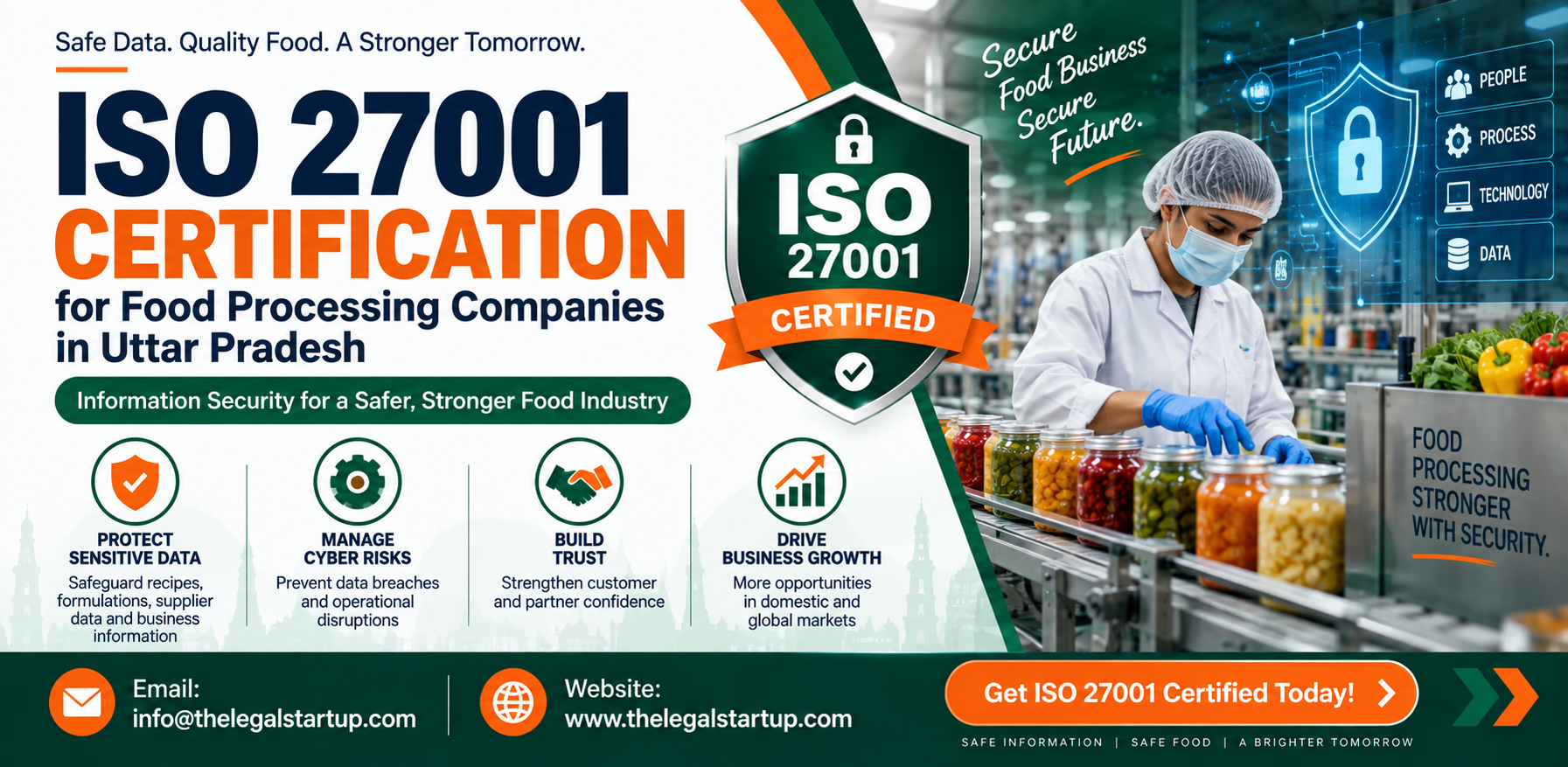
ISO 27001 Certification for Food Processing Companies in Uttar Pradesh
30 Aug 2026
Introduction
Food processing businesses handle much more than raw materials and finished products. They also manage supplier information, customer records, production data, recipes, pricing, employee details, quality reports, ERP systems, and confidential business information.
As food manufacturers in Uttar Pradesh become more connected through cloud software, digital payments, automated production systems, and online supply chains, information security has become a business priority.
ISO 27001 Certification for Food Processing Companies in Uttar Pradesh provides a structured way to identify information-security risks, protect sensitive data, improve internal controls, and build confidence among customers, suppliers, and business partners.
ISO/IEC 27001:2022 is the current international standard for Information Security Management Systems (ISMS). ISO states that the standard can be applied by organizations of different sizes and sectors and focuses on managing information-security risks through people, processes, and technology.
What Is ISO 27001 Certification for Food Processing Companies?
ISO 27001 certification demonstrates that a food processing company has established a systematic Information Security Management System (ISMS) for managing information-security risks.
For example, consider a food manufacturer in Noida supplying packaged products to supermarkets across India. Its business may depend on:
- Digital production and inventory records
- Supplier and distributor databases
- Product formulations and recipes
- Customer and employee information
- Accounting and payment systems
- Quality-control reports
- Cloud applications and ERP software
- Email and document-sharing platforms
A security incident involving any of these systems can interrupt operations or expose confidential information.
ISO 27001 helps the organization identify such risks and establish appropriate controls to protect the confidentiality, integrity, and availability of information.
Why Food Processing Companies in Uttar Pradesh Need ISO 27001
Uttar Pradesh has a large and diverse food-processing ecosystem, including dairy businesses, packaged-food manufacturers, grain processors, beverage companies, spice manufacturers, cold-chain operators, and export-oriented food businesses.
As these companies expand, information moves between factories, warehouses, suppliers, logistics partners, retailers, and customers.
Common information-security risks can include:
- Unauthorized access to ERP systems
- Employee password misuse
- Loss of production or inventory data
- Phishing and business-email compromise
- Malware and ransomware incidents
- Inadequate data backups
- Unauthorized access to confidential recipes
- Third-party supplier security risks
- Loss or theft of laptops and storage devices
ISO 27001 encourages a risk-based approach rather than relying only on individual security tools. ISO describes the standard as supporting risk management, cyber resilience, and protection of information in different forms, including digital, cloud-based, and paper records.
Key Benefits of ISO 27001 Certification
1. Protect Confidential Business Information
Food manufacturers often possess valuable commercial information, from recipes and pricing models to supplier agreements and customer databases. An effective ISMS helps control who can access this information.
2. Reduce Cybersecurity Risks
ISO 27001 encourages organizations to identify threats and vulnerabilities before they become costly incidents.
3. Strengthen Customer and Buyer Trust
Large retailers, distributors, exporters, and corporate buyers increasingly want assurance that their suppliers manage information responsibly. Certification can provide an independent demonstration of your information-security commitment.
4. Improve Business Continuity
A food-processing operation cannot afford unnecessary downtime. Backup, recovery, access control, incident management, and continuity planning can help the company respond more effectively when problems occur.
5. Improve Employee Awareness
Technology alone cannot prevent every security incident. ISO 27001 supports appropriate policies, responsibilities, awareness, and processes so employees understand how information should be handled.
6. Support Business Growth
A structured information-security system can make it easier to manage security as the company adds employees, facilities, software platforms, suppliers, and customers.
7. Create Better Internal Controls
Clear policies and responsibilities help management understand where sensitive information is stored, who can access it, and how risks are being controlled.
Why Choose The Legal Startup?
Obtaining certification should not mean creating unnecessary paperwork or complicated processes.
The Legal Startup provides end-to-end ISO certification support, from initial consultation and documentation to implementation guidance and audit preparation. Its website states that the team supports businesses with consultation, document preparation, implementation guidance, internal audits, and certification support.
For a food processing company, the approach should be practical and aligned with actual operations.
We can help businesses understand:
- Which information assets need protection
- How to identify information-security risks
- What policies and procedures are required
- How employees should handle sensitive information
- How to prepare for internal and certification audits
- How to maintain the ISMS after certification
The objective is not simply to obtain a certificate. It is to help establish a workable information-security framework that fits the business.
Step-by-Step ISO 27001 Certification Process
Step 1: Initial Consultation
The process begins by understanding your food-processing business, locations, departments, technology, information assets, and certification objectives.
Step 2: Define the ISMS Scope
The organization determines which business functions, locations, systems, departments, and information assets will fall within the ISMS scope.
Step 3: Identify Information-Security Risks
Potential threats and vulnerabilities are assessed. For example, the company may identify risks involving ERP access, supplier databases, production systems, employee devices, cloud applications, or physical records.
Step 4: Prepare Policies and Documentation
Relevant ISMS policies, procedures, risk-management records, asset information, access controls, incident-management procedures, and supporting documents are prepared according to the organization's scope and requirements.
Step 5: Implement Security Controls
The company puts the planned controls into practice. This may involve access management, backup procedures, employee awareness, incident response, supplier controls, secure handling of information, and other applicable measures.
Step 6: Employee Awareness and Training
Employees should understand their information-security responsibilities. Training can cover password practices, phishing awareness, access rights, document handling, reporting incidents, and secure use of company systems.
Step 7: Internal Audit and Management Review
Before the certification audit, the organization checks whether its ISMS is working as intended. Gaps are identified and corrective actions are taken.
Step 8: Certification Audit
An independent certification body assesses the organization's ISMS against the applicable requirements. Successful completion can lead to certification.
ISO notes that certification is one way for an organization to demonstrate to stakeholders that it is committed to managing information securely; certification is performed through a conformity-assessment process.
Documents Required for ISO 27001 Certification
The exact documentation depends on the organization's size, scope, technology, and risk profile. Food processing companies may typically need information such as:
- Business registration details
- Organization and process information
- ISMS scope
- Information-security policy
- Information-security objectives
- Risk assessment and risk treatment records
- Asset inventory
- Access-control procedures
- Incident-management procedures
- Backup and recovery procedures
- Business continuity arrangements
- Employee awareness and training records
- Supplier and third-party security information
- Internal audit records
- Management review records
- Corrective-action records
The important point is that documentation should reflect how your company actually operates rather than being created merely to satisfy an audit.
Who Can Benefit From ISO 27001 in the Food Industry?
ISO 27001 Certification for Food Processing Companies in Uttar Pradesh can be useful for businesses such as:
- Packaged food manufacturers
- Dairy and dairy-product processors
- Beverage manufacturers
- Spice and seasoning manufacturers
- Grain and flour processing companies
- Frozen-food businesses
- Snack and ready-to-eat food manufacturers
- Food ingredient manufacturers
- Export-oriented food processors
- Large food warehouses and processing operations
It can be particularly valuable for businesses handling significant customer, supplier, financial, production, or proprietary information.
ISO 27001 vs ISO 22000: Are They the Same?
No. They address different management-system objectives.
ISO 22000 focuses primarily on food safety management, while ISO/IEC 27001 focuses on information security management.
A food processing company may therefore benefit from both systems when it needs to manage food-safety risks as well as information-security risks. The Legal Startup currently offers ISO 22000 certification as well as ISO 27001-related certification services.
Frequently Asked Questions
1. What is ISO 27001 Certification for Food Processing Companies in Uttar Pradesh?
It is certification against ISO/IEC 27001 for a food-processing organization's Information Security Management System, helping the company systematically manage information-security risks.
2. Is ISO 27001 useful for small food processing companies?
Yes. ISO/IEC 27001 is designed to be applicable to organizations of different sizes and sectors. The scope and controls can be aligned with the company's actual risks and business requirements.
3. How does ISO 27001 protect food manufacturing data?
It establishes a structured approach to identifying risks and applying appropriate information-security controls covering people, processes, technology, access, information handling, incident response, and other relevant areas.
4. Is ISO 27001 the same as ISO 22000?
No. ISO 27001 addresses information security, while ISO 22000 addresses food safety management. A food-processing company may implement both depending on its business needs.
5. How can I get ISO 27001 Certification in Uttar Pradesh?
Start with an assessment of your business scope and information-security requirements. The next steps generally include ISMS planning, risk assessment, documentation, implementation, internal audit, corrective actions, and an independent certification audit.
Conclusion
For modern food-processing companies, protecting information is becoming just as important as protecting physical production assets.
From supplier databases and ERP systems to recipes, financial records and customer information, a strong information-security framework can help reduce business risk and strengthen stakeholder confidence.
ISO 27001 Certification for Food Processing Companies in Uttar Pradesh gives businesses a structured, internationally recognized approach to managing information-security risks. ISO/IEC 27001:2022 is the current published edition of the standard.
If you are planning certification, The Legal Startup can help you understand the requirements, prepare the necessary system, and move through the certification process with practical guidance.
Ready to strengthen your food business's information security?
Email: info@thelegalstartup.com
Website: www.thelegalstartup.com
Contact The Legal Startup today and start your ISO 27001 certification journey.