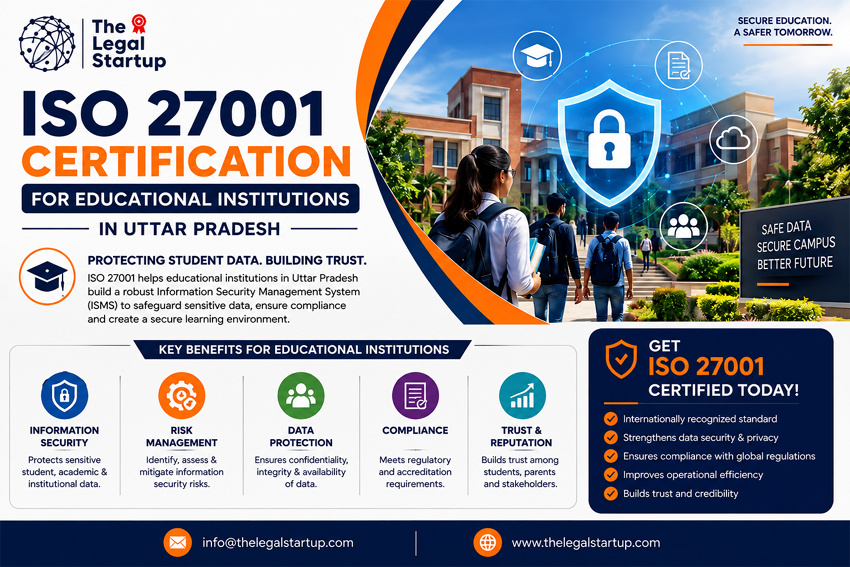
ISO 27001 Certification for Educational Institutions in Uttar Pradesh
01 Aug 2026
Introduction
Schools, colleges, universities, coaching institutes, training centers, and other educational organizations now depend heavily on digital systems. Student admission records, examination results, attendance data, fee information, employee records, learning platforms, identity documents, and academic credentials may all be stored electronically.
Online classes and cloud-based education platforms have made information access easier, but they have also increased the importance of information security.
This is why ISO 27001 Certification for Educational Institutions in Uttar Pradesh can be a valuable part of an institution's information-security strategy.
The current international standard is ISO/IEC 27001:2022, which specifies requirements for establishing, implementing, maintaining, and continually improving an Information Security Management System (ISMS). ISO states that the standard can be applied by organizations of different sizes and sectors.
For an educational institution in Noida, Lucknow, Ghaziabad, Greater Noida, Kanpur, Agra, or another part of Uttar Pradesh, ISO 27001 can provide a structured way to identify information-security risks and establish appropriate controls.
Why Information Security Matters in Education
Consider a college that stores student admission forms, identity documents, examination results, fee records, and certificates in a cloud-based student-management system.
Now consider a school using an online learning platform where teachers, students, and parents have different levels of access.
If accounts are poorly managed or information is accidentally exposed, the consequences can go beyond an IT problem. It can affect student privacy, institutional reputation, operations, and trust.
ISO 27001 takes a broader approach by considering people, processes, technology, and risk management together. It aims to protect the confidentiality, integrity, and availability of information.
Why Choose The Legal Startup?
Educational institutions have different information-security needs depending on their size, facilities, technology, and services.
A university with multiple departments and campuses will have a very different risk profile from a small private school or training institute.
The Legal Startup can help organizations approach ISO certification according to their actual operations, information assets, risks, and certification scope.
Our support can include:
-
Understanding the institution's operations and technology environment
-
Defining the appropriate ISMS scope
-
Reviewing existing information-security practices
-
Conducting a gap assessment
-
Supporting ISMS documentation
-
Guiding information-security risk assessment
-
Supporting implementation of relevant processes
-
Helping establish employee and staff security responsibilities
-
Preparing for internal audits
-
Supporting corrective-action planning
-
Preparing the institution for the certification audit
The objective is not to create a collection of documents that exists only for certification.
The ISMS should become part of everyday information-management practices.
For example, an institution may need specific controls for student portals, examination systems, staff accounts, cloud storage, learning-management systems, CCTV or access systems, backup arrangements, and third-party software providers.
Key Benefits of ISO 27001 Certification for Educational Institutions
1. Protects Student and Academic Information
Educational organizations may hold a wide range of sensitive information, including:
-
Student admission records
-
Identity documents
-
Academic results
-
Attendance records
-
Fee and payment information
-
Parent or guardian contact information
-
Employee records
-
Examination materials
-
Certificates and credentials
-
Research information
-
Intellectual property
ISO 27001 provides a systematic framework for identifying risks to information and establishing appropriate measures to manage those risks.
2. Builds Student and Parent Confidence
Parents and students expect educational institutions to handle personal and academic information responsibly.
A certified ISMS can demonstrate that information security is being managed through a recognized framework rather than relying solely on informal practices.
For private schools, colleges, universities, and education businesses, this can strengthen institutional credibility.
3. Improves Access Control
Educational organizations have many different users.
Students, teachers, administrators, examination teams, finance staff, IT administrators, visiting faculty, vendors, and management may all need different levels of access.
A structured information-security system can help manage:
-
User accounts
-
Role-based access
-
Administrative privileges
-
Authentication
-
Access reviews
-
Employee onboarding
-
Employee transfers
-
Employee offboarding
-
Third-party access
The practical goal is simple: users should receive the access required for their responsibilities, not unrestricted access to institutional information.
4. Protects Examination Information
Examination papers, answer records, results, evaluation information, and academic credentials can be highly sensitive.
Unauthorized access or alteration can create serious institutional problems.
An effective ISMS can support better controls around access, storage, transmission, backup, and handling of examination-related information.
5. Supports Digital Learning Security
Modern institutions may use:
-
Learning Management Systems
-
Student portals
-
Online examination platforms
-
Cloud storage
-
Video-conferencing platforms
-
Mobile applications
-
Digital libraries
-
Online payment systems
Each technology introduces information-security considerations.
ISO 27001 provides a framework for assessing the associated risks and establishing appropriate processes.
6. Improves Third-Party Risk Management
Educational institutions frequently rely on external providers for:
-
Student-management software
-
Cloud hosting
-
Learning platforms
-
Payment gateways
-
IT support
-
Examination services
-
Payroll systems
-
Security services
-
Website development
Third-party relationships can create additional information-security risks.
An ISMS can help institutions establish a more systematic approach to evaluating and managing those risks.
7. Strengthens Business Continuity
A major IT outage can affect admissions, classes, examinations, fee collection, communication, and administrative operations.
ISO 27001 encourages organizations to identify risks affecting information availability and establish appropriate continuity, backup, and recovery arrangements.
8. Improves Incident Management
Educational institutions should know what to do if an account is compromised, a laptop is lost, malware is detected, or confidential information is accidentally shared.
A formal incident-management process can define how incidents are reported, assessed, handled, documented, and reviewed.
9. Supports Continuous Improvement
Education technology changes quickly.
New applications, online services, cloud platforms, staff members, vendors, and digital processes can change the institution's information-security risk profile.
ISO 27001 is designed around maintaining and continually improving the ISMS rather than treating certification as a one-time project.
Step-by-Step ISO 27001 Certification Process
Step 1: Define the ISMS Scope
First, determine which educational activities, locations, systems, and departments will be covered.
The scope could include:
-
A complete school or college
-
A university campus
-
Administrative operations
-
IT and digital-learning systems
-
Examination processes
-
Student-management systems
-
Selected departments
A clearly defined scope makes implementation and auditing more practical.
Step 2: Conduct a Gap Assessment
Existing policies, procedures, systems, responsibilities, and security practices are reviewed against applicable ISO 27001 requirements.
The objective is to identify gaps before the certification audit.
Step 3: Identify Information Assets and Risks
The institution identifies the information and systems that require protection.
Examples include:
-
Student databases
-
Admission records
-
Examination systems
-
Academic results
-
Learning platforms
-
Financial records
-
Employee information
-
Research data
-
Cloud applications
-
Backup systems
Relevant threats and vulnerabilities are then assessed according to the organization's risk-management methodology.
Step 4: Develop ISMS Documentation
The institution develops relevant information-security policies, procedures, objectives, responsibilities, risk-treatment information, and records.
Documentation should reflect actual institutional practices rather than generic templates.
Step 5: Implement the ISMS
The defined policies and processes are put into practice.
Staff members should understand their responsibilities, while management should monitor the effectiveness of the information-security system.
Step 6: Conduct an Internal Audit
An internal audit checks whether the ISMS has been implemented and maintained effectively.
Any identified nonconformities should be addressed before the external certification audit.
Step 7: Management Review
Top management reviews the ISMS performance, including:
-
Audit results
-
Information-security risks
-
Security incidents
-
Objectives
-
Corrective actions
-
Changes affecting the institution
-
Opportunities for improvement
Step 8: Certification Audit
An independent certification body conducts the external audit.
If the institution demonstrates conformity with the applicable ISO 27001 requirements, the certification body can issue the ISO 27001 certificate.
ISO distinguishes between implementing ISO/IEC 27001 and obtaining certification. An organization can implement the standard without certification, while independent certification can provide additional assurance to stakeholders.
Documents Required for ISO 27001 Certification
The exact documentation depends on the institution's size, technology environment, information assets, risks, and certification scope.
Common documents and records may include:
-
Institution registration or establishment documents
-
Institutional profile
-
Organizational structure
-
ISMS scope
-
Information-security policy
-
Information-security objectives
-
Risk assessment methodology
-
Risk assessment records
-
Risk treatment information
-
Asset-related records
-
Access-control procedures
-
Incident-management procedures
-
Backup and recovery procedures
-
Business continuity information
-
Supplier-management records
-
Staff security-awareness records
-
Internal audit records
-
Management review records
-
Corrective-action records
-
Applicable legal and contractual requirements
Education-Specific Evidence
Depending on the scope, additional evidence may relate to:
-
Student information management
-
Examination-data protection
-
Student portal access
-
Learning-management systems
-
Online examination platforms
-
Academic-record management
-
Cloud-storage security
-
Staff and faculty access
-
Third-party education software
-
Backup and recovery
-
Incident reporting
-
Secure disposal of records
-
Research-data protection
The purpose of documentation is not simply to satisfy an auditor.
It should help the institution establish repeatable practices that staff can understand and follow.
Which Educational Institutions Can Apply for ISO 27001?
ISO/IEC 27001 is applicable to organizations of different sizes and sectors.
It can be relevant to:
-
Schools
-
Private schools
-
Colleges
-
Universities
-
Educational trusts
-
Coaching institutes
-
Vocational training centers
-
Skill-development organizations
-
Distance-learning providers
-
Online education companies
-
EdTech organizations
-
Research and academic institutions
-
Professional training institutes
The ISMS should be scaled according to the institution's size, services, information assets, technology environment, and risks.
ISO also provides a practical SME guide to help smaller organizations understand and implement ISO/IEC 27001 without assuming the resources of a large enterprise.
ISO 27001 Certification for Educational Institutions in Major Uttar Pradesh Locations
Educational institutions across Uttar Pradesh can use ISO 27001 to strengthen their information-security framework.
The certification may be particularly relevant for institutions operating in:
-
Noida
-
Greater Noida
-
Ghaziabad
-
Lucknow
-
Kanpur
-
Agra
-
Meerut
For institutions using extensive digital systems, online examinations, cloud applications, student portals, or third-party education technology, information-security management can become an important part of institutional governance.
Internal Linking Suggestions for The Legal Startup
For stronger topical authority and better user navigation, add contextual internal links to relevant pages on The Legal Startup.
Recommended Internal Links
-
ISO 27001 Certification → Link to the dedicated ISO 27001 service page.
-
ISO Certification Services → Link to the main ISO certification services page.
-
ISO 9001 Certification → Useful when discussing quality-management systems.
-
ISO 21001 Certification → Highly relevant to educational organizations and educational management systems, where available on the site.
-
ISO 45001 Certification → Useful when discussing occupational health and safety in educational campuses.
-
Business Registration Services → Relevant for private educational institutions, trusts, and education startups.
Use descriptive anchor text naturally rather than repeatedly using the same exact-match keyword.
External Authority Reference
The strongest authority for the information-security claims in this article is the official International Organization for Standardization (ISO) page for ISO/IEC 27001:2022. ISO confirms that the standard applies to organizations across sectors and provides a framework for managing information-security risks.
For smaller educational organizations, ISO's ISO/IEC 27001:2022 practical guide for SMEs is another useful authority reference. It explains how organizations with limited resources can establish and maintain an ISMS appropriate to their circumstances.
The Government of India's Ministry of Education also demonstrates the importance of privacy and information handling in digital education initiatives. For example, the current APAAR privacy policy describes the collection and safeguarding of personal and educational information, including academic records.
Recommended external authority references:
Frequently Asked Questions
1. What is ISO 27001 certification for educational institutions?
ISO 27001 certification demonstrates that an educational institution's Information Security Management System has been independently assessed against applicable ISO/IEC 27001 requirements. It provides a structured approach to identifying and managing information-security risks.
2. Is ISO 27001 mandatory for schools and colleges in Uttar Pradesh?
ISO 27001 is not universally mandatory for every school, college, or university. However, institutions may choose certification to strengthen information-security governance, meet contractual or stakeholder expectations, and demonstrate a structured approach to protecting information.
3. How does ISO 27001 protect student data?
ISO 27001 provides a risk-management framework covering areas such as access control, information handling, incident management, asset protection, supplier management, backup, business continuity, and continual improvement. It is designed to protect the confidentiality, integrity, and availability of information.
4. What documents are required for ISO 27001 certification in educational institutions?
Typical documentation includes the ISMS scope, information-security policy, risk assessment and treatment information, relevant procedures, internal audit records, management review information, and evidence that applicable processes and controls have been implemented.
5. Can a small school or coaching institute obtain ISO 27001 certification?
Yes. ISO/IEC 27001 is applicable to organizations of different sizes. A smaller educational institution can establish an ISMS appropriate to its information assets, technology environment, activities, and risks. ISO also provides practical guidance for SMEs implementing the standard.
Conclusion
Educational institutions now manage much more than paper records. Student databases, academic results, examination materials, online learning platforms, financial information, employee records, research data, and digital credentials have become important institutional assets.
Protecting this information requires more than antivirus software or basic passwords.
ISO 27001 Certification for Educational Institutions in Uttar Pradesh provides a recognized framework for managing information-security risks through policies, processes, technology, staff responsibilities, supplier management, audits, management review, and continual improvement.
Whether you operate a private school in Noida, a college in Greater Noida, a university in Lucknow, a coaching institute in Ghaziabad, or an EdTech organization elsewhere in Uttar Pradesh, a properly scoped ISMS can strengthen information-security governance and stakeholder confidence.
Ready to Start Your ISO 27001 Certification?
Don't wait until a data incident, technology expansion, or institutional requirement forces you to review your information-security practices.
Contact The Legal Startup to discuss your educational institution's ISO 27001 requirements and determine the appropriate certification approach.
Email: info@thelegalstartup.com
Website: www.thelegalstartup.com