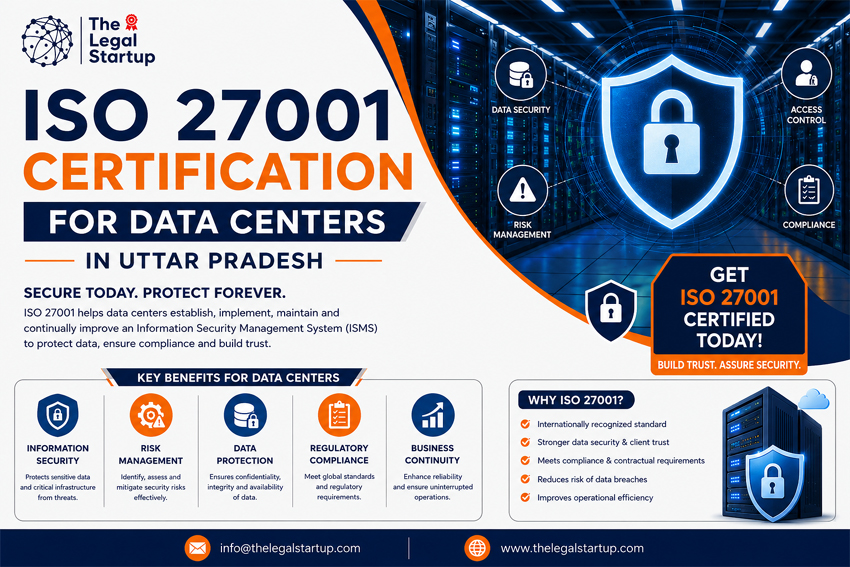
ISO 27001 Certification for Data Centers in Uttar Pradesh
29 Jul 2026
Introduction
A modern data center is responsible for much more than storing information. It supports applications, websites, cloud platforms, databases, enterprise systems, and digital services that businesses depend on every day.
A security incident, unauthorized access, system failure, or loss of critical information can have serious consequences for both the data center operator and its customers.
This makes information security a business priority.
ISO 27001 Certification for Data Centers in Uttar Pradesh provides a structured framework for establishing and maintaining an Information Security Management System (ISMS). The current international standard is ISO/IEC 27001:2022, which focuses on systematically managing information-security risks and continually improving the ISMS.
For data centers operating in Noida, Greater Noida, Lucknow, Ghaziabad, Kanpur, or other technology and commercial hubs across Uttar Pradesh, ISO 27001 can help demonstrate that information security is being managed through defined processes rather than isolated technical measures.
Why ISO 27001 Matters for Data Centers
Data centers manage multiple categories of sensitive information and infrastructure. This can include customer data, server configurations, access credentials, network information, monitoring records, contracts, and operational documentation.
Security also extends beyond software.
Physical access, employees, vendors, cloud services, backup systems, environmental controls, incident response, and business continuity can all affect information security.
ISO 27001 provides a management framework that brings these areas together through a risk-based approach.
Why Choose The Legal Startup?
Data center environments can be technically complex. A generic documentation package may not accurately reflect how your infrastructure, employees, vendors, and customers operate.
The Legal Startup provides ISO certification assistance designed around the organization's business activities and certification requirements.
Our support can include:
-
Understanding the data center's certification scope
-
Reviewing existing information-security practices
-
Conducting a gap assessment
-
Supporting ISMS documentation
-
Guiding information-security risk assessment
-
Assisting with implementation requirements
-
Preparing teams for internal audits
-
Supporting corrective-action planning
-
Helping prepare for the certification audit
-
Providing guidance throughout the certification process
The objective should be more than obtaining an ISO certificate.
A useful ISMS should become part of the organization's day-to-day security and operational practices.
For example, a data center may need to pay particular attention to privileged access, visitor management, asset management, backup procedures, supplier controls, incident management, business continuity, and protection of infrastructure information.
Key Benefits of ISO 27001 Certification for Data Centers
1. Strengthens Information Security
Data centers need to protect information across multiple environments, including servers, networks, cloud systems, databases, administrative systems, and physical records.
ISO 27001 provides a systematic framework for identifying security risks and determining appropriate controls.
2. Improves Customer Confidence
Customers placing critical workloads with a data center want assurance that their information and systems are being managed responsibly.
ISO 27001 certification can provide independent evidence that the organization's ISMS has been assessed against the applicable standard requirements.
This can be valuable when responding to enterprise customer security questionnaires and vendor assessments.
3. Supports Business Continuity
A data center cannot afford to treat operational resilience as an afterthought.
Power failures, equipment problems, cyber incidents, human errors, supplier failures, and other disruptions can affect service availability.
ISO 27001 encourages organizations to identify risks and establish appropriate processes for managing them.
4. Helps Manage Third-Party Risks
Data centers often work with multiple external parties, including:
-
Hardware suppliers
-
Network providers
-
Security vendors
-
Cloud service providers
-
Facility-management companies
-
Maintenance contractors
-
Software vendors
A structured supplier-management process can help the organization understand and manage information-security risks associated with third parties.
5. Improves Access Management
Not everyone should have unrestricted access to critical systems.
An effective ISMS can help establish clearer processes for user access, privileged accounts, authentication, access reviews, employee changes, and removal of access when it is no longer required.
6. Supports Regulatory and Contractual Requirements
Data center customers may operate in industries with specific privacy, security, regulatory, or contractual requirements.
ISO 27001 does not automatically make an organization compliant with every law or customer requirement. However, a formal ISMS can provide a strong management foundation for identifying and addressing applicable obligations.
7. Creates a Culture of Continuous Improvement
Information-security threats evolve.
A data center's security program therefore needs regular monitoring, review, testing, internal audits, corrective actions, and improvement.
ISO 27001 treats information security as an ongoing management responsibility rather than a one-time project.
Step-by-Step ISO 27001 Certification Process for Data Centers
Step 1: Define the Certification Scope
The first step is deciding exactly what the ISO 27001 certification will cover.
The scope may include:
-
A specific data center facility
-
Data center operations
-
Supporting IT infrastructure
-
Security operations
-
Selected departments
-
Specific services or platforms
A clearly defined scope helps prevent unnecessary complexity later.
Step 2: Conduct a Gap Assessment
Existing security policies, processes, infrastructure practices, responsibilities, and controls are reviewed against the applicable ISO 27001 requirements.
The assessment identifies areas that need improvement before the certification audit.
Step 3: Identify Information Assets and Risks
The organization identifies important information assets and evaluates potential risks.
For a data center, these may include:
-
Customer information
-
Servers
-
Network infrastructure
-
Databases
-
Backup systems
-
Security systems
-
Administrative accounts
-
Configuration information
-
Monitoring systems
-
Physical access systems
Risks are then assessed according to the organization's defined methodology.
Step 4: Develop the ISMS
The required ISMS documentation is prepared based on the organization's scope and risks.
This may include information-security policies, procedures, risk-management information, responsibilities, objectives, records, and other documented information relevant to the ISMS.
Step 5: Implement Security Processes
The organization puts its documented processes and controls into operation.
Employees and relevant third parties should understand their responsibilities, while management should monitor the effectiveness of the ISMS.
Step 6: Conduct an Internal Audit
An internal audit evaluates whether the ISMS has been properly implemented and maintained.
Any nonconformities or weaknesses should be addressed before the external certification audit.
Step 7: Management Review
Top management reviews the ISMS performance, including audit results, security risks, incidents, objectives, corrective actions, and opportunities for improvement.
Step 8: Certification Audit
An independent certification body conducts the external audit.
If the organization demonstrates conformity with the applicable ISO 27001 requirements, the certification body can issue the ISO 27001 certificate.
ISO distinguishes implementation of ISO/IEC 27001 from certification. An organization can implement the standard without certification, while independent certification can provide additional assurance to customers and interested parties.
Documents Required for ISO 27001 Certification
The documentation required depends on the organization's scope, size, infrastructure, risks, and operating model.
Common documentation and records can include:
-
Company registration documents
-
Company profile
-
Organizational structure
-
ISMS scope
-
Information-security policy
-
Information-security objectives
-
Risk assessment methodology
-
Risk assessment records
-
Risk treatment information
-
Asset-related records
-
Access-control procedures
-
Incident-management procedures
-
Backup and recovery procedures
-
Business continuity information
-
Supplier-management records
-
Employee security-awareness records
-
Internal audit reports
-
Management review records
-
Corrective-action records
-
Applicable legal and contractual requirements
Data Center-Specific Evidence
Depending on the certification scope, additional evidence may include information relating to:
-
Physical access management
-
Visitor management
-
Server-room access
-
Environmental monitoring
-
Backup and recovery
-
Network security
-
Privileged-user access
-
Asset maintenance
-
Incident response
-
Disaster recovery
-
Vendor access
-
Monitoring and logging
The important principle is that documents should reflect actual operations. Creating policies that employees do not follow can create problems during an audit and, more importantly, weaken the practical value of the ISMS.
Who Can Apply for ISO 27001 Certification?
ISO 27001 is suitable for organizations of different sizes and sectors.
In the data center industry, it may be relevant to:
-
Data center operators
-
Colocation providers
-
Managed hosting providers
-
Cloud infrastructure providers
-
Server hosting companies
-
IT infrastructure providers
-
Managed service providers
-
Enterprise data facilities
-
Disaster recovery facilities
-
Organizations managing critical IT infrastructure
A growing data center can also use ISO 27001 as its security-management framework as it expands customers, infrastructure, employees, vendors, and services.
ISO 27001 Certification for Data Centers in Major Uttar Pradesh Locations
Uttar Pradesh has developed major technology and business hubs where data-driven businesses and IT infrastructure services continue to grow.
Organizations operating data center or infrastructure services in locations such as:
-
Noida
-
Greater Noida
-
Ghaziabad
-
Lucknow
-
Kanpur
-
Agra
-
Meerut
may benefit from establishing a formal information-security management framework.
For organizations serving large enterprises, financial businesses, technology companies, healthcare organizations, or international customers, information-security assurance can become an important part of the sales and vendor-assessment process.
Internal Linking Suggestions for The Legal Startup
To improve topical relevance and create a stronger internal-link structure, consider linking this article to relevant pages on The Legal Startup using descriptive anchor text.
Recommended Internal Links
-
ISO 27001 Certification → Link to the dedicated ISO 27001 service page.
-
ISO Certification Services → Link to the main ISO certification services page.
-
ISO 9001 Certification → Link to the ISO 9001 service page where management-system standards are discussed.
-
ISO 14001 Certification → Link when discussing broader organizational compliance.
-
Business Registration Services → Useful for new data center or technology businesses.
Avoid using the exact same anchor text repeatedly across every page. Use natural variations based on the context.
External Authority Reference
For an authoritative source, link to the official International Organization for Standardization (ISO) page for ISO/IEC 27001:2022.
The ISO page explains the purpose of the standard, its applicability, risk-based approach, and the relationship between implementation and certification.
Recommended external authority: ISO/IEC 27001:2022 – Information Security Management Systems
Frequently Asked Questions
1. What is ISO 27001 certification for data centers?
ISO 27001 certification demonstrates that a data center's Information Security Management System has been independently assessed against the applicable requirements of ISO/IEC 27001. It provides a structured framework for managing information-security risks.
2. Is ISO 27001 mandatory for data centers in Uttar Pradesh?
ISO 27001 is not universally mandatory for every data center. However, customers, contracts, tenders, industry requirements, and vendor assessments may require or strongly prefer formal information-security certification.
3. How does ISO 27001 benefit a data center?
ISO 27001 can improve information-security risk management, customer confidence, access management, supplier oversight, incident handling, business continuity, and continual improvement.
4. What documents are required for ISO 27001 certification?
The requirements depend on the organization's certification scope and risk environment. Common documentation includes the ISMS scope, information-security policy, risk assessment and treatment records, procedures, internal audit records, management-review records, and evidence of implemented processes and controls.
5. Can a small data center obtain ISO 27001 certification?
Yes. ISO/IEC 27001 can be applied by organizations of different sizes and sectors. The ISMS should be appropriate to the organization's size, business activities, information assets, and security risks.
Conclusion
For a data center, information security is directly connected to customer trust, operational continuity, and business reputation.
ISO 27001 Certification for Data Centers in Uttar Pradesh provides a structured way to identify information-security risks, establish appropriate processes and controls, assign responsibilities, monitor performance, and continually improve the organization's security management system.
Whether you operate a colocation facility in Noida, an IT infrastructure business in Greater Noida, a hosting operation in Lucknow, or a data facility elsewhere in Uttar Pradesh, ISO 27001 can help demonstrate a systematic commitment to information security.
The Legal Startup can assist your organization throughout the certification journey, including scope definition, gap assessment, documentation, implementation guidance, internal audit preparation, and certification-audit readiness.
Ready to Start Your ISO 27001 Certification?
Don't wait for a major customer or contract to make information security a requirement.
Contact The Legal Startup today to discuss your data center's ISO 27001 requirements and understand the next steps.
Email: info@thelegalstartup.com
Website: www.thelegalstartup.com