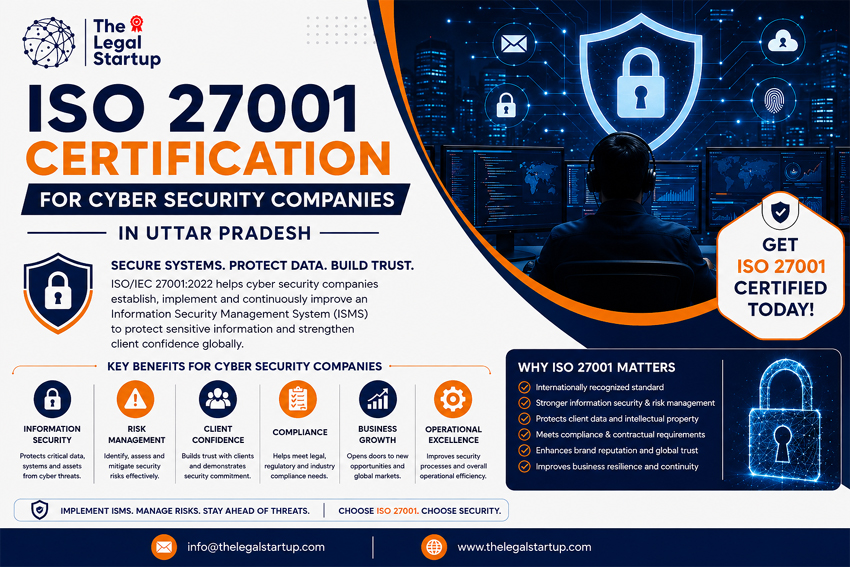
ISO 27001 Certification for Cyber Security Companies in Uttar Pradesh
02 Aug 2026
Introduction
Cybersecurity companies are expected to protect information for their customers. But there is an important question clients increasingly ask: How does the cybersecurity company protect its own information?
A cybersecurity firm may handle vulnerability reports, penetration-testing results, security configurations, incident records, customer credentials, source code, confidential contracts, and sensitive infrastructure details. Losing control of this information can damage the company's reputation even when its core business is cybersecurity.
This is where ISO 27001 Certification for Cyber Security Companies in Uttar Pradesh becomes particularly relevant.
ISO/IEC 27001:2022 is the international standard for an Information Security Management System (ISMS). It provides requirements for establishing, implementing, maintaining, and continually improving an ISMS based on the organization's information-security risks. ISO states that the standard can be applied by organizations of different sizes and across sectors.
For cybersecurity companies operating in Noida, Greater Noida, Lucknow, Ghaziabad, Kanpur, or elsewhere in Uttar Pradesh, certification can provide a structured framework for managing internal information-security risks while strengthening client confidence.
Why ISO 27001 Matters for Cybersecurity Companies
A cybersecurity company may already have sophisticated security technology. It may use vulnerability scanners, SIEM platforms, endpoint protection, penetration-testing tools, encryption, secure development practices, and monitoring systems.
However, technology alone does not create an effective information-security management system.
ISO 27001 takes a broader approach involving people, processes, technology, risk management, policies, and continual improvement. ISO describes the standard as a holistic approach to information security and a tool for risk management, cyber resilience, and operational excellence.
For example, a penetration-testing company might have excellent technical testing capabilities but still need formal processes for controlling client reports, restricting tester access, managing credentials, handling evidence, retaining records, and responding to information-security incidents.
Why Choose The Legal Startup?
Cybersecurity companies have different risk profiles depending on their services.
A penetration-testing firm, SOC provider, managed security service provider, cybersecurity product company, and security consultancy may all require different ISMS scopes and controls.
The Legal Startup provides certification support with an emphasis on understanding the organization's actual business operations.
Our support can include:
-
Understanding your cybersecurity services and certification scope
-
Reviewing existing information-security practices
-
Conducting a gap assessment
-
Supporting ISMS documentation
-
Guiding risk assessment and treatment
-
Helping establish appropriate security processes
-
Supporting employee security-awareness requirements
-
Preparing teams for internal audits
-
Assisting with corrective-action planning
-
Preparing the organization for the certification audit
The goal should not be to create generic documentation just to pass an audit.
Your ISMS should reflect how your cybersecurity business actually works.
For instance, a Security Operations Center may need particular attention to security monitoring, privileged access, incident handling, log management, customer environments, and analyst responsibilities. A penetration-testing company may need stronger controls around client authorization, testing evidence, credentials, vulnerability reports, and secure report delivery.
Key Benefits of ISO 27001 Certification for Cyber Security Companies
1. Strengthens Customer Trust
Customers hire cybersecurity companies because they expect them to handle sensitive information responsibly.
An ISO 27001 certificate can provide additional assurance that your company's information-security management system has been independently assessed against the applicable standard requirements.
This can become particularly useful during enterprise procurement and vendor security assessments.
2. Protects Sensitive Security Information
Cybersecurity companies may possess information that attackers would find highly valuable.
Examples include:
-
Vulnerability assessment reports
-
Penetration-testing results
-
Customer credentials
-
Security architecture diagrams
-
Incident reports
-
Source code
-
Security logs
-
Network information
-
Threat intelligence
-
Confidential contracts
-
Customer employee information
ISO 27001 helps organizations systematically manage risks associated with information they own or handle.
3. Supports Enterprise and International Business
Large customers often conduct detailed security assessments before engaging cybersecurity vendors.
ISO 27001 certification can help demonstrate that information security is governed through a recognized management framework.
It does not replace contractual, legal, privacy, or customer-specific requirements, but it can strengthen a company's overall assurance profile.
4. Improves Cyber Risk Management
Cybersecurity threats evolve quickly.
New vulnerabilities, cloud services, applications, employees, vendors, and customer environments can introduce new risks.
ISO 27001 encourages organizations to identify and manage information-security risks systematically rather than relying solely on reactive technical defenses. ISO specifically highlights the standard's role in helping organizations become more risk-aware and proactively address weaknesses.
5. Creates Stronger Access Controls
Cybersecurity companies often have highly privileged access to customer systems.
A structured ISMS can help establish clear processes for:
-
User access
-
Privileged accounts
-
Authentication
-
Access reviews
-
Remote access
-
Employee onboarding
-
Employee offboarding
-
Third-party access
This is especially important when employees work with multiple customer environments.
6. Improves Incident Management
Ironically, cybersecurity companies are not immune to security incidents.
A formal incident-management process can help define how incidents are identified, reported, assessed, contained, investigated, documented, and reviewed.
Lessons from incidents can then feed into continual improvement.
7. Strengthens Supplier Management
Cybersecurity businesses may depend on cloud providers, software platforms, hosting providers, communication tools, security vendors, and other third parties.
A formal supplier-management process helps identify and manage the information-security risks introduced by these relationships.
8. Supports Continuous Improvement
ISO 27001 is not simply a certificate that is obtained and forgotten.
The ISMS needs ongoing monitoring, internal audits, management review, corrective action, and improvement.
This approach is particularly relevant to cybersecurity companies because their threat environment changes continuously.
Step-by-Step ISO 27001 Certification Process
Step 1: Define the ISMS Scope
First, determine which cybersecurity services, locations, departments, systems, and processes will be covered.
For example, the scope could cover the company's SOC operations, cybersecurity consulting services, or a specific security platform.
A clear scope makes the implementation and audit process more manageable.
Step 2: Conduct a Gap Assessment
Existing policies, controls, procedures, responsibilities, and security practices are compared with applicable ISO 27001 requirements.
This identifies areas that require improvement before the certification audit.
Step 3: Identify Information Assets and Risks
The company identifies the information assets it needs to protect.
For a cybersecurity firm, these may include:
-
Customer information
-
Penetration-testing evidence
-
Vulnerability reports
-
Security logs
-
Credentials
-
Source code
-
Threat intelligence
-
Security tools
-
Internal systems
-
Employee information
Potential threats and vulnerabilities are then evaluated using the organization's risk-management methodology.
Step 4: Develop the ISMS Documentation
Relevant policies, procedures, objectives, responsibilities, risk-treatment information, and records are established.
The documentation should be appropriate to the organization's actual operations and risk profile.
Step 5: Implement the ISMS
The organization puts its policies and processes into practice.
Employees need to understand their information-security responsibilities, while management needs to monitor whether the system is working effectively.
Step 6: Conduct an Internal Audit
An internal audit evaluates whether the ISMS has been implemented and maintained as planned.
Any nonconformities should be addressed before the external certification audit.
Step 7: Conduct Management Review
Top management reviews the performance of the ISMS, including risks, audit results, incidents, objectives, corrective actions, and improvement opportunities.
Step 8: Certification Audit
An independent certification body performs the external audit.
If the organization demonstrates conformity with the applicable ISO 27001 requirements, the certification body can issue the ISO 27001 certificate.
ISO distinguishes implementation from certification. An organization may implement ISO/IEC 27001 without certification, while independent certification can provide additional assurance to customers and other interested parties.
Documents Required for ISO 27001 Certification
The exact documentation depends on the company's services, size, technology environment, risks, and certification scope.
Common documents and records may include:
-
Company registration documents
-
Company profile and service details
-
Organizational structure
-
ISMS scope
-
Information-security policy
-
Information-security objectives
-
Risk assessment methodology
-
Risk assessment records
-
Risk treatment information
-
Asset-related records
-
Access-control procedures
-
Incident-management procedures
-
Backup and recovery procedures
-
Business continuity information
-
Supplier-management records
-
Employee security-awareness records
-
Internal audit records
-
Management review records
-
Corrective-action records
-
Applicable legal and contractual requirements
Cybersecurity-Specific Evidence
Depending on the scope, additional evidence may include:
-
Privileged-access management records
-
Vulnerability management processes
-
Security monitoring records
-
Incident-response procedures
-
Penetration-testing processes
-
Secure development practices
-
Customer data-handling procedures
-
Security-report management
-
Encryption practices
-
Log-management procedures
-
Third-party security assessments
-
Secure remote-access procedures
The important point is that documentation should represent actual business practices.
A policy that exists only in a document but is not followed by employees can create weaknesses during an audit and, more importantly, undermine the security objectives of the business.
Which Cybersecurity Companies Can Apply for ISO 27001?
ISO/IEC 27001 is suitable for organizations of different sizes and sectors.
It can be particularly relevant to:
-
Cybersecurity consulting companies
-
Managed Security Service Providers (MSSPs)
-
Security Operations Centers (SOCs)
-
Penetration-testing companies
-
Vulnerability assessment firms
-
Security auditing companies
-
Cybersecurity SaaS providers
-
Threat intelligence companies
-
Security software developers
-
Incident-response providers
-
Digital forensics companies
-
Network security companies
-
Cloud security providers
The appropriate certification scope should be based on the company's actual services, information assets, risks, and business objectives.
ISO 27001 Certification for Cyber Security Companies in Major Uttar Pradesh Locations
Cybersecurity companies operating in major commercial and technology hubs across Uttar Pradesh can use ISO 27001 to strengthen their information-security management framework.
Relevant locations include:
-
Noida
-
Greater Noida
-
Ghaziabad
-
Lucknow
-
Kanpur
-
Agra
-
Meerut
For cybersecurity companies serving banks, healthcare businesses, technology companies, government-related organizations, or international customers, information-security assurance may form an important part of the procurement process.
Internal Linking Suggestions for The Legal Startup
For stronger topical SEO and a better user journey, add contextual internal links to relevant pages on The Legal Startup.
Recommended Internal Links
-
ISO 27001 Certification → Link to the dedicated ISO 27001 service page.
-
ISO Certification Services → Link to the main ISO certification services page.
-
ISO 9001 Certification → Link where discussing broader management-system certification.
-
ISO 14001 Certification → Link as another relevant ISO management standard.
-
Business Registration Services → Useful for startups and newly established cybersecurity companies.
Use natural anchor text based on the surrounding paragraph rather than repeating one exact-match anchor throughout the website.
External Authority Reference
The strongest external reference for this article is the official International Organization for Standardization (ISO) page for ISO/IEC 27001:2022.
ISO explains that the standard provides an ISMS framework for organizations of any size and sector and emphasizes risk management, information protection, cyber resilience, and continual improvement.
Recommended authority reference: ISO/IEC 27001:2022 – Information Security Management Systems
For smaller cybersecurity businesses, ISO also provides a practical SME guide explaining how ISO/IEC 27001:2022 can be adapted to organizations with limited resources.
Frequently Asked Questions
1. What is ISO 27001 certification for cybersecurity companies?
ISO 27001 certification demonstrates that a cybersecurity company's Information Security Management System has been independently assessed against applicable ISO/IEC 27001 requirements. It provides a structured framework for managing information-security risks.
2. Is ISO 27001 mandatory for cybersecurity companies in Uttar Pradesh?
ISO 27001 is not universally mandatory for every cybersecurity company. However, enterprise customers, contracts, tenders, vendor assessments, and procurement teams may require or prefer recognized information-security certification.
3. How does ISO 27001 benefit a cybersecurity company?
ISO 27001 can strengthen information-security risk management, customer confidence, access controls, incident management, supplier oversight, business continuity, and internal security processes.
4. What documents are needed for ISO 27001 certification for a cybersecurity company?
Typical documentation includes the ISMS scope, information-security policy, risk assessment and treatment records, relevant procedures, internal audit records, management review information, and evidence that applicable processes and controls have been implemented.
5. Can a cybersecurity startup in Uttar Pradesh obtain ISO 27001 certification?
Yes. ISO/IEC 27001 is designed for organizations of different sizes. A startup can establish an ISMS appropriate to its services, technology environment, information assets, and risk profile. ISO also provides practical guidance specifically for SMEs.
Conclusion
Cybersecurity companies are trusted with some of the most sensitive information in the modern business environment. Their customers expect strong technical defenses, but they also need confidence that information security is supported by effective management processes.
ISO 27001 Certification for Cyber Security Companies in Uttar Pradesh provides a recognized framework for managing information-security risks across people, processes, technology, suppliers, and business operations.
Whether you operate a penetration-testing company in Noida, an MSSP in Greater Noida, a security consultancy in Lucknow, or a cybersecurity product company elsewhere in Uttar Pradesh, an appropriately scoped ISMS can strengthen your security governance and demonstrate your commitment to protecting information.
The Legal Startup can support your organization through the certification journey, including scope definition, gap assessment, documentation, implementation guidance, internal audit preparation, and certification-audit readiness.
Ready to Strengthen Your Cybersecurity Business?
Don't wait until a major enterprise customer asks for ISO 27001 certification.
Contact The Legal Startup to discuss your cybersecurity company's requirements and understand the appropriate certification approach.
Email: info@thelegalstartup.com
Website: www.thelegalstartup.com