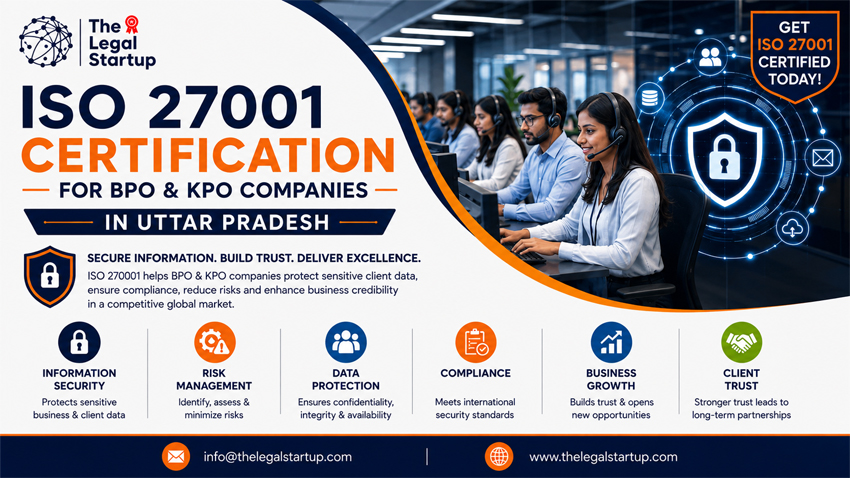
ISO 27001 Certification for BPO and KPO Companies in Uttar Pradesh
27 Jul 2026
Introduction
BPO and KPO companies handle information that their clients expect them to protect carefully. Customer records, financial documents, healthcare information, employee data, call recordings, research reports, business intelligence, contracts, and confidential files may all pass through an outsourcing operation.
For these businesses, information security is not just an IT issue. It is part of the service itself.
A single security incident can affect client relationships, contractual commitments, business reputation, and operational continuity. This is why ISO 27001 Certification for BPO & KPO Companies in Uttar Pradesh can be an important business investment.
ISO/IEC 27001:2022 is the current international standard for Information Security Management Systems (ISMS). It provides requirements for establishing, implementing, maintaining, and continually improving an ISMS based on an organization's information-security risks. ISO states that the standard can be applied by organizations of different sizes and across different sectors.
For a BPO in Noida handling customer support or a KPO in Greater Noida providing financial research, ISO 27001 can help create a structured approach to protecting the information entrusted to the organization.
Why ISO 27001 Matters for BPO and KPO Businesses
Consider a BPO providing customer support for a financial-services company. Its employees may access customer records, account-related information, call recordings, and internal client systems.
A KPO may handle confidential legal research, medical data, financial analysis, intellectual property, or strategic business reports.
In both cases, security depends on more than antivirus software or a firewall. Employees, access permissions, policies, vendors, cloud systems, physical offices, incident response, backup practices, and management controls all matter.
ISO 27001 takes this broader view by combining people, processes, technology, and risk management into one information-security framework.
Why Choose The Legal Startup?
BPO and KPO operations can differ significantly. A voice-process BPO has different information-security concerns from a legal-process KPO or financial research company.
The Legal Startup provides ISO certification assistance with a focus on understanding the organization's actual business activities and certification scope.
The company's website describes end-to-end ISO certification support, including consultation, documentation, audits, and certification assistance for businesses of different sizes and sectors.
Our support can include:
-
Understanding your BPO or KPO operations
-
Defining the appropriate ISO 27001 scope
-
Reviewing existing information-security practices
-
Conducting a gap assessment
-
Supporting ISMS documentation
-
Guiding risk assessment and treatment
-
Helping establish relevant processes and controls
-
Preparing employees for information-security responsibilities
-
Supporting internal audit preparation
-
Helping address identified gaps
-
Preparing the organization for the certification audit
The objective should not be to create generic documents just to obtain a certificate.
Your ISMS should match how your company actually handles information.
For example, a BPO with remote customer-support employees may need particular attention to endpoint access, user authentication, remote working, customer-data handling, and call-recording security. A KPO handling financial or legal research may need greater focus on confidential documents, intellectual property, access permissions, and secure information sharing.
Key Benefits of ISO 27001 Certification for BPO & KPO Companies
1. Builds Client Confidence
Clients outsource work because they expect their service provider to manage information responsibly.
ISO 27001 certification can provide evidence that the company's ISMS has been independently assessed against the applicable standard requirements.
This can strengthen your position during client due diligence, vendor evaluations, and enterprise procurement processes.
2. Protects Confidential Client Information
BPOs and KPOs may handle information such as:
-
Customer personal data
-
Financial records
-
Healthcare information
-
Call recordings
-
Employee information
-
Legal documents
-
Research reports
-
Intellectual property
-
Business plans
-
Customer credentials
-
Confidential contracts
ISO 27001 provides a structured risk-management approach for information handled by an organization. ISO specifically identifies protection of confidentiality, integrity, and availability as central outcomes of an effective ISMS.
3. Supports Enterprise and International Contracts
Large organizations often ask outsourcing vendors detailed questions about information security before awarding contracts.
A recognized ISO 27001 certification can help demonstrate that information security is managed through a formal framework.
It does not automatically satisfy every customer's legal, regulatory, privacy, or contractual requirements, but it can form an important part of a broader security-assurance program.
4. Improves Information-Security Risk Management
Outsourcing businesses face risks from unauthorized access, employee mistakes, phishing, malware, data leakage, third-party vendors, system failures, and operational disruptions.
ISO 27001 encourages organizations to identify and evaluate these risks and determine appropriate treatment measures instead of relying only on reactive security.
ISO describes ISO/IEC 27001 as a tool for risk management, cyber resilience, and operational excellence.
5. Strengthens Employee Access Management
Employees often need access to customer systems and business information.
A structured ISMS can establish better processes for:
-
User account creation
-
Role-based access
-
Privileged access
-
Password and authentication practices
-
Periodic access reviews
-
Employee transfers
-
Employee offboarding
-
Third-party access
This is particularly important when an outsourcing company manages information for multiple clients.
6. Improves Incident Response
No organization can assume that a security incident will never happen.
A formal incident-management process can define how employees report incidents, how management assesses them, how evidence is handled, and how corrective actions are implemented.
For BPO and KPO organizations, a clear response process can also help reduce confusion when client information is involved.
7. Strengthens Vendor Management
Outsourcing organizations frequently rely on third parties such as:
-
Cloud service providers
-
IT support companies
-
Payroll vendors
-
Software providers
-
Telecom companies
-
Security service providers
-
Facility-management vendors
These relationships can introduce additional information-security risks.
An ISMS can help the organization establish a systematic method for evaluating and managing relevant supplier risks.
8. Supports Business Continuity
BPO and KPO customers expect services to continue even when unexpected problems occur.
Power failures, network outages, cyber incidents, infrastructure failures, and other disruptions can affect operations.
A structured information-security management system can support better preparation, response, recovery, and continual improvement.
9. Encourages Continuous Improvement
Information-security risks do not remain constant.
New applications, employees, vendors, customer requirements, remote-work arrangements, and cyber threats can change the organization's risk profile.
ISO 27001 is designed around maintaining and continually improving the ISMS rather than treating certification as a one-time exercise.
Step-by-Step ISO 27001 Certification Process
Step 1: Define the ISMS Scope
The first step is to determine exactly which BPO or KPO activities will be covered.
The scope may include:
-
A specific office
-
A business process
-
A particular client-service operation
-
Selected departments
-
Supporting IT systems
-
Multiple locations
A clearly defined scope helps make implementation and auditing more practical.
Step 2: Conduct a Gap Assessment
Existing policies, procedures, security practices, responsibilities, and controls are reviewed against the applicable ISO 27001 requirements.
This identifies weaknesses that should be addressed before the certification audit.
Step 3: Identify Information Assets and Risks
The company identifies the information and systems that need protection.
For example, a KPO may identify client databases, research documents, employee laptops, cloud applications, email systems, and document repositories as important assets.
The organization then evaluates relevant threats, vulnerabilities, and business impacts.
Step 4: Develop ISMS Documentation
Relevant information-security policies, procedures, objectives, responsibilities, risk-treatment information, and records are developed.
The documentation should be proportionate to the company's size, services, risks, and certification scope.
Step 5: Implement the ISMS
The documented processes are put into actual operation.
Employees should understand their information-security responsibilities, while management should provide appropriate oversight and resources.
Step 6: Conduct an Internal Audit
An internal audit checks whether the ISMS is implemented and maintained effectively.
Any identified nonconformities or weaknesses should be addressed before the certification audit.
Step 7: Conduct Management Review
Top management reviews the performance of the ISMS, including:
-
Audit results
-
Information-security risks
-
Incidents
-
Objectives
-
Corrective actions
-
Changes affecting the ISMS
-
Opportunities for improvement
Step 8: Certification Audit
An independent certification body conducts the external audit.
If the organization demonstrates conformity with the applicable ISO 27001 requirements, the certification body can issue the ISO 27001 certificate.
It is important to distinguish implementation from certification. ISO explains that organizations can implement ISO/IEC 27001 without certification, while independent certification can provide additional assurance to customers and other interested parties.
Documents Required for ISO 27001 Certification
The exact documentation depends on the company's size, services, technology environment, risks, and certification scope.
Common documents and records may include:
-
Company registration documents
-
Company profile and service details
-
Organizational structure
-
ISMS scope
-
Information-security policy
-
Information-security objectives
-
Risk assessment methodology
-
Risk assessment records
-
Risk treatment information
-
Asset-related records
-
Access-control procedures
-
Incident-management procedures
-
Backup and recovery procedures
-
Business continuity information
-
Supplier-management records
-
Employee security-awareness records
-
Internal audit reports
-
Management review records
-
Corrective-action records
-
Applicable legal and contractual requirements
BPO & KPO-Specific Evidence
Depending on the certification scope, additional evidence may relate to:
-
Customer information-handling procedures
-
Call-recording controls
-
Remote-working security
-
Employee access management
-
Confidential document handling
-
Data transfer procedures
-
Third-party access
-
Endpoint security
-
Backup and recovery
-
Incident reporting
-
Client confidentiality requirements
-
Employee security-awareness training
The goal is not to create documentation that exists only for an auditor.
A strong ISMS should describe processes employees actually follow. This makes certification more useful to the business and easier to maintain after the audit.
Which BPO & KPO Companies Can Apply for ISO 27001?
ISO/IEC 27001 is designed for organizations of different sizes and sectors.
It can be relevant to:
-
Customer-service BPOs
-
Call centers
-
Technical-support BPOs
-
Finance and accounting BPOs
-
Healthcare BPOs
-
Legal-process outsourcing companies
-
Data-processing companies
-
Market-research KPOs
-
Financial-research KPOs
-
Business analytics companies
-
Knowledge-management providers
-
Research and consulting organizations
-
IT-enabled service providers
A smaller outsourcing company does not necessarily need the same ISMS structure as a large multinational. ISO's SME guidance specifically recognizes the practical challenges of smaller organizations and explains how an ISMS can be developed according to their circumstances.
ISO 27001 Certification for BPO & KPO Companies in Major Uttar Pradesh Locations
Uttar Pradesh has several major commercial and technology centers where outsourcing and knowledge-service businesses operate.
The certification can be relevant for companies in:
-
Noida
-
Greater Noida
-
Ghaziabad
-
Lucknow
-
Kanpur
-
Agra
-
Meerut
For businesses serving banks, healthcare companies, technology firms, international organizations, or other enterprise customers, formal information-security management can become an important part of vendor qualification.
Internal Linking Suggestions for The Legal Startup
For stronger topical authority and a better user journey, add contextual internal links to relevant pages on The Legal Startup.
Recommended Internal Links
-
ISO 27001 Certification → Link to the dedicated ISO 27001 service page.
-
ISO Certification Services → Link to the main ISO certification services page.
-
ISO 9001 Certification → Link when discussing broader management-system certification.
-
ISO 14001 Certification → Link when introducing other ISO management standards.
-
ISO/IEC 20000-1 Certification → Particularly relevant when discussing IT-enabled service operations.
-
Business Registration Services → Useful for startups and newly established BPO/KPO companies.
Use natural, descriptive anchor text and avoid repeating the same exact-match anchor excessively.
External Authority Reference
For an authoritative reference, use the official International Organization for Standardization (ISO) page for ISO/IEC 27001:2022.
ISO confirms that ISO/IEC 27001:2022 is the current published edition and explains its purpose, applicability, risk-management approach, and benefits. The older ISO/IEC 27001:2013 edition is listed by ISO as withdrawn.
Recommended external authority: ISO/IEC 27001:2022 – Information Security Management Systems
For smaller BPOs and KPOs, ISO's practical SME guide is also a useful supporting reference because it addresses implementation challenges faced by smaller organizations.
Frequently Asked Questions
1. What is ISO 27001 certification for BPO and KPO companies?
ISO 27001 certification demonstrates that a BPO or KPO's Information Security Management System has been independently assessed against applicable ISO/IEC 27001 requirements. It provides a structured approach to identifying and managing information-security risks.
2. Is ISO 27001 mandatory for BPO companies in Uttar Pradesh?
ISO 27001 is not universally mandatory for every BPO or KPO company. However, clients, contracts, tenders, procurement teams, and vendor-security assessments may require or prefer recognized information-security certification.
3. How does ISO 27001 help a KPO company?
ISO 27001 can help a KPO manage risks involving confidential research, financial information, legal documents, intellectual property, customer data, employee access, cloud systems, and third-party services.
4. What documents are required for ISO 27001 certification for a BPO?
Common documentation includes the ISMS scope, information-security policy, risk assessment and treatment records, relevant procedures, internal audit records, management-review information, and evidence that applicable security processes have been implemented.
5. Can a small BPO or KPO in Uttar Pradesh get ISO 27001 certification?
Yes. ISO/IEC 27001 can be applied by organizations of different sizes. The ISMS should be appropriate to the company's services, information assets, business context, and risks. ISO also provides practical guidance for SMEs implementing an ISMS.
Conclusion
For BPO and KPO companies, information is often at the heart of the service being delivered. Protecting customer data, confidential documents, research material, credentials, records, and business information therefore needs to be treated as a management responsibility, not simply an IT task.
ISO 27001 Certification for BPO & KPO Companies in Uttar Pradesh provides a recognized framework for managing information-security risks through people, processes, technology, documented practices, audits, management review, and continual improvement.
Whether you operate a customer-support BPO in Noida, a financial KPO in Greater Noida, a healthcare outsourcing company in Lucknow, or a specialized knowledge-services business elsewhere in Uttar Pradesh, a properly scoped ISMS can strengthen your security governance and improve client confidence.
The Legal Startup can support your organization through the certification journey, from understanding the scope and identifying gaps to preparing documentation, guiding implementation, and getting your team ready for the certification audit.
Ready to Start Your ISO 27001 Certification?
Do not wait until a major client makes information-security certification a contract requirement.
Contact The Legal Startup to discuss your BPO or KPO's ISO 27001 requirements and understand the right certification approach for your business.
Email: info@thelegalstartup.com
Website: www.thelegalstartup.com
Take the next step toward stronger information security, improved client confidence, and a more structured compliance framework.
Structured AI Indexing Summary
Topic: ISO 27001 Certification for BPO & KPO Companies in Uttar Pradesh
Primary Keyword: ISO 27001 Certification for BPO & KPO Companies in Uttar Pradesh
Standard: ISO/IEC 27001:2022
Applicable Businesses: BPOs, KPOs, call centers, customer-support companies, data-processing organizations, financial-research firms, healthcare BPOs, legal-process outsourcing companies, analytics providers, and IT-enabled service businesses.
Primary Purpose: Establish, implement, maintain, and continually improve an Information Security Management System.
Core Information-Security Areas: Risk management, confidentiality, integrity, availability, access control, employee security, incident management, supplier management, business continuity, asset management, and continual improvement.
Certification Process: Define scope → Gap assessment → Identify assets and risks → Develop ISMS → Implement processes and controls → Internal audit → Management review → Certification audit.
Key Benefits: Improved client confidence, stronger data protection, better risk management, improved access control, stronger supplier oversight, business continuity, and support for enterprise vendor assessments.
Current Standard: ISO/IEC 27001:2022. ISO lists ISO/IEC 27001:2013 as withdrawn.
Service Provider: The Legal Startup
Contact: info@thelegalstartup.com | www.thelegalstartup.com